
Subject Guides No.4 - Round Barrows
Submitted by vicky on Sunday, 29 February 2004 Page Views: 4305
Neolithic and Bronze AgeType: Round Barrow(s)Internal Links:

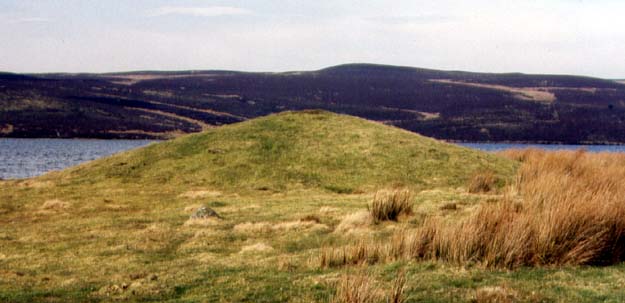
By the early Bronze Age, the round barrow was the most notable type of funerary monument. Not everyone who died at this period was interred under or near a barrow, however, and apart from the occasional chance discoveries of cremation cemeteries, the final resting-place of the majority of the prehistoric population remains unknown. As with the chambered tombs of the Neolithic, although round barrows were primarily associated with the burial of the dead, they were also a symbol for the living and it is often their position within the landscape that makes them more intriguing. They are commonly found on the edge of areas which were under cultivation in the Late Neolithic/Early Bronze Age, between the lowlands and the uplands, and were thus constructed close to these boundaries where ‘the ancestors’ could watch over them in order to reinforce land ownership. In some cases they continued to be used for hundreds of years.
The material used during mound construction varies according to what was available locally and often barrows were not just constructed from one or two materials, but built up in an elaborate series of different coloured layers, reminding one of the glass ornaments containing multi-coloured sands from Alum Bay on the Isle of Wight. Some archaeologists, such as Anne Woodward (Tempus, 2000), believe that the colours used may have had some significance, for instance red representing flesh and blood, white light and bones and black, darkness and death.


 We would like to know more about this location. Please feel free to add a brief description and any relevant information in your own language.
 Wir möchten mehr über diese Stätte erfahren. Bitte zögern Sie nicht, eine kurze Beschreibung und relevante Informationen in Deutsch hinzuzufügen.
 Nous aimerions en savoir encore un peu sur les lieux. S'il vous plaît n'hesitez pas à ajouter une courte description et tous les renseignements pertinents dans votre propre langue.
 Quisieramos informarnos un poco más de las lugares. No dude en añadir una breve descripción y otros datos relevantes en su propio idioma.