Featured: Explore Scotland (and everywhere else) with our Megalithic Portal iPhone app

Explore Scotland (and everywhere else) with our Megalithic Portal iPhone app

Random Image

Megaliths, Stones of Memory

Megaliths, Stones of Memory

Login

Register here - as a registered user you get more features and fewer ads.

Who's Online

There are currently, 1098 guests and 4 members online.

Sponsors

<< County Introductions >> Subject Guides No.3 - Crosses and Early Christian Sculptured Stones

Submitted by Thorgrim on Thursday, 16 September 2004  Page Views: 11418

Early MedievalType: Ancient Cross

Internal Links:

St Piran's Cross
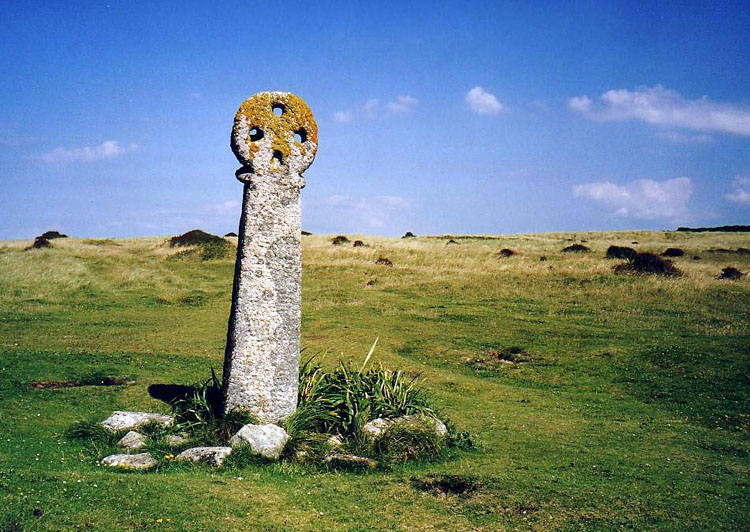
St Piran's Cross submitted by Thorgrim : Difficult to find amid the dunes of Penhale Sands, this 8 foot cross stands close to the sand-buried church of St Piran's Oratory. This is the earliest recorded stone cross in Cornwall and is dedicated to its patron saint and that of tinners and miners. Near Perranporth at SW7720 5646 (Vote or comment on this photo)
Images from the Pagan past conflict and co-exist with Christian symbolism in the carvings on many early cross shafts. The cross was a Pagan symbol long before it was a Christian one and the familiar cross in a circle is actually an ancient sun disc that has been carved in stone since the Bronze Age. Writhing serpents, ancient gods, foliage, rosettes and sun spirals are all to be found alongside strange interpretations of the crucifixion. Leaning broken by a stile or standing proudly in a churchyard, hidden in a tangled hedgerow or high on a bleak moor, these crosses waymark the passage from Paganism to Christianity.

The earliest and most primitive, are the incised cross-decorated stones of Cornwall, Wales, Galloway and the Isle of Man. They blend elements of Romano-British paganism with "Celtic" Christianity and date from the fifth and sixth centuries. They are also found more widely in Scotland and Ireland from the seventh century. Then came the eighth and ninth century Pictish cross-slabs of Scotland and those of Ireland and the Isle of Man which are stylistically similar. By the ninth century and into tenth, crosses were larger and much more ornate with strong pagan influence from Anglo-Saxon and Viking art. This can be seen most dramatically at Gosforth where Odin, Thor and Loki share the cross shaft with the crucifixion of Christ.

High crosses were erected in the eighth, ninth and tenth centuries, mainly in the north of England with a few further south. Some are "wheel-headed" and others are "free-armed". Some were used for religious services and others to indicate boundaries such as those at Macclesfield, which mark the northern boundary of the Kingdom of Mercia. There are less than fifty Anglo-Saxon high crosses in England that have survived the fury of the Reformation. They also suffered from the Puritans and in eastern England, where this was strongest, only fragments have survived. Such crosses should not be confused with much later market crosses and the waymarking crosses of Dartmoor and Yorkshire.

Why are photographs of crosses appearing on the Megalithic Portal? It is true that none are prehistoric, but they are contemporary with the Pictish stones that we have included for some time. They are of course "mega liths" - big stones! But the real reason is that they are of interest to some, if not all, of our visitors and they do graphically record and reflect the conflict and integration of Paganism and Christianity as well as the influx and integration of immigrants and settlers. At present, we do not include crosses later than the Norman Conquest, but invite you to send us photos and descriptions of any earlier ones you may find. Grid references are pretty essential, but if you cannot manage that, please send the name of the cross or the nearest town, village or farm. If in doubt about age, you can send anyway, but only those that are pre-Norman will be used at present. We hope to extend the time period later.

Good hunting!

<< Introduction to Leicestershire and Rutland

Introduction to prehistoric Malta and Gozo >>

Please add your thoughts on this site

Chariot of the Soul by Linda Proud - a compelling tale of Britain, Rome and one man

Chariot of the Soul by Linda Proud - a compelling tale of Britain, Rome and one man

Sponsors

More County Introductions

See all County Introductions →

Latest Visit Logs

  • Gavurtepe
    “An ancient mound clearly visible and recognizable, but no structures could be clearly identified. I…”
    by longhintim · 13 Jul 2026
  • Teos
    “Nicely managed with clear signposts and footpaths, but a rather large site so a bit of walking is re…”
    by longhintim · 13 Jul 2026
  • Tas Kule
    “Easily accessible just beside the road. The outlook reminds me of the tomb of Cyrus in Pasargadae.”
    by longhintim · 13 Jul 2026
  • Neonteikhos
    “This place actually used to be a major Aeolian city state in the region To get to the site, I par…”
    by longhintim · 13 Jul 2026
  • Assos Temple of Athena
    “The temple of Athena is at the acropolis. Apart from the temple of Athena, Assos is a quite large s…”
    by longhintim · 13 Jul 2026

"Subject Guides No.3 - Crosses and Early Christian Sculptured Stones" | Login/Create an Account | 4 News and Comments
  
Go back to top of page    Comments are owned by the poster. We aren't responsible for their content.
Re: Subject Guides No.3 - Crosses and Early Christian Sculptured Stones by Anonymous on Friday, 21 April 2017
Hi there. I visited some ruins on the Dingle Penninsula in Dunbeg Ireland about 6 years ago and I am trying to find info on the Prehistoric, 30-500BC ruins. I wanted to share the ancient cross depictions with my instructor. Thank youfor any tips on searching or photos. I found them once and tried to send them to my email but it didn't work )-: Thanks so much!
Blessings,
Chris
[ Reply to This ]

Re: Subject Guides No.3 - Early Christian Sculptured Stones by Anonymous on Saturday, 02 January 2010
Of course one other reason for including Stone Crosses in the Megalithic database is that, in more than 60% of the cases, the crosses replaced standing stones ... DUH!
[ Reply to This ]

Re: Subject Guides No.3 - Early Christian Sculptured Stones by Anonymous on Saturday, 06 August 2005
I have a photo of incised cross on my web page at: Link

Don't have the exact location but on a farmer's land in Llanfyrnach, Pembrokeshire. The farmer told me there were several standing stones on the hill above.

Barbara Henry
[ Reply to This ]
    Re: Subject Guides No.3 - Early Christian Sculptured Stones by Thorgrim on Saturday, 06 August 2005
    (User Info | Send a Message)
    Thanks for that link to your website, Barbara. That type of incised cross in a ring is one of the earliest types of carved Christian stones in Britain. It has even been found in mosaic on the floor of a Roman villa. Your stone at Llanfyrnach could date from as early as the 5th century AD. We have a photo of a similar stone at St Non's Capel at St Davids. St Non was the mother of St David. If you enter Llanfyrnach into the Search box at the top of every page on the Portal, you willl see photos of the standing stones at Llanfyrnach. Similarly, enter St Non's into the Search box to see the ring-cross there.
    [ Reply to This ]

Your Name: Anonymous [ Register Now ]
Subject:


Add your comment or contribution to this page. Spam or offensive posts are deleted immediately, don't even bother

<<< What is five plus one as a number? (Please type the answer to this question in the little box on the left)
You can also embed videos and other things. For Youtube please copy and paste the 'embed code'.
For Google Street View please include Street View in the text.
Create a web link like this: <a href="https://www.megalithic.co.uk">This is a link</a>  

Allowed HTML is:
<p> <b> <i> <a> <img> <em> <br> <strong> <blockquote> <tt> <li> <ol> <ul> <object> <param> <embed> <iframe>

We would like to know more about this location. Please feel free to add a brief description and any relevant information in your own language.
Wir möchten mehr über diese Stätte erfahren. Bitte zögern Sie nicht, eine kurze Beschreibung und relevante Informationen in Deutsch hinzuzufügen.
Nous aimerions en savoir encore un peu sur les lieux. S'il vous plaît n'hesitez pas à ajouter une courte description et tous les renseignements pertinents dans votre propre langue.
Quisieramos informarnos un poco más de las lugares. No dude en añadir una breve descripción y otros datos relevantes en su propio idioma.