
Subject Guides No.1 - Rock Art
Submitted by andy_h on Monday, 16 February 2004 Page Views: 8909
Rock ArtType: Rock ArtInternal Links:

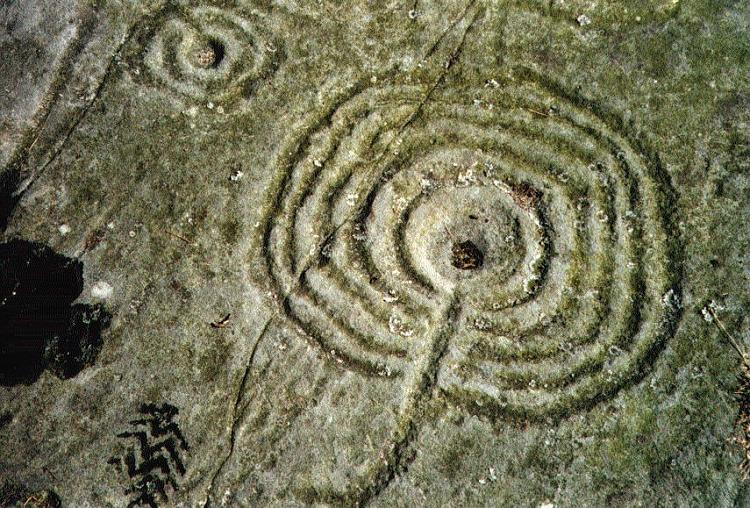
Almost entirely restricted to Northern England, Scotland and Ireland, (apart from a few rare exceptions) rock art is not a phenomenon that seems to have spread to Southern England or Wales (notable exceptions here being Bryn Celli Ddu and Barclodiad Y Gawres passage graves, both on Anglesey). Most rock art seems to have been created by a process of 'pecking' the rock with either stone tools or antler picks and are not incised.
Stylistically, there is a bewildering range of variations based around the staple cup and ring mark. Whereas a profusion of cups with multiple rings adorn rock panels throughout Scotland, Cumbria and Northumbria, cups with more than a single ring are rare in Yorkshire. The creators preferring a cup and groove style, either enclosing a number of cups (eg the Idol Stone), or meandering across the rock face to create a seemingly abstract pattern such as the Hangingstones panels on the northern edge of Ilkley Moor. Local traditions and styles developing from the simple cup and ring.
The rock art of Irish Passage Graves again, seemingly takes rock art into largely different territory than English and Scottish motifs, with a huge array of styles and symbols. Most notably at tombs such as Newgrange and Knowth.
In general, rock art is mostly found on the horizontal surfaces of either rock outcrops or land-locked boulders. However, occasionally it can be found on sloping or vertical faces. Maybe this is a deliberate choice by the creators which changes the meaning of whatever the marks symbolised. It has been suggested that a horizontal surface represents female nature and a vertical surface for male.
Figurative forms are very rare in British rock art. Whereas the rock art of Europe employs depictions of reindeer, boats and human forms amongst a range of other symbols (for example, the rock art of Galicia in Spain depicts reindeers or stags alongside cup and ring marks), British rock art appears to be almost entirely 'abstract'.
Axe heads of a Bronze Age style can be found at both Stonehenge and Ri Cruin Cairn in Kilmartin Valley, Argyll. But these are very much the exception and could possibly be of a later date than rock art in the abstract tradition. Also to be found in Kilmartin is a number of standing stones featuring cup marks. This suggests that panels of rock art may have been reused as standing stones and pre-date these monuments. A decorated cyst cover in the Bronze Age, Nether Largie North Cairn, displays weathering of the design, that suggests it was taken from an exposed location for reuse. Information such as this is useful in the notoriously difficult task of dating rock art.
Folklore attached to cup and ring stones may also be a path to insights into the use of rock art. In Yorkshire, cup marks are sometimes known as 'Cat Troughs'. Recorded evidence exists of the practise of pouring milk into cup marks to appease the fairies, persisting into relatively modern times in some parts of the country and indeed, some rocks are still painted white at Easter time. This relationship to fairies and cattle is an interesting connection.
There is little doubt that whatever the meanings intended by the creators of rock art were, it was intended to convey a message. Be that to people familiar with the local landscape, travellers, ancestors, the living, the dead, gods and goddesses or spirits. Some rock art is found on low lying boulders that are easy to spot if walking on a nearby path, while other rock art is above eye level on large boulders, or hidden away in passage graves. Multiple usage and meaning seems to be a more likely interpretation for these symbols rather than a single, definitive meaning.

 We would like to know more about this location. Please feel free to add a brief description and any relevant information in your own language.
 Wir möchten mehr über diese Stätte erfahren. Bitte zögern Sie nicht, eine kurze Beschreibung und relevante Informationen in Deutsch hinzuzufügen.
 Nous aimerions en savoir encore un peu sur les lieux. S'il vous plaît n'hesitez pas à ajouter une courte description et tous les renseignements pertinents dans votre propre langue.
 Quisieramos informarnos un poco más de las lugares. No dude en añadir una breve descripción y otros datos relevantes en su propio idioma.