

Squares in a circular world
Submitted by vicky on Saturday, 29 November 2003 Page Views: 4155
Mysteries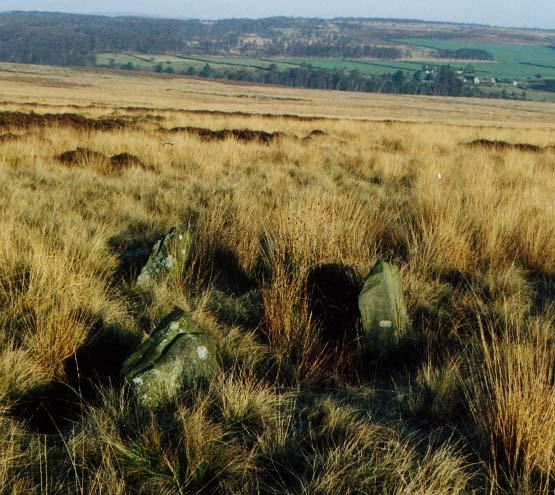
The stone circle – Gibbet Moor North - was discovered in 1985. It is an unusual site consisting of three standing stones forming three corners of a square. Two of them are upright and the third is leaning. This kind of setting is known as a ‘Four Poster’ and is common in Scotland but very rare in England. Although there is no evidence for the position of a surviving fourth stone John Barnatt of the Peak District National Park Archaeology Service believes that all traces have probably been removed by a covering of peat.
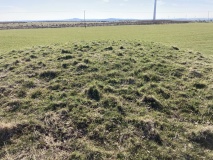
Not far from here is a square barrow with the interesting name of Hob Hurst’s House . This barrow is made up of a central rectangular mound, with an accompanying square ditch then finally an outer square bank. When Thomas Bateman, the famous Derbyshire barrow digger, excavated the site in 1853, he found a square stone-lined grave containing scorched human bones and two pieces of lead ore as well as an unusual semi-circle of small sandstone rocks surrounding the bones. The ‘marking off’ the dead in this way was common practice in the south of England, but again very rare in this part of the world.
Square barrows are not unknown in the prehistoric period but they are usually found much later in the Iron Age and in areas such as North Yorkshire. And so we are left to wonder why in a circular world did a small community of Bronze Age people decide to break the mold? Were they visionaries looking to the future, to a world dominated by squares?
References:
J. Barnatt “The Henges, Stone Circles and Ringcairns of the Peak District”, Department of Archaeology and Prehistory, University of Sheffield (1990)
T. Bateman “Ten Years Diggings in Celtic and Saxon Grave Hills in the Counties of Derby, Stafford and York”, London (1861)


 We would like to know more about this location. Please feel free to add a brief description and any relevant information in your own language.
 Wir möchten mehr über diese Stätte erfahren. Bitte zögern Sie nicht, eine kurze Beschreibung und relevante Informationen in Deutsch hinzuzufügen.
 Nous aimerions en savoir encore un peu sur les lieux. S'il vous plaît n'hesitez pas à ajouter une courte description et tous les renseignements pertinents dans votre propre langue.
 Quisieramos informarnos un poco más de las lugares. No dude en añadir una breve descripción y otros datos relevantes en su propio idioma.