
<< Feature Articles >> Sandy’s Seven Years of Stone Rows
Submitted by Anne T on Friday, 02 August 2019 Page Views: 5359
Neolithic and Bronze AgeType: Stone Row / AlignmentInternal Links:

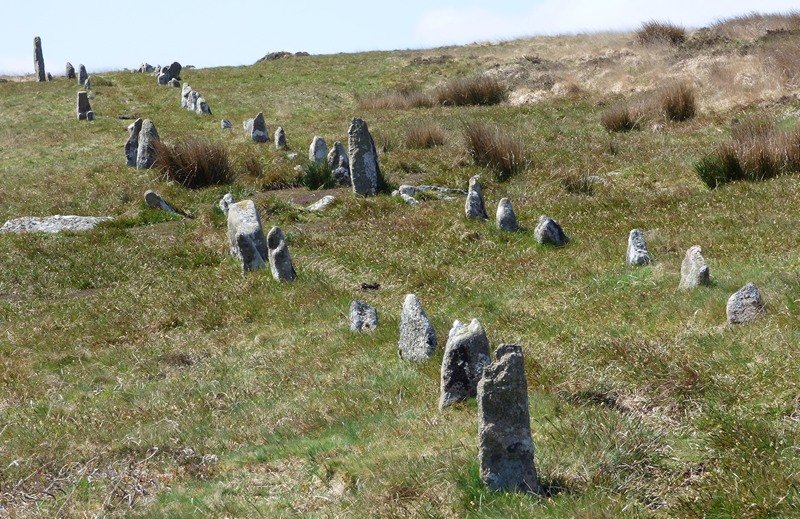
I for one felt this significant milestone shouldn’t pass by without an acknowledgement and a loud ‘Well done, Sandy!”.
To understand how huge this achievement has been, a few facts and figures:
Sandy started with an original list of 327 stone rows scattered the length and breadth of Great Britain, carefully researched from existing reference documentation. Of these, 23 rows were found to have either been destroyed or were no longer visible in the landscape, meaning there were still a total of 304 rows to visit and survey.
• The furthest south has been the Higher Town Bay Row on the Isle of Scilly;
• The furthest north is The Rinns Of Shurdimires in the Shetland Isles;
• The furthest west has been the Airigh Na Gaoitherow in the Western Isles; and
• The furthest east is the High Bride Stones in the North Yorkshire moors.
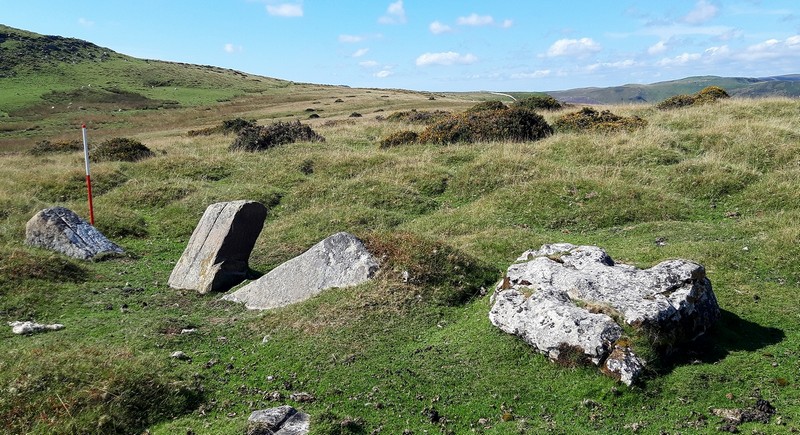 As well as covering an enormous number of miles in his trusty camper van, Sandy estimates he has spent at least 300 days on the road travelling to and from these rows and surveying them. The shortest of the rows, Merrivale 4 on Dartmoor includes three stones and measures 2.97m long the longest is the Upper Erme row also on Dartmoor – some 3,386m long comprising an impressive 922 stones.
Sandy estimates he has (to date) also spent a minimum of 450 more days documenting these rows, producing detailed site plans, ascertaining whether the row lies within a larger ritual landscape (near cairns, henges or stone circles, etc) and what significant landscape features may come into (and go out of) view at particular places along a row, all carefully supported and documented with photographs, diagrams, distribution maps and links to supporting databases and information sources.
All of the stone rows have been graded into six interpretative categories: ‘plausible’, ‘probable’ and ‘possible’ cover the accepted rows; those that are not are described as ‘uncertain’, ‘unlikely’ and ‘not’. Of the 304 rows visited, 44 were dismissed including (much to my disappointment!) Standingstone Rigg in Northumberland.
Sandy tells me his adventure started with “The discovery of the stone row at Bancbryn in South Wales. The resulting battle and confusion over this site highlighted this group of rare and significant monuments were poorly understood by the archaeological profession”. He adds: “My final site visited was Giants’ Stones Hamna Voe on 7th June 2019 which turned out to be a field boundary. This was a little bit of an anti-climax after having travelled so far, but the final row to be ticked off the list, and the end of Stage One of my exploration. I am being alerted to possible unrecorded sites on a regular basis and at the moment have 7 needing visits – all in SW England”.
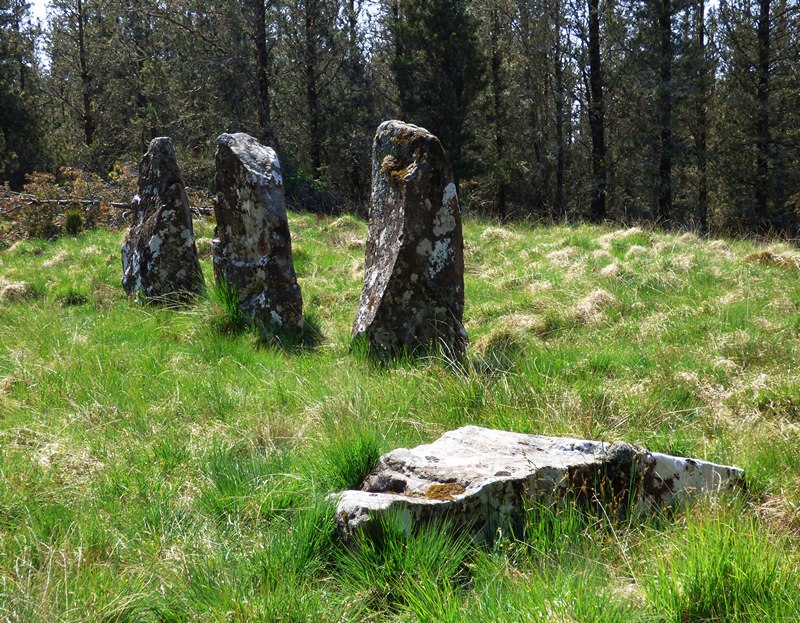 Of course, it should be mentioned that Sandy is not just ‘Mr. Gerrard’, but ‘Dr Gerrard’, a professional archaeologist who worked for more than 20 years for English Heritage. He particularly focused on the early tin industry in Britain, and his publications and books which are still available through Amazon. Along the way he has co-opted the assistance a number of very willing helpers and friends who have helped with surveying and photographing these enigmatic sites. “A huge thank you to everyone I’ve met along the way and supported me in this venture. You are too numerous to mention here, but you all know who you are, and I have valued your help enormously”.
 For more information, please visit Sandy's Stone Rows of Great Britain, and many of his stone row photos and updates have been uploaded to the Megalithic Portal's stone row pages as well.
See also the top 10 most visited stone row web pages on Sandy's Stone Rows of Great Britain site, which is interesting to compare and contrast with Andy B's recent 'Top 15 stone rows in England' compiled from Megalithic Portal visitor data.
If you would like to alert Sandy to another possible stone row, then please contact him via private message from his member page.
In the meantime, very well done, Sandy! What an achievement. Thank you from everyone with an interest in the Stone Rows of Great Britain. All the photos on this page are Sandy's and chosen by him.
<< The Megalithic Temples of Malta - A brief (pre)history
The best ancient sites to visit around Dubrovnik and the Southern Adriatic Coast >>


 We would like to know more about this location. Please feel free to add a brief description and any relevant information in your own language.
 Wir möchten mehr über diese Stätte erfahren. Bitte zögern Sie nicht, eine kurze Beschreibung und relevante Informationen in Deutsch hinzuzufügen.
 Nous aimerions en savoir encore un peu sur les lieux. S'il vous plaît n'hesitez pas à ajouter une courte description et tous les renseignements pertinents dans votre propre langue.
 Quisieramos informarnos un poco más de las lugares. No dude en añadir una breve descripción y otros datos relevantes en su propio idioma.