


Pleiades alignments in Wales? Archaoastronomy at Twmbarlwm Parts 2 and 3
Submitted by Andy B on Monday, 18 July 2011 Page Views: 6249
Iron Age and Later PrehistoryCountry: Wales County: Monmouthshire (Sir Fynwy) Type: HillfortInternal Links:


Part 2 - Additional connections to the Pleiades layout in South Gwent, and
Part 3 - Normans:-Castles and Churches.
The theme in this article is connection and continuity. We have seen the use of the Pleiades and standing stones in conjunction with the hills Twmbarlwm and Gray Hill in part 1 which we have dated to circa 2500BC. Here we extend the associations.
Gray Hill
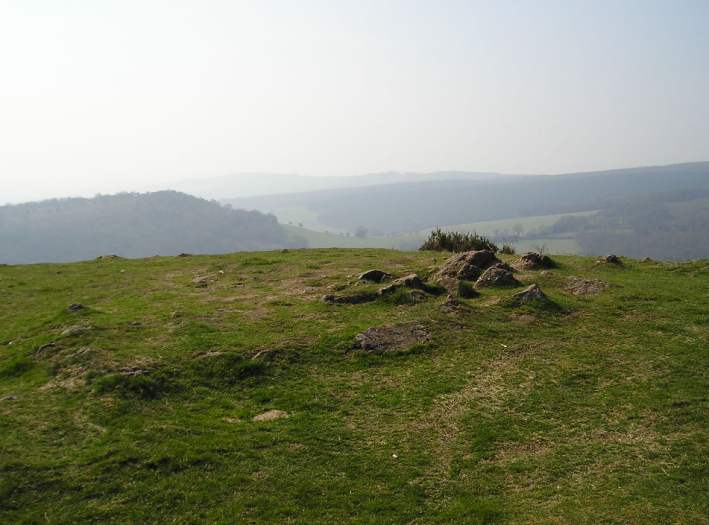
The line of vision of Pleiades rise from Twmbarlwm passes beyond the western end of Gray Hill where, at the top of the steep slope to the reservoir, a cairn or at least a large mound was erected, almost certainly in conjunction with this Pleiades set up whether used for burial or not. Further along this line is found the precisely placed top stone of a solar arrangement. The lowest stone here is adjacent to what is marked on the OS maps as a stone circle but which appears to be the remnants of a kerbed cairn with its internal diameter being 11 of Alexander Thom’s megalithic yards and its external diameter 12 of the same units. Kerb thickness is therefore seen as approximately 1.36 feet.Dating here is problematic; however, the relevant top stone of the alignment is exactly on the line to Twmbarlwm, the Pleiades line of 2500 BC. This is very unlikely to be coincidence. Again, the Pleiades alignment from Twmbarlwm gives the elevation of the stone on the hill side but this stone is not dependent upon the Pleiades line for its lateral position along the hill. It is nonetheless intriguing that the lower stone of this alignment is due east of the southern edge of the cairn or mound at the top of the western end of the hill and this may have denoted the position of the alignment when seen in conjunction with the top stone and the Pleiades line. This may also have given the position of the small cairn or circle adjacent to the lower stone of this alignment.
This lower stone is square and set to the cardinal points. Along the alignment and 72 feet from the lowest stone lies what was probably a mid stone, now prone on the ground and directly alongside he relevant line. Overall length of the alignment is circa 72 megalithic yards. If the measure is significant here then a combination of Pleiades alignment, a due east position from the southern edge of the large cairn and the measure would effectively give the locations here quite accurately.
From the above information it seems possible that the large cairn on the western end of the hill may have been set up not as a burial chamber but as an astronomical marker, primarily for the Pleiades and the positions of the solar alignment and smaller cairn may have been denoted by this, the Pleiades line and measure.
The methodology of the top stone of this alignment complies with the methodology of the stones of Trellech, the Harold Stones. The Trellech stones have been very loosely dated to 1400-1500 BC by archaeologists but this is no more than speculation, no archaeological investigation has been conducted to search for datable material and hence the date is, in fact, meaningless, it is no more than a guess. This date was applied earlier by the author to the Gray Hill stones as the similarity in style was apparent but the interjection of the Pleiades at Gray Hill casts doubt upon this idea and it now seems more likely that the 2500BC date would apply to both sites. What can be stated firmly is that the top stone of the solar alignment aligns via the Pleiades alignment of 2500BC to the western end of Gray Hill and ultimately to the top of Twmbarlwm.
To continue reading the article, download the PDFs, Part 2 and Part 3
Harry Sivertsen is the author of the books Measurements of the Gods and Deluge:From Genesis to Atlantis, which contain more of his research. These are available via the links to Completelynovel.com. The ebook versions are just £5.99 each and have rated 4/5 stars from readers there.
Part 1 is introduced here and the PDF link is here: Part 1.
Note: Read Parts 2 and 3 of the article by Harry Sivertsen


 We would like to know more about this location. Please feel free to add a brief description and any relevant information in your own language.
 Wir möchten mehr über diese Stätte erfahren. Bitte zögern Sie nicht, eine kurze Beschreibung und relevante Informationen in Deutsch hinzuzufügen.
 Nous aimerions en savoir encore un peu sur les lieux. S'il vous plaît n'hesitez pas à ajouter une courte description et tous les renseignements pertinents dans votre propre langue.
 Quisieramos informarnos un poco más de las lugares. No dude en añadir una breve descripción y otros datos relevantes en su propio idioma.