
Mysterious Minoans Were European, DNA Finds
Submitted by coldrum on Wednesday, 31 July 2013 Page Views: 4959
Natural PlacesCountry: Greece Region: Crete Type: Cave or Rock ShelterInternal Links:


The conclusion, published today (May 14) in the journal Nature Communications, was drawn by comparing DNA from 4,000-year-old Minoan skeletons with genetic material from people living throughout Europe and Africa in the past and today.
"We now know that the founders of the first advanced European civilization were European," said study co-author George Stamatoyannopoulos, a human geneticist at the University of Washington. "They were very similar to Neolithic Europeans and very similar to present day-Cretans," residents of the Mediterranean island of Crete.
While that may sound intuitive, the findings challenge a long-held theory that the ancient Minoans came from Egypt.
The Minoan culture emerged on Crete, which is now part of Greece, and flourished from about 2,700 B.C. to 1,420 B.C. Some believe that a massive eruption from the Volcano Thera on the island of Santorini doomed the Bronze Age civilization, while others argue that invading Mycenaeans toppled the once-great power.
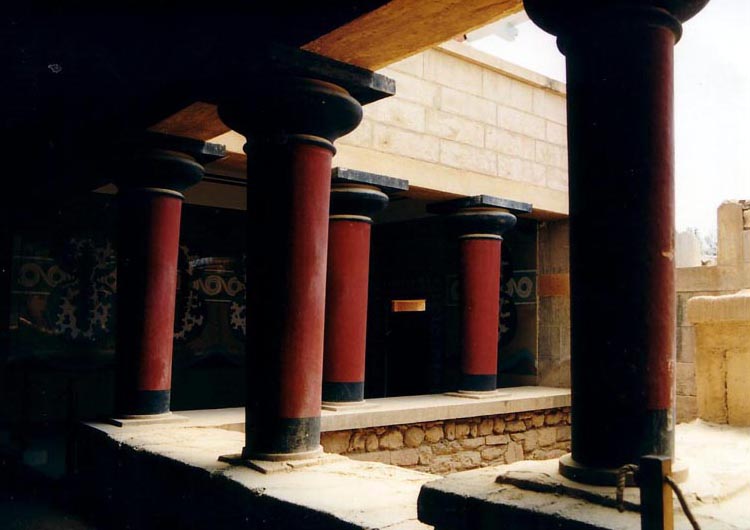
When British archaeologist Sir Arthur Evans discovered the Minoan palace of Knossos more than 100 years ago, he was dumbstruck by its beauty. He also noticed an eerie similarity between Minoan and Egyptian art, and didn't believe that the culture was homegrown.
"That's why Evans postulated the civilization was imported from Egypt or Libya," Stamatoyannopoulos told LiveScience.
To test that idea, the research team analyzed DNA from ancient Minoan skeletons that were sealed in a cave in Crete's Lassithi Plateau between 3,700 and 4,400 years ago. They then compared the skeletal mitochondrial DNA, which is stored in the energy powerhouses of cells and passed on through the maternal line, with that found in a sample of 135 modern and ancient populations from around Europe and Africa.
The researchers found that the Minoan skeletons were genetically very similar to modern-day Europeans — and especially close to modern-day Cretans, particularly those from the Lassithi Plateau. They were also genetically similar to Neolithic Europeans, but distinct from Egyptian or Libyan populations.
The findings argue against Evan's hypothesis and suggest that locals, not African expats, developed the Minoan culture.
"It was a period of excitement around the Mediterranean," so although the Minoans definitely had contact with their African neighbors across the Mediterranean, any similarities in art were probably the result of cultural exchange, Stamatoyannopoulos said.
The findings suggest that the ancient Minoans were likely descended from a branch of agriculturalists in Anatolia (what is now modern-day Turkey and Iraq) that fanned out into Europe about 9,000 years ago. If so, the Minoans may have spoken a proto-Indo-European language derived from the one possibly spoken by those Anatolian farmers, the researchers speculate.
Knowing that the Minoan language has Indo-European roots could help archaeologists decipher a mysterious Minoan writing system, known as Linear A, Stamatoyannopoulos said.
The prevailing theories hold that Minoan was a separate language family. The analysis of DNA from the Lassithi cave is a "valuable contribution," said Colin Renfrew, an archaeologist from the McDonald Institute for Archaeological Research at the University of Cambridge, who was not involved in the study. However, to make a clearer connection to the Anatolian migration, the researchers should have compared the Minoan DNA with more DNA samples from modern and ancient Anatolia, he said.
livescience.com
Note: Remains in Cretean Cave Support Minoan European Origin.


 We would like to know more about this location. Please feel free to add a brief description and any relevant information in your own language.
 Wir möchten mehr über diese Stätte erfahren. Bitte zögern Sie nicht, eine kurze Beschreibung und relevante Informationen in Deutsch hinzuzufügen.
 Nous aimerions en savoir encore un peu sur les lieux. S'il vous plaît n'hesitez pas à ajouter une courte description et tous les renseignements pertinents dans votre propre langue.
 Quisieramos informarnos un poco más de las lugares. No dude en añadir una breve descripción y otros datos relevantes en su propio idioma.