

Mesolithic and Bronze Age archaeological found at new US Embassy, London
Submitted by coldrum on Friday, 20 June 2014 Page Views: 3893
Neolithic and Bronze AgeCountry: England County: Greater LondonInternal Links:

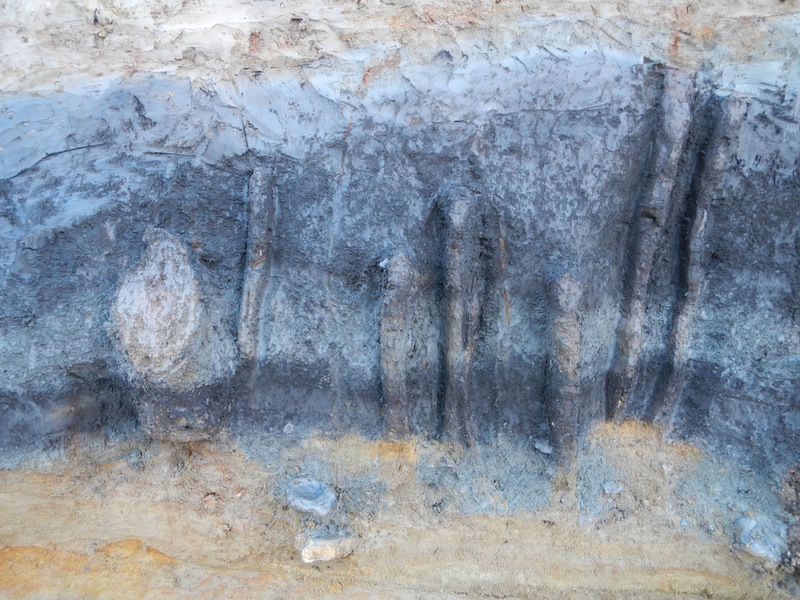
A 12-metre long prehistoric fish trap and evidence of camp fires have also been found among a range of Mesolithic and Bronze Age artefacts. The islands were once large and dry enough for prehistoric settlers, with fertile marsh banks offering rich food sources and productive hunting grounds.
“Prehistoric sites are rare in London owing to their ephemeral nature as well as urban development,” says Kasia Olchowska, a Senior Archaeologist for Museum of London Archaeology.
“What we have found may be the earliest archaeological evidence currently known from London.
“Further analysis will involve several diagnostic tests which can be applied to confirm the age of the artefact. These tests relate to shape, measurements and manufacture technique and involve comparing the artefact to other known flint tool types.
“It will be interesting to see how this evidence relates to other prehistoric structures on the nearby Thames foreshore.
“We hope to be able to reconstruct and have a better understanding of the prehistoric landscape of a much wider area than at present.”
The rest of the prehistoric surface uncovered at the construction site is up to 11,750 years old, carbon dating showed. At that time, the London area was wetter than it is today, with a network of channels that swirled around sandy islands, Olchowska said. The land was likely too wet for a permanent settlement, but the vast, open space may have been a good spot to set up camp for hunting and fishing expeditions.
Archaeologists uncovered several patches of scorched ground and burned animal bones, which may be evidence of campfires, Olchowska said. "We think that [the fires] are potentially marking a spot that people were coming back to seasonally," Olchowska told Live Science.
In the southwestern corner of the site, the team also found two rows of disintegrating wooden stakes stretching over an area 39 feet (12 meters) long. These fences might represent an early fish trap used to round up a catch in a basket or net.
The team found other stone tools, too, including a 12,000-year-old plunging blade, which would have been set in bone or wood and used as a tool or weapon, and handheld Neolithic scrapers that would have been used for woodwork or hide-cleaning.
Near the embassy site, archaeologists have previously discovered other prehistoric archaeological remains, including a Bronze Age jetty and a 7,000-year-old timber structure near the Thames. The new discovery gives archaeologists a chance to reconstruct a wider area of prehistoric London, Olchowska said. She is putting together a history of this period in light of her findings at the embassy.
Sources: www.culture24.org.uk and www.livescience.com
Note: Earliest archaeological evidence in London could have been found at new US Embassy


 We would like to know more about this location. Please feel free to add a brief description and any relevant information in your own language.
 Wir möchten mehr über diese Stätte erfahren. Bitte zögern Sie nicht, eine kurze Beschreibung und relevante Informationen in Deutsch hinzuzufügen.
 Nous aimerions en savoir encore un peu sur les lieux. S'il vous plaît n'hesitez pas à ajouter une courte description et tous les renseignements pertinents dans votre propre langue.
 Quisieramos informarnos un poco más de las lugares. No dude en añadir una breve descripción y otros datos relevantes en su propio idioma.