
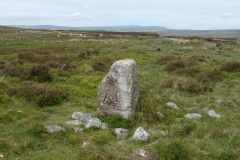

Megaliths of the Upland South, Imposing stones of uncertain function
Submitted by Andy B on Monday, 10 June 2013 Page Views: 8259
Neolithic and Bronze AgeCountry: United States State: Tennessee Type: Standing Stone (Menhir)Internal Links:


The paper is Megaliths in the Upland South: Imposing Stones of Uncertain Function and was published in the Journal of Alabama Archaeology 56(1):33-63, June 2012. Authors
Ball, Donald B. and John C. Waggoner, Jr.
As discussed in some detail in this paper, megaliths are "few and far between" in this region. To the best of my knowledge, this is the first paper specifically devoted to documenting these stones as they appear in this portion of the United States - they have attracted far more attention in the New England states as you may know.
I should note that as a practicing archaeologist I do not see any cultural or chronological link between the examples I have reported and similar large stones in Europe. Rather, I believe that such stones in this portion of the United States represent independent invention for as yet unknown religious or ceremonial purposes. I will go out on the proverbial limb, however, and express as a personal opinion that it possible that the erection of these stones was at least partially influenced by contact (be it direct or indirect) from groups in Central America.
The term megalith (or menhir) is best known in association with large free standing stones erected in the British Isles and portions of western Europe. Not so well known are three such monuments in Putnam and Smith counties in the central Cumberland River Valley of north-central Tennessee, six in east-central Alabama, two in Union County, Georgia, one in Lewis County, West Virginia, and two in southern Pennsylvania.
In common with many of their European counterparts, the chronology, cultural association, and function of these pillars have been the subject of varying degrees of conjecture but in reality all are poorly understood. It is the purpose of this article to bring together the available information and pertinent source materials referable to these enigmatic monuments of unknown purpose within the Upland South region of the USA.
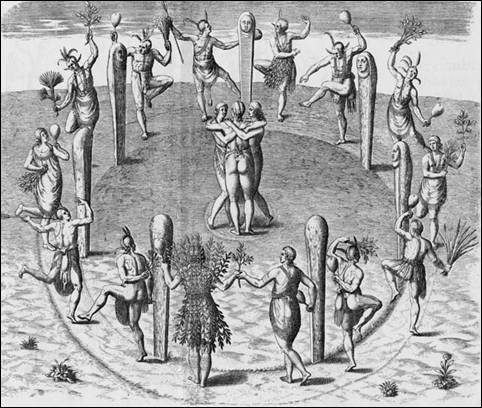
As they might also be of interest to you, I have inserted below two illustrations which appeared in the "as submitted" article which (perhaps for reasons of spatial limitations) were not included in the published version.
Sites discussed in the article include
Monterey Standing Stone, Putnam County, Tennessee (site page)
Kempville Standing Stone, Smith County, Tennessee
Difficult Standing Stone, Smith County, Tennessee
Site 1Cy225, Horn Mountain Stone, Talladega National Forest, Clay County, Alabama (site page)
Site 1Ra28, Rother L. Harris Reservoir Stone, Randolph County, Alabama (site page)
Site 1Ta756, Talladega National Forest Stone, Talladega County, Alabama (site page)
Site 1Ta756, Talladega National Forest Stone, Talladega County, Alabama (site page)
Site 1Le307, Lee County, Alabama
Site 1Ca887, Choccolocco Stone, Calhoun County, Alabama (site page)
Site 9Un367, Track Rock Gap, Union County, Georgia, two possible megaliths
Stonewall Resort State Park, Lewis County, West Virginia
Juniata Standing Stone, Huntingdon County, Pennsylvania
Montour Trail, South Park near Pittsburgh, Pennsylvania
(with thanks to Bat400 for additional site research)
Further details are in the paper, which can be downloaded and read here. (PDF file, 850KB)
Note on Two Possible Upland South Megaliths by Donald B. Ball
Following the publication of the article in Vol. 56, No. 1 of the Journal of Alabama Archaeology, I was pleased to receive two communications regarding possible additional and previously unreported examples of these stones.
The first of these was an email dated September 26, 2012, from Mr. E. Raymond Evans of Chattanooga, Tennessee, who remarked:
I …remember seeing a [standing] stone in Rhea County, TN, that was very much like your Figure 2 picture of the Kempville Megalith in Smith County. It was limestone and had no tool marks of any kind on it. I always thought it was a natural standing stone.
The second communication, dated September 29, 2012, from Mr. Ken Pennington of Trenton, Georgia, remarked:
Over the years I have received reports of a single upright stone that is located on the farm of my great, great, great grandfather William Fowler on Lookout Mountain. I have been told by persons knowledgeable of its location that they will eagerly show it to me anytime. I had assumed it must have served as a boundary marker which is common but this one seems to be of a height that impressed those that have seen it. Now I will make an effort to go see it and measure it and take photographs.
As of the date at which this note was prepared (October 27, 2012), I have not received any additional information about either of these stones. Granting that such standing stones are “few and far between,” members of the Alabama Archaeological Society are urged to document, photograph, and report any examples they may find either in Alabama or other states.
There can be little doubt that additional stones of this nature yet remain to be discovered and I would very much like to hear about them.
Donald B Ball


 We would like to know more about this location. Please feel free to add a brief description and any relevant information in your own language.
 Wir möchten mehr über diese Stätte erfahren. Bitte zögern Sie nicht, eine kurze Beschreibung und relevante Informationen in Deutsch hinzuzufügen.
 Nous aimerions en savoir encore un peu sur les lieux. S'il vous plaît n'hesitez pas à ajouter une courte description et tous les renseignements pertinents dans votre propre langue.
 Quisieramos informarnos un poco más de las lugares. No dude en añadir una breve descripción y otros datos relevantes en su propio idioma.