

★Japanese Chronology for Stone circles (late Jōmon era, 6000-3000 BCE
Submitted by Aska on Friday, 11 June 2021 Page Views: 1429
Neolithic and Bronze AgeCountry: Japan Type: Stone CircleInternal Links:

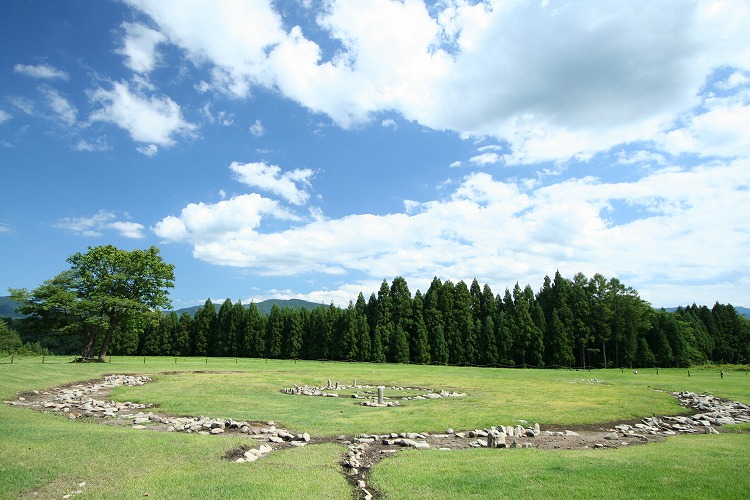
In contrast to the British stone circles which seemed to be constructed by the instruction of the rulers of stratified society for the purpose of astronomical observation, the constituent stones of ring type in Japan are extremely small, i.e. skull-size, and their arrangement is not geometrical but random. Some scholars suppose that these sites were sort of community plaza of ancient egalitarian society and those who could bring and add new stones were accepted as new participants of the community. There are skull-size stones called “chikara-ishi” (力石 = power stone) in the precincts of Japanese Shintō shrines or other places, local legends tell that if anyone could lift the stone up his/her dream would come true. “Chikara-ishi” might be the heritage from Jōmon world. Sundial type, along with small ring type, should be individual tombstones. There are also so many stone settings in amorphous shape, in other words stone circle might be merely one of variations of stone setting sites. And at the end of Jōmon era, timber circles appeared in Hokuriku region : Toyama and Ishikawa prefectures. There are also non-geometric stone circles (or enclosure) in southern Japan. They have not been scientifically investigated yet but most of them should be one of proto-Shintō worship sites called “iwasaka” (磐境 = stone boundary) which might be constructed during Asuka era (7th C) guessing from the fact some of them diverted the fragments of nearby broken Kofun (3rd -6th C) as their constituent stones. Unfortunately “iwasaka” examples are rare and not popular as another proto-Shintō worship sites “iwakura” (磐座 = stone pedestal), huge natural rock outcrops, which “iwakura-mania” hunts for.
Basic Resources:Main Article: ★★Japanese Chronology with Featured Stone Monuments In Every Era
- 季刊考古学(101) pp.5-94 特集:日本のストーンサークル 2007.11 雄山閣 ISSN:0288-5956 (lit : Archaeological quarterly. No.101. Special feature articles : Stone Circles in Japan)
- 阿部昭典ほか 2023 環状列石(考古調査ハンドブック23) 東京:ニューサイエンス社 ISBN:9784821605354 (lit : Stone Circles(Archaeologlcal Research Handbook 23))

 We would like to know more about this location. Please feel free to add a brief description and any relevant information in your own language.
 Wir möchten mehr über diese Stätte erfahren. Bitte zögern Sie nicht, eine kurze Beschreibung und relevante Informationen in Deutsch hinzuzufügen.
 Nous aimerions en savoir encore un peu sur les lieux. S'il vous plaît n'hesitez pas à ajouter une courte description et tous les renseignements pertinents dans votre propre langue.
 Quisieramos informarnos un poco más de las lugares. No dude en añadir una breve descripción y otros datos relevantes en su propio idioma.