
<< News >> How our shrinking Fens are revealing so much about the past
Submitted by PaulM on Wednesday, 22 February 2006 Page Views: 8287
Site Watch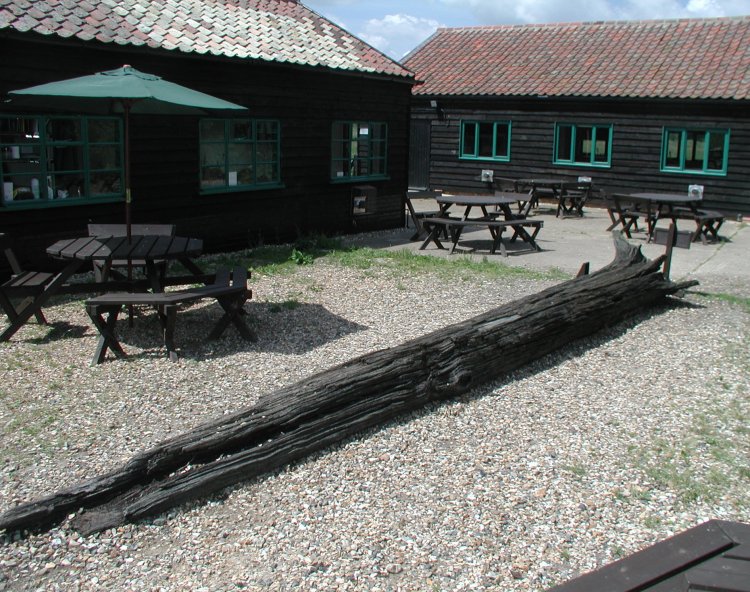
For these bizarre objects are bog oaks, and until they were uncovered by a farmer's plough, they had lain under the earth for thousands of years.
They were once part of a thick blanket of oak forests which covered this part of the world, until the land began to flood.
Large shallow lakes formed when the rivers Nene, Ouse and Welland began to silt up with tidal sands, trapping the water inland.
The oak trees couldn't survive being soaked in the water, their roots began to rot and they eventually toppled over under the water.
Over the years, layers of dead reeds and other plant materials gathered on top of the wood to form peat.
This acted like a natural preservative around the trees because there was no oxygen to rot the wood.
Six thousand years later, and farmers such as Peter Davies, of Eternity Hall Farm, in
Conington, near Peterborough, regularly dig up bog oaks as they till the fields around Holme.
He said: "The peat is shrinking all the time, and that's when the bog oaks appear.
"We have trip beams on our machinery which let us know when we come across one, and then we mark them and take them up.
"They can be quite big, and can do a lot of damage to the machinery if you hit them.
"I once came across a bog oak which was 80 feet, although that was quite exceptional. It is quite normal to see 30 or 40ft long bog oaks."
Confusingly, the bog oaks pictured are probably not oak at all.
Dr Francis Pryor, the archaeologist and Bronze Age expert responsible for uncovering some of the secrets of Flag Fen in Peterborough, believes they look like pine or birch.
These species of trees appeared during a later dry spell, and were also preserved in the peat. The term bog oak is used as a catch-all term for all species of trees preserved in peat.
The bog oaks have proved to be a very important piece of evidence for archaelogists researching the history of the area.
Their tree rings record the history of wet and dry growing seasons, and they helped historians to work out the age of Flag Fen.
Dr Pryor said that neolithic farmers would have been working the land at the time when the bog oaks were still living trees.
When the water levels rose, people retreated to flood-free areas, although they didn't travel very far inland, preferring to live close to the Fen.
"There is a lot to be said for living on the edge of a wetland area. You got the best of both worlds.
"You could exploit the land to grow wheat and barley and then go into the Fen to get protein in the form of wild ducks, eels and geese."
Flocks of sheep were also kept on areas of dry land, a method of farming which generated a lot of wealth.
In the 19th century, the Fens were drained and turned into arable farmland, continuing work which had begun in the 17th century. Bog oaks have been turning up ever since.
Dr Pryor explained: "When you drain the Fen it is suddenly exposed to air. It oxidises the peat, which makes it shrink. There's nothing you can do about it.
"Ploughing make it worse, because it turns over more of the soil and exposes it to the air, like stirring a rice pudding. As the level of the land drops, the trees are exposed."
Source: Peterborough Today 22/02/06
Carving a future for wood
BOG oak started turning up in large number at the turn of the last century.
Many of the early bog oaks were burned, sometimes in huge fires.
According to archaeologist Dr Francis Pryor, this could have unfortunate consequences.
He said: "From time to time they would set the peat itself alight, sparking underground fires which would rage for weeks.
"They would have to get the Army to come and let off bombs to uncover the fires."
Nowadays, there are more sophisticated ways to recycle the wood.
Craftsmen such as Peterborough man Renny Antonelli carve beautiful sculptures and furniture out of the wood, which emerges from the land as a very distinctive jet black colour.
Renny displays his work at the Eco Art Gallery at Thorpe Hall in Longthorpe, and runs courses in bog oak carving at Flag Fen and Peterborough College of Adult Education.
You can carve your own bog oak masterpiece with Renny at a weekend workshop at Flag Fen this summer.
It takes place on May 13 and14, and costs £85, and £5 to £20 for the wood.
• To book, call 01733 313414.

 We would like to know more about this location. Please feel free to add a brief description and any relevant information in your own language.
 Wir möchten mehr über diese Stätte erfahren. Bitte zögern Sie nicht, eine kurze Beschreibung und relevante Informationen in Deutsch hinzuzufügen.
 Nous aimerions en savoir encore un peu sur les lieux. S'il vous plaît n'hesitez pas à ajouter une courte description et tous les renseignements pertinents dans votre propre langue.
 Quisieramos informarnos un poco más de las lugares. No dude en añadir una breve descripción y otros datos relevantes en su propio idioma.