
Boomtime for ancient Ireland traced to Sligo
Submitted by vicky on Friday, 16 July 2004 Page Views: 1407
Neolithic and Bronze AgeCountry: Ireland (Republic of) County: Co. SligoInternal Links:

Archaeologists are finally in agreement that the Megalithic period in Ireland 'boomed' between the years 4200BC and 3500BC. The date controversy over the Irish Megalithic period - most significantly characterised by the Carrowmore site in Sligo - was put to rest at an archaeology conference in Sligo.
The findings of the conference have just been released even though it took place two years ago.
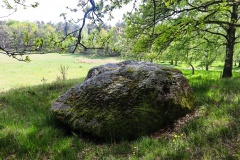
The Carrowmore site has one of the largest concentrations of Megalithic tombs in Western Europe.
It pre-dates the Newgrange and Boyne complex and is older than the Egyptian pyramids.
Swedish Professor Goran Burenhult, who excavated the Carrowmore grave complex for more than 20 years, said that the conference papers gave the most complete picture available on the Megalithic period in Ireland and Western Europe.
During the Megalithic era, most of the giant stone monuments were built.
In the past, it was thought that the pyramid tombs of Egypt and the Middle East were earlier than the Megalithic tombs of Ireland.
However, excavations showed that Carrowmore was both earlier than the Newgrange and Boyne complex and the Egyptian pyramids.
"The early dates revealed by Carrowmore have been controversial," said Professor Burenhult. "But we now have agreement that 4200BC is the start of the Megalithic tradition in Ireland. So we have a chronology now."
The results of the conference, which was held in Sligo two years ago, have just been presented to the Institute of Technology, Sligo.
The Stones and Bones conference was a prelude to the establishment of the BSc in Applied Archaeology course. Professor Burenhult went to Sligo to make the presentation.
He wanted to discuss future links between IT Sligo's Applied Archaeology course and the archaeology course in the University of Gotland, where he is professor.
"There is much more to do at Carrowmore, many more questions to be answered. We have got very firm outline dates and now we can ask questions about the living society behind the tombs."
Source: The Belfast Telegraph 16/07/2004


 We would like to know more about this location. Please feel free to add a brief description and any relevant information in your own language.
 Wir möchten mehr über diese Stätte erfahren. Bitte zögern Sie nicht, eine kurze Beschreibung und relevante Informationen in Deutsch hinzuzufügen.
 Nous aimerions en savoir encore un peu sur les lieux. S'il vous plaît n'hesitez pas à ajouter une courte description et tous les renseignements pertinents dans votre propre langue.
 Quisieramos informarnos un poco más de las lugares. No dude en añadir una breve descripción y otros datos relevantes en su propio idioma.