


Book Review: Stonehenge, cracking the Megalithic code by David Kenworthy
Submitted by cerrig on Sunday, 21 December 2014 Page Views: 4364
StonehengeCountry: England County: Wiltshire Type: HengeInternal Links:


David has come down firmly on the positive side of megalithic man's intelligence and ingenuity, and this is reinforced right through the book. David asserts that the builders of Stonehenge and other such monuments of the time developed a system of measurement that included time and distance, and had linked them together into an integrated whole. He also asserts that the originators of this system had a specific goal in mind when they set out to find these links.
David has examined various megalithic monuments and proposed their uses as instruments in the development of the measurement system, and the proof of the original goal. In doing so he is proposing that there was a "code" prevalent in the planning of these monuments, and this code was discovered unknowingly by Alexander Thom. It was in Professor Thom's work that David first realised the existence of the code - and this is the backbone of the proposed theory.
This first book gives author's take on the current state of play at Stonehenge, and goes on to introduce the basics of his theory into the megalithic science involved in the measurement system proposed. The system involves some ingenious ways of using numbers and recording time, and in compiling this David has leant heavily on other sources, mostly the authors in his reading list at the back of the book - Professor Thom included.
David has taken on board the combined contributions of these sources and come up with what appears to be a novel system, or code, hitherto unrecognised hidden within these sources. This all looks very promising, and David does indeed put a case forward for his theory, although it is just a basic introduction in this first book of the three.
Without going into details as to the various components of David's theory, as presented, this just about covers the premise of this book, although there is much more background detail within it. Which brings me to the readability of the book - in doing so I give due credit to David for putting himself in the position of inviting criticism of his theory and of his competence as an author. A very brave thing to do, especially as self publishing means doing without the invaluable use of an impartial editor. Of course this is proving to be the only way to get published for most new authors, and unfortunately this lack of impartiality shows.
While the book does contain some gems regarding the use of numbers, the possible origin of the mile and its divisions as a system of measurement, and also some interesting conjecture regarding the uses made of megalithic monuments, the way it has been presented leaves much to be desired.
It is a very short book of 84 pages, containing some complex descriptions of various megalithic and stellar layouts, but not one diagram to help with understanding. Without prior knowledge of the concepts involved it's hard to see how anyone could picture the scene, so to speak. I was defeated trying to follow David's explanation of the Stonehenge Aubrey hole calender involving a fire and a moonstone. Try as I might I couldn't get it to work according to his description, even though this involved a genuinely stunning revelation of a second Aubrey (Stukely) circle next to the known one, with the evidence to back it up.
This sort of thing turned up in other places in the book too. All too often David composed passages of text that were quite fluffy and irritating, with concepts that were not well explained unless the reader was already familiar with them. When he'd lulled you into going along with this, like the Phantom Flan Flinger off Tiswas (*), he'd hit you with some number theories that at times seemed to appear out of thin air, leaving you wondering just what had just happened. I was constantly referring to other parts of the book in order to try and make sense of these instances. Maybe someone with a better memory could cope better than me.
The book is written in a quite confusing style. I suppose most new authors' first offerings would be the same, and I am sympathetic to this, but it shows the value of a good editor before rushing into publication, as would appear to be the case here. [Perhaps you should offer your services Cerrig? - MegP Ed]
David seemed to be confused about who his readers will most likely be; are they very well informed and seasoned enthusiasts, or are they uninformed and quite new to the subject? At times the book tries to cater to both of these extremes, sometimes in the same paragraph.
Theories from other sources are brought up throughout the book, sometimes without attribution for the sources - and a partial explanation put forward. Without in depth knowledge of the theory concerned the reader (me) is left wondering what is going on - the flan flinger had struck again.
While I am familiar with some of David's reading list it didn't really equip me to follow some parts of the book. This was a source of some irritation to me, as I wasn't about to re-read a list of other books or purchase new ones in order to follow what was going on in this one, especially as some simple diagrams could have done the job admirably.
Also, it's not clear just what in the book are David's original concepts, and what is from elsewhere - there is no bibliography and some attributions are not attached to the relevant passages in the book - another source of confusion.
In short, a very mixed bag, and difficult to know how to sum it up. The book is not well written, and breaks lots of conventions needed in a good book. I believe this is the result of enthusiasm and inexperience, which I can most certainly sympathise with.
As a book to read, it's hard to recommend. There's far too much that is irrelevant and almost seems to have been put in to fill up the book - which at 84 pages is already quite short. In my view it could be much shorter without affecting it's content at all. At £10 it's poor value for money for the paperback [currently £9.15], although the Kindle version is much more reasonable and probably worth it for the measurement theory involved - which is really the only good part of the book, and definitely worth getting into.
Finally, a point which is a bugbear for me regardless of the content - why three books? This doesn't endear me at all. Why not one book containing the whole thing - following the example of David's reading list, the likes of which this book will be unfavourably compared with. I believe the format is completely wrong - it would have been much better served as a considerably shortened and edited introduction to a bigger and better book.
David Kenworthy is not a writer - yet - but he is a researcher and an enthusiast, with a good eye for possibilities and the courage to share his thoughts with the world. There is much to admire in that.
While this first offering is somewhat disappointing , it can definitely be improved upon, and I'm encouraged to learn that the second book contains much more in the way of diagrams and fuller explanations.
A writing style is something that develops, and I have seen some glimpses of potential. David's real strength is his desire to get involved and see things in a new way, and I hope his other books match this with a much more polished offering.
I wish David well and although this book hasn't gone down well with me, there's still enough in his theory to interest me in his next book , which I will look forward to reading .
Review by Cerrig
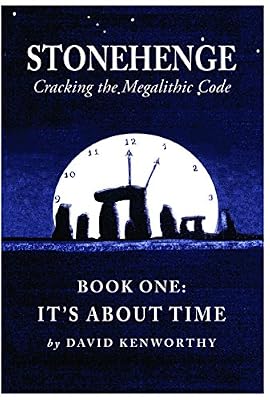 Stonehenge, cracking the Megalithic code by David Kenworthy
Paperback: 84 pages
Publisher: Brown Dog Books (30 Oct 2014)
ISBN: 190305687X
Size: 19.4 x 12.8 x 1.2 cm
Current Price: £9.15 (paperback) £3.09 (variable)
Available from Amazon.co.uk and Amazon.com
(*) Phantom Flan Flinger - For those not versed in British culture of the 1970s - see here...


 We would like to know more about this location. Please feel free to add a brief description and any relevant information in your own language.
 Wir möchten mehr über diese Stätte erfahren. Bitte zögern Sie nicht, eine kurze Beschreibung und relevante Informationen in Deutsch hinzuzufügen.
 Nous aimerions en savoir encore un peu sur les lieux. S'il vous plaît n'hesitez pas à ajouter une courte description et tous les renseignements pertinents dans votre propre langue.
 Quisieramos informarnos un poco más de las lugares. No dude en añadir una breve descripción y otros datos relevantes en su propio idioma.