
Book Review: Hidden Stonehenge - A Temple in North America.. by Gordon R Freeman
Submitted by Runemage on Tuesday, 05 February 2013 Page Views: 6665
Neolithic and Bronze AgeCountry: Canada Type: Round CairnInternal Links:

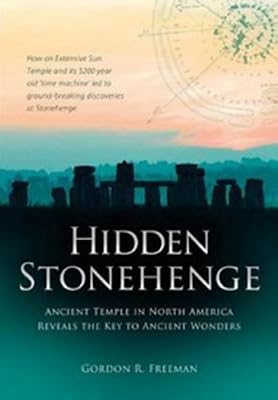
The image of Stonehenge itself is intriguing, with the silver lettering ‘Hidden Stonehenge’ superimposed. It does literally make you want to look inside. And for anyone thinking they’ve already read or heard about every possible theory on Stonehenge, you haven’t and this one’s well worth considering.
What shines out of the pages of this book from the first page is Gordon’s passion for his subject, his infinite patience whilst recording the weather-dependent observations in some extremely remote and hostile areas over many years, his desire to look and learn, to put himself literally inside the site and see, not with a 20th century conditioned mind, but as the indigenous population would have done over millennia. What he’s seen in Alberta does contradict the standard archaeological view of the capabilities of the indigenous people of the time, and their interpretation of this site. It may not be popular there for that reason alone, but look beyond the politics and see what Gordon has discovered with his own eyes and recorded for the rest of us who can’t get out there and repeat his experiences.
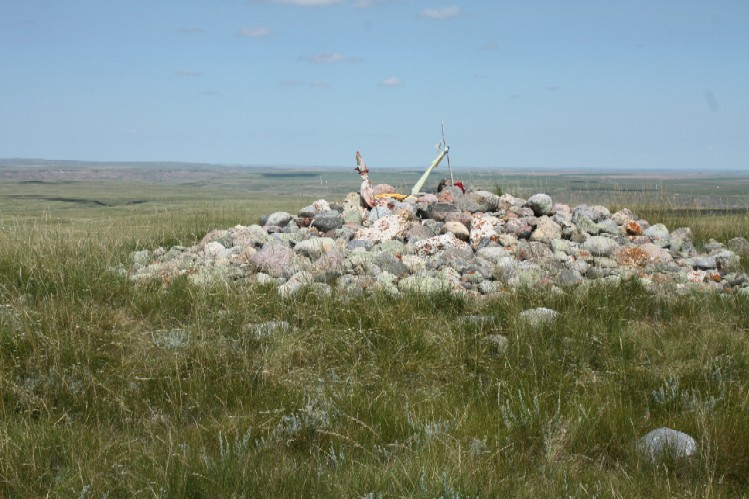
To have found such an important and large working monument among what has been called a natural tumble of stones is an achievement. The site that we call Majorville and much of the surrounding 31 square kilometres which form the whole of its complex is called Ómahkiyaahkohtoohp in the Siksika language (Ómahk for short), meaning "OldBigArrangement" and it has more accents over the letters than my formatting will let me reproduce.
To have decoded the original use of one ancient calendar is a huge achievement, but Gordon didn’t stop there, he decided to see if Stonehenge was built on the same principles and had the same landscape features as Ómahk and if it also worked in the same way. Once again, Gordon goes to the site over several years and at different times of the year and applies the same patient observation techniques and comes up with some very interesting discoveries. The similarities between the two in that context are nothing short of astounding.
Not content with that, Gordon then visits the source of the bluestones used at Stonehenge and the surrounding landscape including Foel Drygarn. I’ve looked at photos of the bluestone quarries, I’ve seen them on aerial shots but what I’ve not done is walk among them. Even if I had, without Gordon’s experience of walking and sighting in Alberta and elsewhere amongst what looks like a jumble of stones, I don’t think I’d see what he does at that site. No-one’s suggested this purpose for that area before to my knowledge. This is yet another part of our prehistory that deserves some more serious investigation, but this will perhaps have to wait for someone younger with the same sense of exploration and enthusiasm.
Gordon recommends we ‘learn to read the patterns of the stones on the ground, someone of European Heritage must abandon the “we are Masters of Nature” way of seeing things. …. Genius existed on the prairies more than 5,000 years ago and it continues in their progeny today.’ This insightful observation describes more than a few of our contributors who have gone to hillsides covered in stones and noticed different arrangements that simply are not random, particularly once they’ve ‘got their eye in’. Gordon has just spent much more time doing exactly that, honing his sight and his instinct, to re-discover the calendars on the land that were so obvious and so necessary to our distant ancestors.
I’d say the most unfortunate thing about the book for those of us who are obsessive about ancient sites is its description on the cover - under the words Hidden Stonehenge it says “Ancient Temple in North America Reveals the Key to Ancient Wonders.” That sounds to our ears like yet another New Agey book on Atlantis or somesuch, yet nothing could be further from the truth. It's probably a side effect of its outlet via Watkins Publishing who are aiming to appeal to their core 'mysteries' readership. Also on the inner cover flap they promote Ómahk as “Canada’s Stonehenge”. This is a concept which regular readers will know has a very unfortunate effect on our MegP Ed, who was last heard uttering "Aaaaaaaarrrggghhh" very loudly. [Aaaaaaaarrrggghhh - MegP Ed] Apart from that, there’s little to dislike.
The presentation of the information in the book is very good. The layout is clear and tasteful. The text is easy to read and understand, complex criteria are explained well, there are, in the author’s own terminology, ‘nerd notes’ galore for people who want all the facts and figures in glorious technical detail. The proximity of the photographs to the relevant text is a delight as this makes it so much easier to see the point of the measurements and directions that the author is discussing on the same page. Many photographs have superimposed lines showing where the sun or moon can be seen at different times, again all tied in with the nearby text.
This book is no armchair theory, Gordon has been to one of the most remote ancient sites on Earth countless times over many decades and in some wintry - at those temperatures the skin is numb - and some scarily adverse conditions, e.g the only way in or out was by small plane, the pilot who dropped him off earlier had come to collect him and left its engine running as Gordon was packing up his equipment. If the plane had stalled they would have never been able to get out.
The main thrust of the book is to demonstrate that ancient man was as intelligent as we are, at least two complex working Solar and Lunar calendars that could be used by observers in an identical way were constructed on the same latitude 1,000 years apart. The evidence, compiled by himself over decades is most convincing. Equinox observation, or lack of it is given special attention and a novel interpretation ensues. Some other sites and other possible calendar locations are mentioned briefly.
Note that I have not deconstructed Gordon's theory in the intricate way beloved of contributors to our Mysteries Forum so I must add that caveat, but say that our review copy is available to an archaeoastronomy aficionado who might care to look further into the claims made and report back. (See a discussion from 2009 when the book first came to our attention)
So to finish, there is also a strong human story interwoven throughout, of his wife’s ceaseless support and bravery accompanying him on his quest, friends who have helped along the way, the helpful and not so helpful people encountered in officialdom, Native American views on Óhmak and last but by no means least, Gordon’s desire to have the whole area recognised, protected and respected for what it is.
Review by Runemage
 Author Gordon R Freeman
Paperback
355 pages
Watkins Publishing
ISBN 978-1-78028-095-0
Available from Amazon.co.uk and Amazon.com.
The author's web site is http://canadastonehenge.com and there are more images of Majorville cairn, its location and background on our site page.


 We would like to know more about this location. Please feel free to add a brief description and any relevant information in your own language.
 Wir möchten mehr über diese Stätte erfahren. Bitte zögern Sie nicht, eine kurze Beschreibung und relevante Informationen in Deutsch hinzuzufügen.
 Nous aimerions en savoir encore un peu sur les lieux. S'il vous plaît n'hesitez pas à ajouter une courte description et tous les renseignements pertinents dans votre propre langue.
 Quisieramos informarnos un poco más de las lugares. No dude en añadir una breve descripción y otros datos relevantes en su propio idioma.