


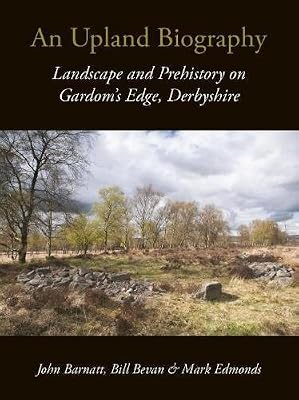
Book Review: An Upland Biography: Landscape and Prehistory on Gardom's Edge
Submitted by Andy B on Tuesday, 25 February 2020 Page Views: 4019
ReviewsCountry: England County: DerbyshireInternal Links:


Rob Ixer writes: Gardom’s Edge lies 10km northeast of Bakewell in Derbyshire, within the Millstone Grit a series of alternating sandstones and shales giving rise to boulder strewn, marginal agricultural land and even worse, poorly drained marshy soils.
The Millstone Grit surrounds the limestones of the White Peak with its well-known, oft-visited Arbor Low recumbent stone circle but itself has distinguished monuments, including the Nine Ladies Circle at Stanton Moor, Mam Tor Hill Fort,/Enclosure Site north of Castleton and the rock art of Gardom’s Edge, the last is now a fibreglass replacement. (pictured top left)
However, the Millstone Grit unlike the White Peak (partly because it has suffered no historical mining, having no reachable lead and zinc ore, fluorspar or barytes) has preserved many smaller, more difficult to discern, Bronze and Iron Age relicts.
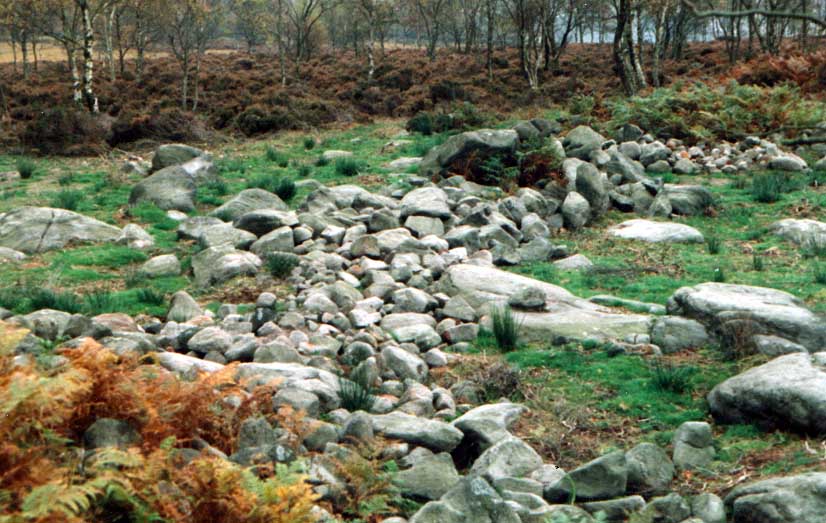 The main chapters are in roughly chronological order and show (by careful excavation and recording) that there is little evidence for occupation until the late Neolithic/Early Bronze Age, when there was stock management and then later in the Late Bronze Age and after, houses and small ‘gardens’ amid abundant clearance cairns and field boundaries.
Despite the lack of finds, other than shale fragments and pot-sherds, the last quarter of the book covers the finds reports, within five appendices, covering worked stone, pottery (macroscopical and petrographical studies), and more exotic items like blue glass and an enigmatic lead object. These are certainly as interesting as the main field text.
The results are mostly to be anticipated, the inhabitants mainly used local and regional resources (locally for the worked shale and within the White Peak for the pottery raw materials) but possibly had (albeit, rare) possessions from very far away. If the report (p172) of epidote as pot temper be correct then that would suggest (barring an erratic source) that some of the pottery was also foreign (Wales would be a first guess). The glass probably is the most exotic item.
The main text of the book is well illustrated and well-written. Although it starts off poorly, with on page one, the use of ‘geologies’ instead of rocks, (an affectation that is rife and is as silly as using ‘archaeologies’ when discussing contexts in a multi-temporal site) and some odd ideas about stratigraphical nomenclature and with a highly idiosyncratic employment of italics, but it soon settles.
 The text is amply illustrated with many black and white figures mainly showing the mapping and excavation of rock piles as they are dismantled. Their very nature determines that the figures are detailed but for non-specialists the choice of stippling and the keys make them difficult to read, initially.
The chapters are separated by excellent atmospheric colour plates together with a page of informal, almost folksy text, a conceit that appears in other Edmond’s books, and maybe for some, more intrusive than inclusive, but is a minor matter and is well-intentioned.
Overall the work shows that Gardom’s Edge had a long but intermittent use by peoples with local and slightly foreign, or sometimes very foreign, contacts (although probably not at first hand). This is not the most earth moving of conclusions but that is precisely the point and value of the book.
Most people do not lead arresting lives but place a cobble or two onto culture’s cairns. The aim of this research (like most of archaeology?) was ‘people… their relationship with land and each other over time’ p138 and this book does just that. It records with skill and in some detail, ordinary folk leaving a series of small, but clearly defined stone legacies (if you have the experience and patience to see it), built one stone upon a stone. It is like a very old East African tale of ‘little people’ and their ‘shambas’, sadly without the resulting lushness, inherent in sunshine and rich volcanic earth, but it is well worth hearing.
Review by Dr R.A.Ixer FSA
An Upland Biography: Landscape and Prehistory on Gardom's Edge, Derbyshire
Authors: John Barnatt; Bill Bevan and Mark Edmonds
Windgather Press 2017 200p, b/w and colour paperback
Now £14.95
Available from Oxbow Books and Amazon.co.uk


 We would like to know more about this location. Please feel free to add a brief description and any relevant information in your own language.
 Wir möchten mehr über diese Stätte erfahren. Bitte zögern Sie nicht, eine kurze Beschreibung und relevante Informationen in Deutsch hinzuzufügen.
 Nous aimerions en savoir encore un peu sur les lieux. S'il vous plaît n'hesitez pas à ajouter une courte description et tous les renseignements pertinents dans votre propre langue.
 Quisieramos informarnos un poco más de las lugares. No dude en añadir una breve descripción y otros datos relevantes en su propio idioma.