

Featured: Explore Scotland (and everywhere else) with our Megalithic Portal iPhone app

Explore Scotland (and everywhere else) with our Megalithic Portal iPhone app

Random Image

Britain BC

Britain BC

Login

Register here - as a registered user you get more features and fewer ads.

Who's Online

There are currently, 818 guests and 10 members online.

Sponsors

Before corn, wild lilies were on ancient menu

Submitted by coldrum on Monday, 09 February 2009  Page Views: 1672

Pre-Contact

<< News >>

Long before humans in North America grew corn and beans, they were harvesting and cooking the bulbs of lilies, wild onions and other plants, roasting them for days over hot rocks, says a Texas archeologist.

The evidence for this practice has long been known of in fire-cracked rock piles found throughout North America, but archeologists have tended to ignore it "because a new pyramid or a Clovis arrow point is much sexier," said archeologist Alston Thoms of Texas A&M University.

In two new reports published online last week in the Journal of Anthropological Archaeology and the Journal of Archaeological Science, Thoms reported that cooking on hot rocks first became a substitute for cooking on hot coals around 9,000 to 10,500 years ago, then had a sudden jump in popularity about 4,000 years ago.

The reason for the changes: population growth that required primitive peoples to exploit new food resources.

Meadowlands and the forest edge were filled with wild plants. The bulbs of these plants are about as nutritious as sweet potatoes, but the only way to make them digestible was to roast them for two days or longer. Large rocks could hold heat without constant maintenance.

From Chicago Tribune.

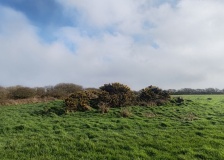
Note: Rock ovens at archaeology sites in the North American west.

Please add your thoughts on this site

Places of Power, Paul Devereux

Places of Power, Paul Devereux

Sponsors

More News

See all News →

"Before corn, wild lilies were on ancient menu" | Login/Create an Account | 1 comment
  
Go back to top of page    Comments are owned by the poster. We aren't responsible for their content.
Ancient Rock Piles Reveal Early American Cuisine by bat400 on Monday, 09 February 2009
(User Info | Send a Message)
Submitted by coldrum. Article on the same subject from Discovery News:

Fire-cracked rock piles found across North America received little scientific attention for decades, but two new studies reveal their importance as early Native American earth ovens. For thousands of years, they were used to cook a favorite food staple: smoky, sweet camas bulbs.

Based on charred remains of plant material found at hot rock oven sites, cooked versions of this root vegetable -- somewhat like a cross between an onion and a potato -- is thought to have been the tortilla of the Stone Age.

The bulbs required up to two days to bake, due to a complex carbohydrate called inulin that is otherwise indigestible.

Alston Thoms, who conducted both studies, told Discovery News that "camas consumption preceded corn consumption everywhere in the U.S. by thousands of years."

"Camas was mashed and pounded with a mortar and pestle into a thick dough that was then shaped into loaves that were later broken apart and cooked," added Thoms, an associate professor of anthropology at Texas A&M University.

He analyzed the fire-cracked rock assemblages and food remains throughout North America, with a particular focus on northwestern and southwestern sites. The findings have been accepted for publication in both the Journal of Anthropological Archaeology and the Journal of Archaeological Science.

Thoms found that fire-cracked rock cooking dates to anywhere from 9,000 years ago to as recent as 400 years ago, with some sites up to 9 feet in diameter containing stones weighing more than 2,000 pounds.
From
Discovery.
[ Reply to This ]

Your Name: Anonymous [ Register Now ]
Subject:


Add your comment or contribution to this page. Spam or offensive posts are deleted immediately, don't even bother

<<< What is five plus one as a number? (Please type the answer to this question in the little box on the left)
You can also embed videos and other things. For Youtube please copy and paste the 'embed code'.
For Google Street View please include Street View in the text.
Create a web link like this: <a href="https://www.megalithic.co.uk">This is a link</a>  

Allowed HTML is:
<p> <b> <i> <a> <img> <em> <br> <strong> <blockquote> <tt> <li> <ol> <ul> <object> <param> <embed> <iframe>

We would like to know more about this location. Please feel free to add a brief description and any relevant information in your own language.
Wir möchten mehr über diese Stätte erfahren. Bitte zögern Sie nicht, eine kurze Beschreibung und relevante Informationen in Deutsch hinzuzufügen.
Nous aimerions en savoir encore un peu sur les lieux. S'il vous plaît n'hesitez pas à ajouter une courte description et tous les renseignements pertinents dans votre propre langue.
Quisieramos informarnos un poco más de las lugares. No dude en añadir una breve descripción y otros datos relevantes en su propio idioma.