
An Introduction to the Archaeoastronomy and Standing Stones Web Site
Submitted by DavidHoyle on Wednesday, 12 February 2025 Page Views: 3569
Other Archaeology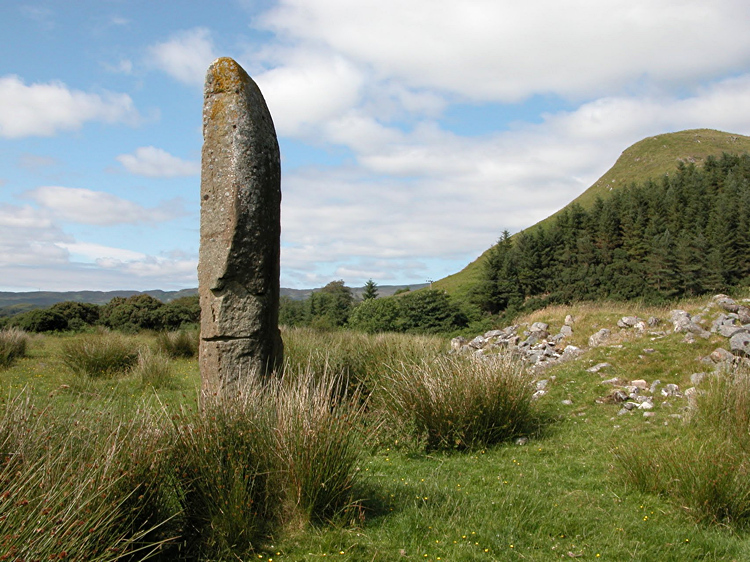
Many of these structures are arranged to reflect practical astronomical functions. This connection with astronomical features likely began with observations of the tides, the Moon, and the Sun. By tracking the Sun’s movement, it would theoretically be possible to create an accurate calendar. Similarly, although lunar cycles are more complex, it is possible to predict solar eclipses, which could have given religious leaders or prophets significant influence within their communities.
Many megalithic structures were built in positions ideal for observing the Sun during solstices and equinoxes, or the Moon at the extremes of its complex cycles across the sky. The site does not delve into the underlying beliefs that motivated people to create such monuments, but it is assumed that these sites served primarily ceremonial rather than practical purposes.
The StandingStones Web Site
I created my website http://www.StandingStones.org to offer resources for those interested in studying ancient sites and their relationships to the surrounding landscape, as well as the rising and setting positions of the sun and moon.It features a viewer that displays the historical rising and setting points of the sun and moon, with detailed landscape renderings from numerous ancient sites across the UK and Europe. It works with, and is linked from all the prehistoric site types recognised by the Megalithic Portal.
Source Data
The viewer contains data from over 24,000 sites, primarily across Europe, with most source data obtained from the Megalithic Portal.Each site features accurate landscape renderings and includes a Stellarium download, enabling even more detailed study and exploration of other astronomical relationships, such as those involving planets and stars.
Each site is accompanied by mapping data that precisely shows the sun and moon’s rising and setting positions, which can help in studying potentially related cairns and other landscape features. Some animations of sites created using Stellarium across the UK are also included for interest.
The source mapping data for the site comes from three primary sources: the SRTM (Shuttle Radar Topography Mission) dataset, UK Ordnance Survey (OS) data, and LiDAR data from the UK, Norway, and parts of Ireland.
The landscapes are generated using an application I created called OpenPanorama, which is open-source and available for download.
Astronomical Patterns of the Sun and Moon
Solstice and Equinox Positions
A solstice occurs when the Sun reaches its most northerly or southerly position. Solstices happen in winter (around December 21) and summer (around June 21).An equinox is when the centre of the visible Sun is directly above the Equator. Equinoxes occur in spring (around March 20) and autumn (around September 23).
Quarter days fall between the equinoxes and solstices, marking the midpoint between them. For the ancient Celts, these days signalled the beginning of a season, not the middle.
Lunar Standstills and Eclipses
The moon’s declination, or its angle relative to the Earth’s equator, varies in an 18.6-year cycle due to lunar precession. This cycle ranges between approximately 18° and 29° north or south. These extremes are known as the minor and major lunar standstills. Around the time of these standstills, eclipse seasons occur near the March and September equinoxes, featuring both solar and lunar eclipses.A major lunar standstill happens when the moon’s declination reaches about 28.725° north or south. This represents the moon’s most northerly and southerly rising and setting positions.
A minor lunar standstill occurs when the moon’s declination is around 18.134° north or south.
Example Sites of Interest
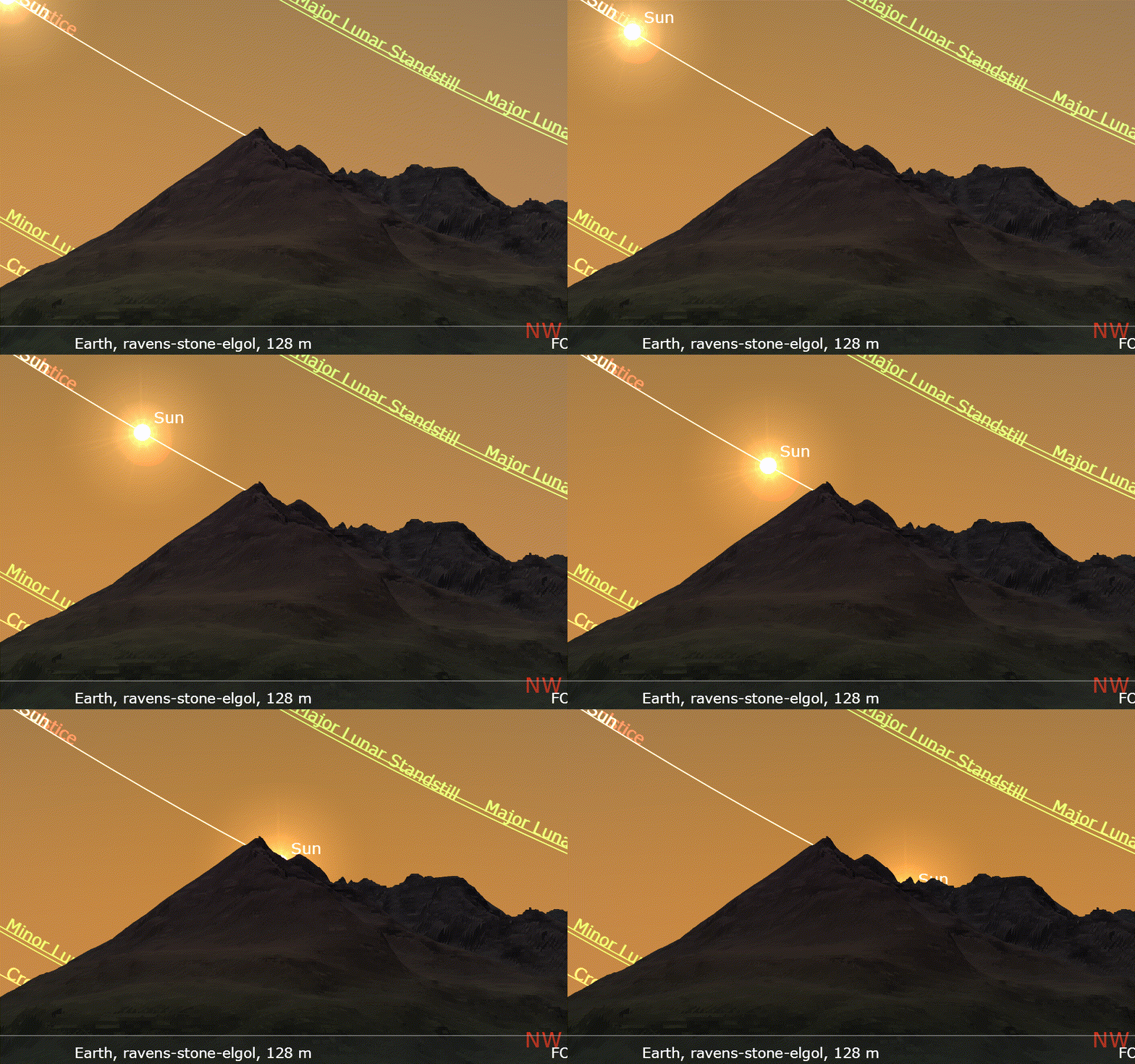
There are so many sites that are fascinating from astronomical viewpoint that it is hard to single out examples but I will try anyway to give a few good examples:Just outside of Elgol on the Isle of Skye was a standing stone (now sadly destroyed) called “Bidein an Fhithich” (the Ravens Beak – presumably it was shaped like a beak) and from there the view of the summer solstice sunset over the end of the Cullin ridge would have been amazing. The following links show the sunset using the viewer and see below a Stellarium generated animation of the same.
The view of the moon set from a stone called Tarbert on the Isle of Gigha is equally fine.
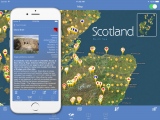
Another site that that is interesting to study is the Kintraw standing stone and the view from it of the distant winter solstice set. Before rendering this site, I didn’t realise that at midwinter, the sun first sets behind the nearby hills, then reappears, then sets again behind the distant “Beinn Shiantaidh” on Jura before peeping out for a final moment before finally setting. The location of the stone is very impressive. This map shows the various locations where the sun set occurs.
A personal favourite of mine is a stone circle in mid Wales called Moel Y Llyn which although not very impressive a circle has an amazing view of the distant Lleyn peninsula and the moon set over it.
You can find links to the horizon app from most Megalithic Portal site pages, just look for the square button as follows in the External Links section of the site page:

If anyone has any more questions then please don't hesitate to contact me, my Megalithic Portal user ID is DavidHoyle
David


 We would like to know more about this location. Please feel free to add a brief description and any relevant information in your own language.
 Wir möchten mehr über diese Stätte erfahren. Bitte zögern Sie nicht, eine kurze Beschreibung und relevante Informationen in Deutsch hinzuzufügen.
 Nous aimerions en savoir encore un peu sur les lieux. S'il vous plaît n'hesitez pas à ajouter une courte description et tous les renseignements pertinents dans votre propre langue.
 Quisieramos informarnos un poco más de las lugares. No dude en añadir una breve descripción y otros datos relevantes en su propio idioma.