

Featured: Hare and Tabor T Shirts for discerning antiquarians

Hare and Tabor T Shirts for discerning antiquarians

Random Image

Inscribed Across the Landscape: The Cursus Monuments of Great Britain

Inscribed Across the Landscape: The Cursus Monuments of Great Britain

Login

Register here - as a registered user you get more features and fewer ads.

Who's Online

There are currently, 1803 guests and 1 members online.

Sponsors

A New Dimension to Ancient Measures by Dr Thomas Gough and Peter Harris

Submitted by stockdale on Saturday, 02 October 2021  Page Views: 5749

Events
<< Books/Products >>

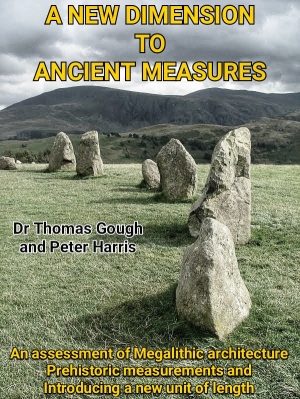
After many years of research and fieldwork, Dr Thomas Gough and Peter Harris have published the results and conclusions in their book, A New Dimension to Ancient Measures, published by Moravian Press of Elgin. The book is now available to order from the Megalithic Portal online shop.

The initial purpose of the research for this book was to establish that a unit of length, the Harris and Stockdale Megalithic Foot, (HSMF), of 1.1785 feet, as deduced by Peter Harris and Norman Stockdale and first put forward in their book. “Astronomy and Measurement in Megalithic Architecture”, Northern Earth, 2015, was known and used in prehistoric Britain.

In this new specific study, using professionally designed computer programmes and statistical assessment not available to the previous authors, the dimensions of stone circles together with other megalithic remains were used to test for use of the HSMF. An unexpected consequence of this was that it revealed much about these megalithic structures and the abilities of the builders.
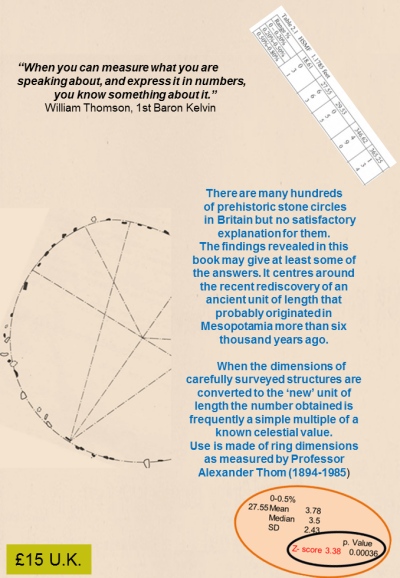
When first found the HSMF unit of length was thought to be a new discovery. However it was soon realised that it was a very ancient unit of measurement, probably originating in Mesopotamia more than 6,000 years ago.

As the analyses of stone ring dimensions using the HSMF are examined, the authors’ unavoidable conclusions are that the knowledge and expertise in prehistory was far in advance of what has been considered possible. Knowledge of the celestial values built into stone rings was not necessarily determined in Britain but had possibly been known for a long time. The fact that employment by the megalithic designers of the remains had used the HSMF in the architecture to unify geometry, important time values and astronomy, poses serious questions to our current commonly held views about prehistoric peoples and their capabilities. These issues and the implications are dealt with in the concluding chapter.

As the book provides much of the data that was used by the authors to substantiate their conclusions, it allows the reader to formulate their own opinions as to either verify or reject their proposals. More than that the book challenges readers, to themselves provide an alternative explanation for the evidence presented and subsequent claims of the authors re the validity of the HSMF. The book certainly asks the reader to reflect on the commonly held view of the megalithic people’s supposed limited knowledge and capabilities and poses some serious questions that challenge our view of history and the recent evolution of mankind.

Review: "As if I didn't already think Peter Harris' new book will be an absolute must-read, I was very pleasantly surprised to look at Peter's introductory PDF and observe that the way the data is organized lays bare the relationship between Anomalistic Month and Eclipse Year" - Robert 'Unhenged', Megalithic Portal Forum

Read the introductory PDF with more detail here (PDF)

The book is now available to order from the Megalithic Portal online shop.

There is lots more about the book, with discussions in the Megalitic Portal Forum

Please add your thoughts on this site

Prehistoric Britain

Prehistoric Britain

Sponsors

More Books/Products

See all Books/Products →

"A New Dimension to Ancient Measures by Dr Thomas Gough and Peter Harris" | Login/Create an Account | 10 News and Comments
  
Go back to top of page    Comments are owned by the poster. We aren't responsible for their content.
Re: A New Dimension to Ancient Measures by Dr Thomas Gough and Peter Harris by STOCKDALE on Friday, 25 March 2022
(User Info | Send a Message)
A new 5 star review on Amazon for our book : "A New Dimension to Ancient Measures."

Tim Rogers
5.0 out of 5 stars A well documented book that seeks to deepen our understanding of the Neolithic period.

Reviewed in the United Kingdom on 24 March 2022

This is a well researched and well-documented book that seeks to deepen our understanding of the Neolithic period in Britain.

"The authors seek to demonstrate that there existed a common unit of measurement, the HSMF, that can be found throughout the ancient world. Through a detailed process of analysis that is thoroughly documented, this measurement can also be found in dozens of stone circles across Britain. But what is special about these numbers, this measurement? The answer can be found in the precise way the moon moves across the night sky.

This is a fascinating little book that goes a long way to helping us understand the origins and meanings behind the hundreds of prehistoric stone circles that can be found across Britain and has the potential to revolutionise our understanding of the period. I would recommend it to anyone who has a serious interest in the history of neolithic Britain, stone circles and early astronomy."
[ Reply to This ]

Re: A New Dimension to Ancient Measures by Dr Thomas Gough and Peter Harris by STOCKDALE on Tuesday, 01 March 2022
(User Info | Send a Message)
Article in Ancient Origins :

https://www.ancient-origins.net/history-ancient-traditions/unit-length-0016466
[ Reply to This ]

Re: A New Dimension to Ancient Measures by Dr Thomas Gough and Peter Harris by STOCKDALE on Wednesday, 23 February 2022
(User Info | Send a Message)

I would gladly and confidently say that Peter Harris' new book with Thomas Gough exceeds even the work of Professor Thom of Megalithic Yard fame in important. Harris not only shows us an unexpected unit, but generously illustrates how to use it for the very obvious purpose of recording astronomy data and formulas.

It is therefore a work on ancient Megalithic metrology of unprecedented quality and importance, and one absolutely vital for understanding the surprising level of success Megalithic astronomers may have been able to achieve in aspiring to preserve their observations and formulas through architectural geometry and proportion. Robert Carl (Amateur ancient metrologist of long standing)
[ Reply to This ]

Re: A New Dimension to Ancient Measures by Dr Thomas Gough and Peter Harris by STOCKDALE on Friday, 07 January 2022
(User Info | Send a Message)
A New Dimension To Ancient Measures by Dr. Thomas Gough and Peter Harris

Although a slim volume, just over seventy-five pages, what it lacks in quantity it more than exceeded my expectations with respect to quality, detail, interpretation and above all, data. This is not by any means a ‘coffee table book’, it is one for those who have a serious interest in the megalithic.
Before reading this book, I was familiar with the concept of the ‘megalithic yard’ and so it should follow that there would be a megalithic foot and inch. This book sets out to describe the megalithic foot – referred to in the text as the ‘HSMF’ – Harris Stockdale Megalithic Foot and is derived from what a mathematician would describe as ‘first principles’.
With the irregularity of shapes and sizes of stones that make up megalithic monuments I was always somewhat sceptical as to how precise measurements could be made. The authors address this by describing a consistent system of defining the positions of stones and therefore a method by which exact measurements can be determined.
In the introduction the authors freely admit that the purpose of megalithic monuments remains unknown – quoting John Mitchel (1982) and Robin Heath (2007) – they do make the connection with certain celestial measurements which are subject to a high degree of statistical analysis throughout the book.
With the assumption that the builders of monuments like Stonehenge, Avebury and the like knew what they were doing a number of questions arise. First is the question of pi (π), a circle with a specific radius can be created using a central peg and a length of rope, both readily available at the time, but a circle with a specific circumference requires a knowledge of the concept of pi. As these circles predate Euclid by several centuries this presents a certain degree of speculation as to how these circles were constructed. The implication is that prehistoric man was rather more intelligent than we have given him credit for. Some of the knowledge could have been through trial and error and independent of any specific units of measurement, e.g. the correct angle for safely leaning a ladder to gain access to a high area is one unit out to four units up, i.e. a ratio. The consistency of the measurements made and calculated by the authors goes beyond this simple imperative for structural security and into the realms of functional design (the exact function will probably never be known).
A universally available resource for prehistoric peoples was the sky. The sun and moon being the most immediate objects that could be observed with the naked eye. In the book, the authors make several references to ‘anomalistic month’, ‘lunar month’, ‘eclipse year’ and ‘solar year’ and use these to analyse the measurements (and include margins of error) taken at various megalithic sites.
The great strength of this book is in the raw data that it provides and then uses to the data to explain the origin and existence of the ‘HSMF’ – Harris Stockdale Megalithic Foot. By providing the raw data the authors are almost throwing down a gauntlet – this is our conclusion, what’s yours?
The link between celestial phenomena and prehistoric society is well documented by the anthropologists linking it to the needs of the early hunter gatherers and their agriculturally based descendants. The conclusion that because of the celestial elements places like Stonehenge were giant calculators, the solstices and equinoxes being important station points of the year, is both reasonable and understandable but and it is a big ‘but’, why was there such a high degree of consistency of measurements (units of length) all across Europe and the ancient civilizations of Egypt, Mesopotamia, the Indus Valley and Babylonia? I suspect these questions will remain
unanswered but this book gives the reader the opportunity to test their own scenarios based on sound measurements and a rigorous description of their limits, accuracy and variability.

Julian A J Rutherford B.Sc., M.Sc.
[ Reply to This ]

Re: A New Dimension to Ancient Measures by Dr Thomas Gough and Peter Harris by STOCKDALE on Tuesday, 21 December 2021
(User Info | Send a Message)

Book Review

A New Dimension to Ancient Measures
Dr Thomas Gough and Peter Harris
Pub. 2021
ISBN 978-1-919648408
Dr Thomas Gough and Peter Harris work together to deliver conclusions about geometric measurements at ancient sites.
Years of research into Britain's ancient monuments and a reinvestigation of many of Alexander Thom’s measurements have led the authors to draw conclusions about a universal measurement. They outline how this has been used at prehistoric sites, within rock art and astronomically linked objects such as the Bush Barrow Lozenge. This is a concise book of 51 pages and appendices, that is illustrated with colour photographs, plans and maps. The short length does not negate the deep dive investigation which is within the text. Not only is the methodological approach and the direction of inquiry outlined. It also contains the collected evidence and conclusions, all given in an accessible form. The introduction covers a discussion about the discovery of the...

Read the rest of this post...
[ Reply to This ]

Re: A New Dimension to Ancient Measures by Dr Thomas Gough and Peter Harris by STOCKDALE on Wednesday, 08 December 2021
(User Info | Send a Message)
It's a real pleasure to announce that Dr Thomas Gough and myself will be speaking at the Megalithomania conference next May in 2022.

We will also be speaking at Neil McDonald's Mysterious Earth conference in Lancashire in September, 2022.

Both occasions will be to talk about the discovery of the HSMF and our new book, 'A New Dimension to Ancient Measures'.

More details to follow. Hope to see some of you there!
[ Reply to This ]

Re: A New Dimension to Ancient Measures by Dr Thomas Gough and Peter Harris by STOCKDALE on Tuesday, 30 November 2021
(User Info | Send a Message)
"Your book and its findings are a positive contribution to the studies of ancient sacred sites."

Peter Knight

Peter Knight - Dartmoor Mindscapes - Re-Visioning A Sacred Landscape. Living in Wiltshire and close to the magical landscape of Avebury, Peter is well known in the South for his entertaining and enthusiastic workshops, convention lectures and field trips. He is an authority on our ancient landscape and weaves this wisdom into his many books. Peter is co-founder of the Dorset Earth Mysteries Group, an Honorary Member of the Dorset Dowsers, Antiquarian Society and the Wessex Dowsers as well as sitting on the committees of the Wyvern Dowsers and Society of Ley Hunters. As a freelance magazine writer, his work has appeared on radio and TV, most notably on Channel 4 with Monty Don in Don Roamin’.
[ Reply to This ]

Re: A New Dimension to Ancient Measures by Dr Thomas Gough and Peter Harris by STOCKDALE on Saturday, 27 November 2021
(User Info | Send a Message)
Book review: Dr. Thomas Gough and Peter Harris ‘A New Dimension to Ancient Measures ' by Chris Snook, Archaeology Plus Ltd.

The authors fully acknowledge their debt to Alexander Thom, who revolutionised the study of megalithic structures in Britain and France with his series of books, (one with his son Archie). The Megalithic Yard was Thom’s bombshell deduction, with the battle for recognition still running after 40 years. Euan Mackie, using sites in Scotland, broadly concurs with Thom’s claims. In contrast, Clive Ruggles’ re-evaluation of Thom’s fieldwork made him suggest that Thom’s ‘millimetre accuracy’ claims were not substantiated.

The same problems arise for the new definition of the ‘Harris Stockdale Megalithic Foot’, or HSMF, which it is claimed by the authors allows for the application of basic geometry to create the key aspects of circles devoted to lunar and/or solar measurements. It is relatively easier to get accurate dimensions for the Great Pyramid of Cheops/Khufu...

Read the rest of this post...
[ Reply to This ]

Re: A New Dimension to Ancient Measures by Dr Thomas Gough and Peter Harris by STOCKDALE on Friday, 19 November 2021
(User Info | Send a Message)
I am really pleased to say that this month's Northern Earth journal has just published a review of our new book written by Dr John Hill, Liverpool University.

The book is available for sale from the Megalithic Portal bookshop, found under Earth Mysteries or directly from myself on: [email protected]

This is what it says:

A NEW DIMENSION TO ANCIENT MEASURES
Thomas Gough & Peter Harris
Moravian Press, 2021. 76pp, £15. 978-1-9196484-0-8

This book continues in the direction of the theories of Alexander Thom and his Megalithic Yard, but with an interesting twist. Here we see the
discovery of a new unit of measurement, the Harris and Stockdale Megalithic Foot (HSMF), some 1.1785 feet long.

What I like about this book are the three methods in which the evidence for the existence of the HSMF has been gathered and presented.

Firstly, it is the result of almost 50 years of painstaking research of survey and
investigation.

Secondly, the quantifiable mathematical data...

Read the rest of this post...
[ Reply to This ]

Your Name: Anonymous [ Register Now ]
Subject:


Add your comment or contribution to this page. Spam or offensive posts are deleted immediately, don't even bother

<<< What is five plus one as a number? (Please type the answer to this question in the little box on the left)
You can also embed videos and other things. For Youtube please copy and paste the 'embed code'.
For Google Street View please include Street View in the text.
Create a web link like this: <a href="https://www.megalithic.co.uk">This is a link</a>  

Allowed HTML is:
<p> <b> <i> <a> <img> <em> <br> <strong> <blockquote> <tt> <li> <ol> <ul> <object> <param> <embed> <iframe>

We would like to know more about this location. Please feel free to add a brief description and any relevant information in your own language.
Wir möchten mehr über diese Stätte erfahren. Bitte zögern Sie nicht, eine kurze Beschreibung und relevante Informationen in Deutsch hinzuzufügen.
Nous aimerions en savoir encore un peu sur les lieux. S'il vous plaît n'hesitez pas à ajouter une courte description et tous les renseignements pertinents dans votre propre langue.
Quisieramos informarnos un poco más de las lugares. No dude en añadir una breve descripción y otros datos relevantes en su propio idioma.