
The Spiritual Landscape
Submitted by Thorgrim on Friday, 04 November 2005 Page Views: 14294
MysteriesCountry: England County: SomersetInternal Links:

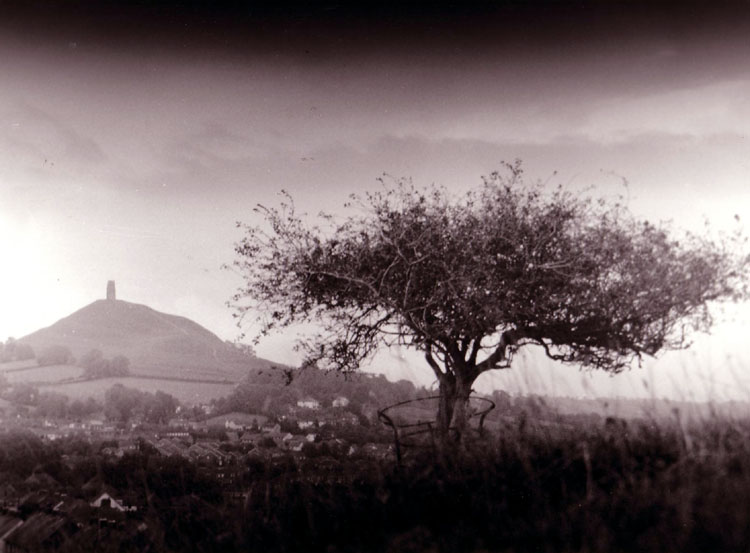
Very early one October morning, I climbed Glastonbury Tor in thick mist. I saw nothing but the ground before me until, as I neared the summit, I came out of the fog into brightness. The sun had just cleared the eastern horizon and shone upon a sea of golden pink. Distant islands floated on the mist and I looked across to mythical Camelot at South Cadbury. To the north, the long line of the Mendips led my eye westward to lonely Brent Knoll and then on to the distant Quantocks. The nearby island of Wearyall Hill with its Holy Thorn was just across a channel of soft pink sea and it seemed perfectly possible to wade across to magical Chalice Hill. Then came the certainty that this was how the landscape would have looked many years ago before the Levels were drained, when Somerset was truly the Summer Land and the hills were islands in a winter born lagoon. I stood on the island Tor - enchanted. Gradually and then more surely, the sun climbed higher and the mist evaporated. The islands became rooted to the earth and the mundane ugliness of rooftops and chimneys, then houses and streets became the familiar reality. But what of the landscape that I had seen but minutes before? Had it no reality? Was it just an accident of time, an illusion of mist, a trick of perspective? I have been back many times, but have never recovered that lost fleeting landscape. The physical landscape is still there, but what of the spiritual landscape that I experienced on that misty morning? How can I revisit that?
What is it about certain landscapes that can move us to joy and even tears of emotion? Is there a harmony of shapes and colours that trigger a response that we know, but cannot define? We gasp when we come upon it unawares, we seek it where we know it might be, we weep when it is destroyed by new roads or power cables and we seek to reproduce it endlessly in photographs and paintings. But why? What does it have that other scenes lack? What are the essential ingredients and how are they to be arranged to satisfy our elusive quest? In China and Japan, much is made of landscape harmonies and disharmonies. Landscape engineering was often carried out to place hills in just the right place. Are we trying to regain something that we feel we have lost - the Garden of Eden or Shangri-La? Or do we have deep in our sub-conscious a mental ideal landscape? When we see something that comes close to resembling it - we gasp at the sudden recognition. But where does that ideal landscape come from - is it inherent or acquired?
Do you know of a favourite landscape that you are intimately familiar with? You know every mountain, river, forest and plain. You know its history and you know its people, but you have never been able to go there in person. Perhaps your landscape is far away in Tibet or South America, perhaps it was long ago when intrepid adventurers began to explore Africa. Perhaps you know the sacred landscape of Salisbury Plain when Stonehenge was new or the streets of ancient Rome. Perhaps your intimate landscape never had a physical existence at all, but you know it well. If it is Gondor or The Shire you can talk about it for hours to others who know it as well as you do. You know its geography and you know its history. You know how to journey from Bree to Rivendell and you know the upper and lower routes across the Misty Mountains. But you cannot go there by car or plane and Thomas Cook does not run a package tour. Does that mean that it doesn't exist - it has no reality? You know that it has reality, because you have seen it, but from a different perspective. Is that just an imaginary perspective or does it sometimes become a tangible reality?
Does any landscape have substance or is it merely perspective? Stand at Point A and you may see a valley between two mountains - stand at Point B and you may not be able to see the valley at all. Go down into the valley and you may only be able to see one mountain or the other, but not both at the same time. Of course the land is constant, the geography conforms to the map, but the landscape depends entirely on your perspective - the point that you choose to view it from determines your perception and the landscape that you see. So that introduces the element of choice. How many ways are there to perceive the physical geography? North, east, south and west - above and below, from a car, on foot or in a hot air balloon. The scene will look so very different after snow or in bright sunshine, in mist, at night, at sunset - so that brings in weather, light and time. With all those variables and infinite combinations of viewpoint, light, weather and time - what is the reality? What does the landscape really look like? Has it any reality? Is it real or an illusion born of time and spatial relativity? Go down the hill from your viewpoint and into the landscape and it is not there when you arrive. To find it again, you have to go back up to your original viewpoint.
So which is real – the physical landscape which is entirely dependent on your chosen viewpoint or your own inner spiritual landscape? Why not tell us about yours?


 We would like to know more about this location. Please feel free to add a brief description and any relevant information in your own language.
 Wir möchten mehr über diese Stätte erfahren. Bitte zögern Sie nicht, eine kurze Beschreibung und relevante Informationen in Deutsch hinzuzufügen.
 Nous aimerions en savoir encore un peu sur les lieux. S'il vous plaît n'hesitez pas à ajouter une courte description et tous les renseignements pertinents dans votre propre langue.
 Quisieramos informarnos un poco más de las lugares. No dude en añadir una breve descripción y otros datos relevantes en su propio idioma.