
The Great Stone Circles – How they Work Part 6b
Submitted by JACKME on Saturday, 16 July 2005 Page Views: 5089
Neolithic and Bronze AgeCountry: England County: Cumbria Type: Stone CircleInternal Links:


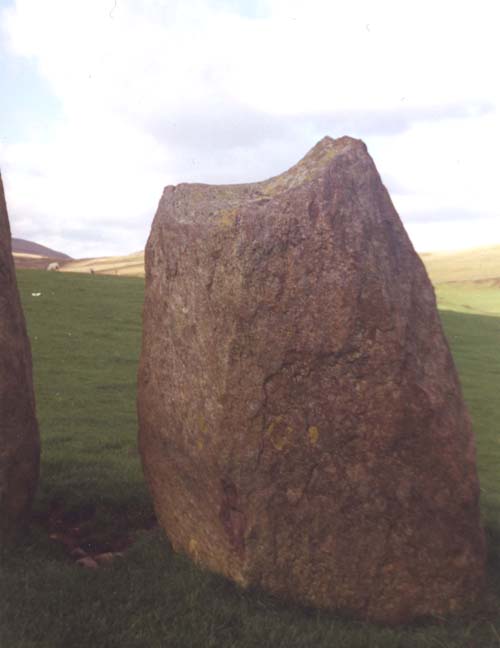
The Moon Cycles - Swinside Moon Northern Rise.
At Swinside there are stones further north of where the sun could ever have possibly risen, and upon closer inspection I discovered one of these seemed to be shaped like a crescent moon (stone 2 – see photo above). A simple computer program showed that the Moon Major Standstill Most Northerly Rise (MMaSMNR ) was at about 36 degrees, and taking a back bearing from Stone 2, the target turned out to be Stone 39 (the back sight for the Midsummer sunrise) as seen in this diagram. When I approached this stone, it appeared that the stones across the circle all lined up with prominent features on the skyline. These included hill peaks, dips and other features which looked as if they had been manmade such as a shaped rock, a fallen standing stone and a boulder perched on the crest. Elsewhere mounds have been created. This strongly suggested nine steps equalling the nine years between the MMaS and MmiS with the boulder making ten, another step over Stone 10, which is a tabletop type altar stone.Stone 39 is a fallen diamond shaped stone with a point at the top. The thickness of this point, when viewed over would have given a slightly different sight in comparison to a theodolite pivoting on a sharp point. These constructions are so accurate that this type of difference shows time and again. If we assume that roughly half of the moon rises and half of the sets are at night time, this does not explain why they built skyline markers for the moon which we cannot be seen in the dark. Whilst equally the other way round during daylight hours, the moon is difficult to see.
It appears therefore that the ancient builders went to tremendous efforts to provide skyline markers for the moon rises and sets between the Major and Minor Standstills. Where the skyline had no suitable natural markers they used a nearer horizon, and built their own markers, as is shown in these next three photos of the markers around Swinside including the shaped rock on Thwaite Yeat , the fallen standing stone and the boulder on the crest . In many other places they dug away the ground from below rocks to emphasise the line or used mounds as can be seen at Castlerigg on Latterig and elsewhere. These were most probably never designed as burial mounds or barrows as they are often called.
There are four sectors where the moon rises or sets between the Moon Major Standstills (MMaS) and Moon Minor Standstills (MMiS), and all of these are visible at Swinside, and indeed all of the Great Circles that have been visited. Everywhere these annual steps are indicated by the stones, using the same principles but with some variations on the theme. Each sector has the 10th position over an altar shaped stone which is at the southern end of the sector where the moon passes each time. It is next to the Minor Standstill in the northern sectors and the Major Standstill in the southern sectors.
It took a great deal of time to confirm the observation or back sight stones for the other three sectors at Swinside, but in the end it was quite simple, with the moonrises seen from the back sights used for the solstice sunrises, and the solstice sunrise triples used as back sights for the setting moons. It should be noted however that it does not happen this way at all the circles.
The only piece left in the jigsaw then was Stone 1, a moon shaped pointed stone with no obvious moon use - the moon could never have been seen in this position over the hills. Eventually I realised that Stone 1 marked the MMaSMNR on a flat plain at a very early date, which I have termed ‘the invisible MMaSMNR’. It is difficult to understand how and why did they did this, but it demonstrates that the builders were aware of this fact and able to mark it out.
I shall continue with the moon phases at Swinside next week.
Contents page for the whole series is here
Note: This is the ninth of a series of previously unpublished articles by retired farmer, Jack Morris-Eyton.


 We would like to know more about this location. Please feel free to add a brief description and any relevant information in your own language.
 Wir möchten mehr über diese Stätte erfahren. Bitte zögern Sie nicht, eine kurze Beschreibung und relevante Informationen in Deutsch hinzuzufügen.
 Nous aimerions en savoir encore un peu sur les lieux. S'il vous plaît n'hesitez pas à ajouter une courte description et tous les renseignements pertinents dans votre propre langue.
 Quisieramos informarnos un poco más de las lugares. No dude en añadir una breve descripción y otros datos relevantes en su propio idioma.