


The Great Stone Circles – How they Work Part 15 Stonehenge Re-visited
Submitted by JACKME on Monday, 16 June 2008 Page Views: 5199
StonehengeCountry: England County: Wiltshire Type: HengeInternal Links:


Click here to download a PDF version including the images.
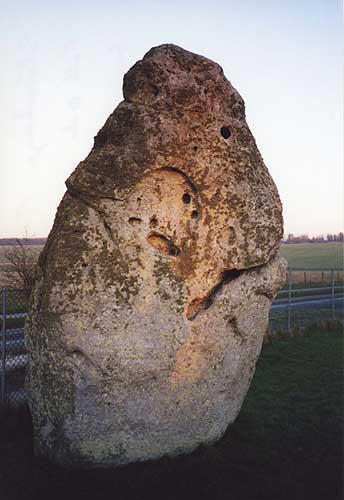
Fig 1. The Heel Stone lit up by the setting sun at Full Orb on 5 January 2003.
In my original article I got it slightly wrong, because I deduced what I expected would happen rather than waiting and observing. I asked Angie Lake to dowse around the outside of the circle to look for force lines which I suspected went to the important Sun and Moon rising and setting positions along the skyline. These she found.
When we had finished three separate inner and outer circuits for my survey, she dowsed again for the most important part of the circle. Her rods pointed to Stone 16. At the time we thought they could be pointing through that stone to the Great Trilithon, which I had always assumed was the Great Stone of the circle (see my article number 5a). Angie took several photos but it was not until they were developed that she noticed the symbol of an inverted V mark on the stone. Upon closer inspection it appears that there are the tops of legs on either side of it. This symbol can never have received the direct sunlight at the First Gleam, but does do later because Stone 56 (the Great Trilithon leg that remains standing) is positioned directly in front of it. I have always wondered why the great Trilithon did not receive any rising sunlight in the midwinter period. However, this discovery suggests that the Great Stone is this Goddess Stone, which does receive the sunrise light both at Midwinter and at the Festival of the Returning Sun (FORS) on Jan 6th.
On a previous visit Angie had considered through dowsing that the most important place was the area between the Great Trilithon and Stone 16. There has therefore been consistency in her dowsing and it is possible that these two stone arrangements were created as a sacred area and not just one stone. I am not going into the realms of religion in this article, merely keeping to what I can observe. I will let others work out the religious part.
Fig 3 shows the First Gleam, past Stone 16 in the foreground, over 14(f) & 12(f) on 18.12.07. There are no signs on the ground showing exactly where Stone 13 stood. It is presumed that its position would have created a sharp beam of light on to 16 at First Gleam at the time of construction. Fig 4 shows First Gleam past the bulge in stone 16 as seen on 2nd January 2007.
Today we see the Midsummer Solstice sunrise from the southern edge of Stone 56, over the Heel Stone (Fig 5). This is roughly where it was at the Full Orb stage at the time of construction.
The shaft of light is expected to strike the edge of Stone 16 at the next stage of the sunrise, just before the Sun disappears behind Stone 1. To be checked next summer, hopefully weather permitting.
Later still, after about an hour, the Sun should shine on to the inverted V symbol, when it has risen above the outer lintel over Stone 2. It would have shone through the gap between the two legs of the Great Trilithon at the point where there is a broken notch in the edge of Stone 56. This has not been observed, only surveyed with a theodolite. Unfortunately it was difficult to guarantee that the theodolite was exactly in line between the V and notch in Stone 56, meaning the survey might not be as accurate as it should be, hence the comment ‘about an hour’. Readings were 62°25’from North and an elevation of 8° 20’. An attempt was made to assess the gap width between stones 55 and 56 by measuring the fallen lintel, but no satisfactory result was obtained because the mortise holes are not evenly spaced (being 28 and 53cms from the ends of the lintel) and sadly the tennon on the top of Stone 55 has been knocked off.
I expect the sunlight to show as a notch in the shadow cast by Stone 56, and if I am correct, it will be a little out in height on Midsummer’s Day. Those of you there on that day will have to observe and tell me if I am wrong.
While doing this survey I spotted this image on the inside face of Stone 56 (fig 6) which would probably have been lit up by the Full Orb of the Midsummer Sunrise.
Midwinter Sunset.
The last gleam of the midwinter sunset on Dec 18th 2007 was lost in the murk and the trees on the skyline, but appears to align from the Heel Stone, touching the right hand corner of the Slaughter Stone, past the left hand edge of Stone 56 out to Mound 15 in front of Normanton Furze – see fig 7.
This is the same place that the Full Orb of the Sun was seen on Jan 5th 2003. Unfortunately the cloud has made the photo not worth showing on a small scale, but it did light up the circle on the face of the Heel Stone, as seen above. The light from the Last Gleam of the midwinter setting sun is never strong enough even without cloud to do this.
This therefore confirms my original article (no 13), that the orientation of the axis of Stonehenge at the time of construction, was the Sun’s Full Orb position of the sunrise at the summer Solstice over the Heel Stone, when seen from the south edge of Stone 56. In the opposite direction it is from the Heel Stone, at the period of the Festival of the Returning Sun (FORS) on Jan 6th, past the southern/left edge of Stone 56, to Full Orb over Mound 15.
Article by Jack Morris Eyton with contributions from Helen Denton and Angie Lake,
Click here for more articles and contributions by Jack.
Note: The latest instalment of Great Stone Circles, How they work by Jack Morris-Eyton

 We would like to know more about this location. Please feel free to add a brief description and any relevant information in your own language.
 Wir möchten mehr über diese Stätte erfahren. Bitte zögern Sie nicht, eine kurze Beschreibung und relevante Informationen in Deutsch hinzuzufügen.
 Nous aimerions en savoir encore un peu sur les lieux. S'il vous plaît n'hesitez pas à ajouter une courte description et tous les renseignements pertinents dans votre propre langue.
 Quisieramos informarnos un poco más de las lugares. No dude en añadir una breve descripción y otros datos relevantes en su propio idioma.