
The Great Stone Circles – How they Work Part 13
Submitted by JACKME on Monday, 05 December 2005 Page Views: 13215
Neolithic and Bronze AgeCountry: England County: Wiltshire Type: Stone CircleInternal Links:


The Orientation of Stonehenge
The builders of Stonehenge along with the other great circles of Swinside, Castlerigg, Long Meg and Arbor Low all celebrated ‘The Festival of the Returning Sun’ (FORS) on the 6th January as their most important festival. I am calling it this because it was there long before the people often referred to as the Celts appeared, so we should not use their name for it. They erected stones aligning to the Full Orb, (that is when the sun appears to break contact with the Earth), both in the morning and in the evening, when the setting sun is exactly opposite the midsummer rising sun at Stonehenge at the time of construction.In approximately 2000BC the ancients counted forward 19 days from the solstice, to make their year 13 moons. The Moslem Faith on the other hand uses 12 moons to the year and moves Ramadan back 11 days each year. By using the computer program Redshift 3, it tells us that today the sun rises at the same azimuth on the 17th day after the winter solstice as it did on the 19th day after the solstice in 2000BC, giving us the date of January 6/7th.
Or it could just be that on this date, because of the nearly level skyline at Stonehenge, the Full Orb of the FORS setting sun is positioned exactly opposite where the Full Orb of the rising summer solstice sun would have been at the time of construction over the Heel Stone. There is no shaft of light or shadow at the First Gleam because the Sun is too weak at this stage. The layout is designed to throw a shaft of light through the gap between the legs of the Great Trilithon at this time to strike the edge of Stone 15, a bun shaped alter type. This could be the reason why all the ‘experts’ have failed to note this very accurate occurrence, as they have assumed that the First Gleam was the most important. All the main Great Circles follow the same basic principles. However, at the other circles, because of their varying skylines, this straight through alignment does not occur, which suggests that the number of days from the solstice fixes this festival.
At Stonehenge the evening sunset on FORS was the most important of the year, and is the one major solar event which can be seen by all entering the site as a public visitor. In order to give people two chances to see this sequence I am putting this on now, so that you can go and have a look between December the 3rd and 8th, and again around January 6th. The sun is in the same position on both of these dates. Note that December 5th is the Festival of Aphrodite and January 6th is Epiphany in the Christian calendar.
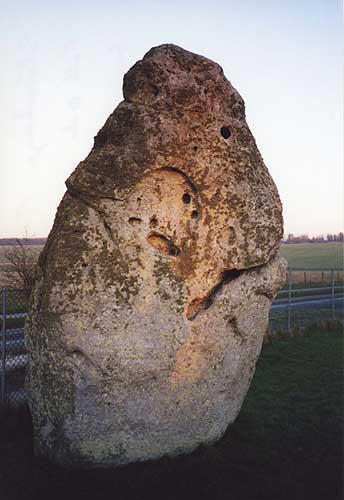
Whilst waiting for the sun to go down watch from the western end and see the effect of the shadows of the lintels moving up the Heel Stone as in this photograph. Don’t leave it too late before going around to the Heel Stone, because if you are lucky with the evening murk and low cloud, you will see the full sun over the Slaughter Stone, past Stone 56 (the Great Trilithon) just touching mound 15 by Normanton Furze, at the same time as the light shines onto the Heel Stone as pictured here.
The shaft of light strikes the Heel Stone lighting up the incised circle as in the photo above. How many thousands of people have walked past this and not noticed it?
It is possible that had the other leg of the Trilithon been standing, the notch in Stone 56 would have matched the facture in Stone 55, and would have cast a round circle of light onto the incised circle in the Heel Stone, as it does in at least one other place in the circle at Stonehenge. Unfortunately this has not been fully observed on the correct date and was just off target both times it was watched.
There are possibly several other incised circles etc which, it is guessed, will do the same thing, but due to time, distance, and having to book private access research time weeks in advance, three out of my last four private access entries have failed due to the weather. Research has virtually stopped until a local assistant can be found and better arrangements can be made with English Heritage. So far I have driven over 15,000 miles undertaking research on Stonehenge alone, and many more miles with all the other sites visited.
At the time of construction the First Gleam of the midsummer Solstice was viewed from right hand side of Stone 55 (the fallen leg). The Full Orb shaft of light went through the gap between the legs striking the edge of Stone 15, a bun shaped alter stone and the Full Orb +2 was seen from the left hand side of Stone 56. Another case of side steping as seen with the Moon at Castle Rigg. Now it rises just to the left of the point of the Heel Stone, when viewed from the same place as seen here.
These two alignments are directly opposite each other providing the centre line for Stonehenge.
In order to witness this, it needs to be a very clear evening, otherwise the sun disappears into the murk at the critical time. Please tell us all at the Portal if you are lucky. It would be fantastic to confirm that this is the orientation of Stonehenge, and not the midwinter sunset as some people hopefully imagine is the centre line.
Next: Midwinter Solstice - Comparing four circles
Contents page for the whole series is here
Note: This is the seventeenth of a series of previously unpublished articles by retired farmer, Jack Morris-Eyton.
Are you planning a visit to Stonehenge in the next week? If so we’d love to hear from you, especially if you are able to confirm Jack’s observations on the amazing sequence of events that takes place there at sunset at this time of the year. If Jack is correct, his research could revolutionise theories on the purpose of Stonehenge.

 We would like to know more about this location. Please feel free to add a brief description and any relevant information in your own language.
 Wir möchten mehr über diese Stätte erfahren. Bitte zögern Sie nicht, eine kurze Beschreibung und relevante Informationen in Deutsch hinzuzufügen.
 Nous aimerions en savoir encore un peu sur les lieux. S'il vous plaît n'hesitez pas à ajouter une courte description et tous les renseignements pertinents dans votre propre langue.
 Quisieramos informarnos un poco más de las lugares. No dude en añadir una breve descripción y otros datos relevantes en su propio idioma.