
Review of Cave of Forgotten Dreams Film Premier and live Q+A with Werner Herzog
Submitted by Andy B on Wednesday, 23 March 2011 Page Views: 9210
Natural PlacesCountry: France Type: Cave or Rock ShelterInternal Links:

Only one film is being made inside the cave, due to its fragile nature and the need to protect it from damage such as the mould caused by too many people visiting Lascaux cave. Werner Herzog was fortunate to get permission, in preference to many French directors. He spoke about this in the Q&A afterwards, there was an agreement to make the film for a nominal fee, and it is copyright free for French educational establishments. Presumably he earns from international cinema showings such as last night's premiere. It also helped that the French minister of culture was a fan of his work.
Getting back to the film, my companions and myself found the 3D to be extremely effective and clear. We didn't experience the distracting 3D speckling complained of by one reviewer - apart from in one short dark segment.
Overall it was a serene affair, Herzog didn't whizz the camera apart from a couple of 'wake you up' sequences. The motion was generally very smooth and there were some clever shots over the water of the nearby river arch. I was left wondering how these were done until at the end of the film the remote control helicopter operator swung into view as part of a long fly-past. This was deliberate, the production process was part of the story and this was fine.
In the cave there were just four crew allowed including Herzog, all carrying battery powered LED light panels. The lighting, although limited was well done, with the lights gradually panned to reveal details of the art, and the sparkling calcite on the cave walls, which seemed at times to interact with the dark outlines of the animals. There were a couple of sequences attempting to simulate flaming torches, these didn't really work and I wondered whether the flickering electric LED candles that are now available could have been used to good effect.
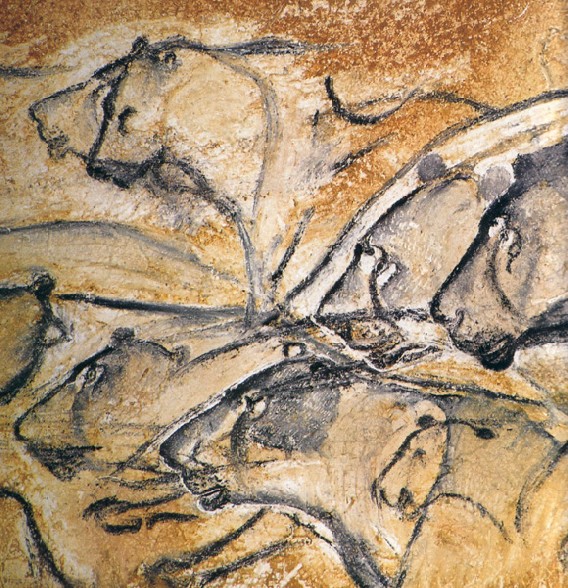
The cave art is remarkable of course, and the 3D does exactly what is expected, allowing you to appreciate the shape and form of the surfaces and how they interact with the paintings. Many of the animals were drawn in multiple poses, suggesting movement in a kind of proto-animation. Male and female animal heads seemed in some cases to be superimposed, either next to each other, or is there some suggestion of shape shifting or fluidity – this was discussed later in the film. The scientists and art historians are also beginning to work out a chronology for the overlapping images which is interesting.
We were taken on a flythrough of 3D points based on a complete laser scan of the cave. Impressive, but I would have liked to see a bit more of this, perhaps showing where the paintings are in the cave.
The crew managed to film in some very inaccessible locations, including putting a small camera out on a long pole to view what is painted around a big stalagmite or 'rock pendant', thought to be a plump female torso overlaid with a bison. This is the only human representation in the cave and led on to a discussion of 'Venus' statuettes, with the 3D being used well to show a big collection from a museum in Germany, some of which were new to me. I wasn't able to catch the names of any of the museums or scientists shown as the captions were very quick and it's very difficult to write in the dark wearing 3D glasses! I'll research and add some of this information shortly.
There were insightful interviews, with one mustachioed archaeologist making more 3D spectacle by launching a quite sophisticated spear with a spear thrower. (Bow and arrow had yet to be invented.)
Hearing of the plan to recreate the cave in its entirety as part of a theme park, complete with smells, Herzog searched out a slightly eccentric master perfumier who said one of his pastimes was to try and 'sniff out' the locations of undiscovered caves by their unique smell. Whether this was successful seemed somewhat doubtful – Herzog later told in the Q&A that he didn't think the cave smelled of anything much at all.
We weren't able to see everything due to the limitation of staying on the metal walkways, but not only is there cave art, the floors of the cave are littered with large animal bones and skulls. Some of these have calcified into strange stalagmites. There are also fresh looking footprints and some extraordinary rippling formations on the floor. We were shown an area of the cave where ancient people had rubbed flaming sticks, presumably to rekindle them, here they managed to get a radiocarbon date of 28,500 years ago.
Herzog has a reputation for an idiosyncratic approach to structure and commentary, which seems well loved by his followers – the audience seemed mainly composed of film buffs rather than prehistory enthusiasts. However he was thoughtful enough to allow space for the original art to make its impression on you on without imposing his own ideas.
The time was well used with long slow pans of the rock surfaces, accompanied by sparse modern music with multiple voices and stringed instruments in complex harmonies. The length of these sequences served to get you in a relaxed and almost floaty and insightful state of mind, the music and panning images building in intensity, then we were jolted outside to the bright sunlight for a rather pointless concluding interview with the spear-throwing mistouchey bloke from earlier. I felt the end should have carried on building the with the pans around the walls and the music crescendo, then gently introduce the credits and you'd feel thoroughly satisfied and end on much more of a 'wow'.
There was a strange postscript which other film reviewers seem to focus on, where he muses about some albino crocodiles he found in a nearby jungle park. They made a fun subject for the 3D but it amounted to a little Herzogian distraction tacked on the end and nothing more.
Finally we were whisked via live link to the Ritzy Theatre in Brixton for the interview with Werner Herzog. He explained how he first got interested in cave paintings as a boy, earning his own money to buy an expensive book on the subject. He talked of his approach to documentary making, where he likes to be 'ice cold, like a surgeon' in his approach, and yet to tell stories rather than just pile fact on fact. He is demanding of his interviewees but feels he has a knack of a careful listening approach that extracts the most out his subjects.
The questions from the audience were good and my question was answered: no he didn't dream of the cave while making the film. He says he doesn't seem to have dreams at all. However one of the archaeologists interviewed in the film did talk of dreams, and feeling quite overwhelmed with being in the cave, needing several days outside again to 'absorb' the experiences. Other cave visitors also spoke of feeling watched and overlooked in some parts of the cave in quite a profound and creepy way.
With the History Channel and More 4 involved Cave of Forgotten Dreams will presumably by on the TV in 2D in the not too distant future, so perhaps wait for that if you can't get to the full 3D experience. The producers no doubt have an eye on possibilities for 3D TV but that's something for another day. Well worth finding in 3D if you can.
Review by Andy Burnham of the Megalithic Portal - you are welcome to reproduce of this review as long as you include this credit and a link back to this page.
There is more about the film on our main page for Chauvet Cave.
Note: An exclusive report from Tuesday night's film premier


 We would like to know more about this location. Please feel free to add a brief description and any relevant information in your own language.
 Wir möchten mehr über diese Stätte erfahren. Bitte zögern Sie nicht, eine kurze Beschreibung und relevante Informationen in Deutsch hinzuzufügen.
 Nous aimerions en savoir encore un peu sur les lieux. S'il vous plaît n'hesitez pas à ajouter une courte description et tous les renseignements pertinents dans votre propre langue.
 Quisieramos informarnos un poco más de las lugares. No dude en añadir una breve descripción y otros datos relevantes en su propio idioma.