
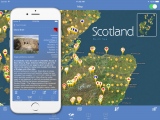
Featured: Explore Scotland (and everywhere else) with our Megalithic Portal iPhone app

Explore Scotland (and everywhere else) with our Megalithic Portal iPhone app

Sacred Stones in Indian Civilization: with Special Reference to Megaliths

Sacred Stones in Indian Civilization: with Special Reference to Megaliths

Login

Register here - as a registered user you get more features and fewer ads.

Who's Online

There are currently, 740 guests and 5 members online.

Sponsors

New 'Virtual Dartmoor' Website Devon

Submitted by AngieLake on Saturday, 03 February 2007  Page Views: 7360

Resources

<< News >>

Country: England County: Devon
Internal Links:

From today's Mid Devon Advertiser [2nd Feb 2007]:

"Virtual moor a big hit. Dartmoor National Park has gone virtual - allowing you to take a trip to the heart of the beauty spot while remaining in the comfort of your own home.

The Virtually Dartmoor website was designed and built by Ashburton-based web design company Integralvision.

Combining recorded memories, archive photos and panoramic images, it has created interactive tours through conifer plantations and prehistoric archaeological sites to a medieval longhouse and even a gunpowder factory. Since its launch, it has been visited by more than 30,000 people from more than 70 countries around the world.

Postbridge is the latest location to be added to the website. The site features specially commissioned 360 degree photographs, which guide the online visitor around the area and record a variety of local residents, features and specialities.

Becky Newell, oral history project officer at DNPA, said: "These tours provide a unique opportunity for those who are unable to visit Dartmoor in person to get a flavour of the place.

It offers those who are planning a visit to the moor the chance to find out more about the area, and it gives those who have visited in person the chance to revisit and learn more detail about what they have seen."

To take a look, log on to:

virtuallydartmoor.

I tried this tonight and was quite impressed. AngieLake.

Please add your thoughts on this site

Prehistoric Settlements

Prehistoric Settlements

Sponsors

More News

See all News →

"New 'Virtual Dartmoor' Website" | Login/Create an Account | 2 News and Comments
  
Go back to top of page    Comments are owned by the poster. We aren't responsible for their content.
Peat bogs yielding secrets of Dartmoor's history by neolithique02 on Wednesday, 03 October 2012
(User Info | Send a Message)
What did Britain look like before mankind turned up and started changing things thousands of years ago? It's a question many people ask – and now some answers are being found on the roof of Dartmoor.

Using the latest technology in two separate projects, scientists have been delving into the moor's infamous peat bogs to find out what the world was like when extinct creatures like the giant aurochs were still roaming around the South West.

Palaeoecological and archaeological surveys of Dartmoor Mires Project restoration areas have been undertaken by Dr Ralph Fyfe and his team at the University of Plymouth, while Dr Phil Newman has produced an extensive and up-to-date study of the peat-cutting industry on the north moor.

And the work has been uncovering some unexpected results, according to a spokesman from Dartmoor National Park Authority (DNPA).

"The study tells us that from 9,500 BC until the early Bronze Age, the landscape of Dartmoor was different to the peat-covered moors that we are so familiar with today – instead, a mosaic landscape composed of bog and dry land was more recognisable for the prehistoric inhabitants of Dartmoor.

"This effectively confirms the likelihood of archaeological remains surviving both beneath the peat and also within it," said the spokesman.

"Pollen analysis has also revealed that the uplands were dominated by hazel woodland from the Late Mesolithic until the Late Iron Age (second half of the first century BC), when there was a shift to a more open, grass-dominated landscape."

Dr Fyfe's palaeoecological survey has been able to establish such facts thanks to Ground Penetrating Radar (GPR). Samples extending down to the base of the peat, known as cores, were extracted at two sites and radiocarbon-dated to establish the exact time at which the bog started to form.

The pollen found within the peat cores was examined and used to build a picture of past climatic conditions on northern Dartmoor.

Meanwhile, Dr Newman's investigation of domestic and industrial peat cutting on northern Dartmoor has provided the most recent and extensive study on the subject.

The study researched industrial peat cutting sites at Blackabrook, Walkham Head and Rattlebrook and examined the historical evidence, including turf extraction techniques and tools.

Nicola Rohan, DNPA's historic environment officer, said: "The peat-cutting heritage is often overshadowed by other aspects of Dartmoor's industrial past, but Dr Newman has shed light on a fascinating subject that has impacted upon the landscape since at least the 13th century AD.

"Similarly, Dr Fyfe's work has illustrated the incredible value of peat as an archive, which will be compromised if our mires continue to erode."

Restoration works started in September 2011 are being continued this autumn – the surveys were made possible thanks to funding from Natural England, facilitated by the trustees of the Forest of Dartmoor Environmentally Sensitive Area Scheme.

Source: This is Exeter [October 01, 2012]
http://archaeologynewsnetwork.blogspot.fr/2012/10/peat-bogs-yielding-secrets-of-dartmoors.html#.UGv7DpgxqSp
[ Reply to This ]

Re: New 'Virtual Dartmoor' Website by hamish on Sunday, 04 February 2007
(User Info | Send a Message)
That's not bad Angie,I wonder if they will put on more or will it just be picturesque and easy to get to sites.

H
[ Reply to This ]

Your Name: Anonymous [ Register Now ]
Subject:


Add your comment or contribution to this page. Spam or offensive posts are deleted immediately, don't even bother

<<< What is five plus one as a number? (Please type the answer to this question in the little box on the left)
You can also embed videos and other things. For Youtube please copy and paste the 'embed code'.
For Google Street View please include Street View in the text.
Create a web link like this: <a href="https://www.megalithic.co.uk">This is a link</a>  

Allowed HTML is:
<p> <b> <i> <a> <img> <em> <br> <strong> <blockquote> <tt> <li> <ol> <ul> <object> <param> <embed> <iframe>

We would like to know more about this location. Please feel free to add a brief description and any relevant information in your own language.
Wir möchten mehr über diese Stätte erfahren. Bitte zögern Sie nicht, eine kurze Beschreibung und relevante Informationen in Deutsch hinzuzufügen.
Nous aimerions en savoir encore un peu sur les lieux. S'il vous plaît n'hesitez pas à ajouter une courte description et tous les renseignements pertinents dans votre propre langue.
Quisieramos informarnos un poco más de las lugares. No dude en añadir una breve descripción y otros datos relevantes en su propio idioma.