

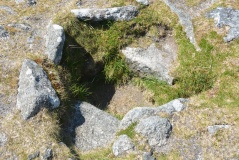

In the Footsteps of Agamemnon
Submitted by AlexHunger on Monday, 04 September 2006 Page Views: 5880
Other ArchaeologyCountry: Greece
In the "Neolithic Attica" book by Professor Maria Pantalidou Gofas, dated 2000, the simple origins of human settlements in Attica are brought to light. There seems to have been very little Pre Ceramic Neolithic activity while populations spring up in small villages all over Attica, from Oropos in the North to Lourion (Sounion) in the South to Eleusis in the West a little later.
The principle beehive of activity appears to have been the area around Marathon and Nea Makri on the East Attica coast. The Neolithic people lived in mud brick huts and also had wattle and daub 'sheds', as indicated in a recent news report about the Peloponese.
They also made increasingly more complex pottery. At a later stage, new people settled next to the old population and made slightly more advanced huts and also started to pave the floors and alleys of these settlements.
The book does not say if this corresponds to the population shifts after the flooding of the Black Sea in about 5600 BCE.
Interestingly only 2 Neolithic Attic Greek graves are known, one on the Acropolis and the other in the Pan Cave near Marathon, neither of which is accessible to tourists.
The Neolithic Greeks did however develop an interest in trading for Obsidian with the Cycladic islands. This led to some people eventually settling there, giving us the Cycladic art we now see in museums.
Robert Graves, author of the “White Goddess” indicated the populations of Greece and elsewhere in Europe tended to change with new migrations from the East and North usually between one era and another.
I have no information on when exactly this might have taken place around Marathon, but about 3200 BCE, the advent of the early Bronze age, the Early Helladic people started to build small cists in the Tsepi neighborhood - Tsepi Early Helladic Graves.
These have been excavated in the 1970s and received an elegant €3.2 million roofed hall to protect them. These several dozen dry stone chambered tombs with limestone slab covers resemble those found elsewhere in Western Europe.
People of the middle Helladic period around 2000 to 1200 BCE then built more substantial chambered tombs with proto dromoses Vranas Middle Helladic Graves, resembling later tholoses. There was little evidence of large limestone slabs for these, but there were kerbstones creating a circular enclosures for tumuli.
 Around 1500 BCE, the Mycenaens, who lived 100 Km further South in the Peloponese set new standards. They were, of course, Acheans, who also came from elsewhere. They not only built perfectly masoned tholoses such as the one at Tiryns that have often withstood the test of time very easily, where tomb robbers have not had a go.
The Mycenaens also built the legendary fortress of Mycenea and Tiryns. While the tholoses had perfectly squared stones, the fortress still used cyclopean blocks, which have also been called polygonal.
I'm absolutely convinced that they learned stone working somewhere else to the north or east of Greece in order to apply these skills on the door frames of their tholoses or on the famous Lions’ Gate. The Acheans were expert seafarers and traders, and also well trained in the art of war.
It is fanciful to imagine the Trojan Paris arriving by ship at Tiryns, the Mycenean sea port fortress, for his diplomatic mission, only to see emotions run riot over Helen. We all know how the Trojan war ended, but the Acheans got little joy from their victory.
Within a few short decades, the heroic Bronze age Mycenaens were conquered by the dull farmers from the North who however had better Iron weapons. The palaces fell into neglect and the tombs of heroes and kings were forgotten while Greece entered into a Dark Age of about 400 years with little or no building monumental activity.
Ironically, it is the Pantheon of the Dorians we now see as typically Greek, whereas the Mycenaens would have worshipped the Titans. Eventually around the 7th century BCE, even the descendants of Dorians started building Archaic temples. Most of these where destroyed during the Persian invasion in 490 BCE, as described by Herodotus.
 Thankfully Greece enjoyed a new flowering immediately afterwards during the classic age of the 4th century which gave us the Parthenon and many other such Doric temples in Greece, such as Sounion and many other parts of the Mediterranean.
The missing megaliths are, however, still a concern. During my intensive travels in Attica and parts of the Peloponese, there was no shortage of large boulders that might made a good Dolmen or Menhirs. Either they were all destroyed, which appears unlikely, or cultural difference led them to not be built at all. Time will tell.
An original article by AlexHunger.
Note: An introduction to the some of the many Greek sites Alex has been contributing to the Portal.


 We would like to know more about this location. Please feel free to add a brief description and any relevant information in your own language.
 Wir möchten mehr über diese Stätte erfahren. Bitte zögern Sie nicht, eine kurze Beschreibung und relevante Informationen in Deutsch hinzuzufügen.
 Nous aimerions en savoir encore un peu sur les lieux. S'il vous plaît n'hesitez pas à ajouter une courte description et tous les renseignements pertinents dans votre propre langue.
 Quisieramos informarnos un poco más de las lugares. No dude en añadir una breve descripción y otros datos relevantes en su propio idioma.