


Book Review: Singing up the Country by Bob Trubshaw
Submitted by Runemage on Sunday, 19 August 2012 Page Views: 19164
Neolithic and Bronze AgeCountry: England County: Wiltshire Type: Stone CircleInternal Links:


All were introduced to explain the method of creating a songline - a navigation aid and sense of place in and belonging to the landscape, not as a fantasy but as a plausible theory based on current scholarship.
While we are always admonished never to judge a book by its cover, I do like to ponder what impressions are given as I look at a book for the first time. This one is matte board which intensifies the image, there’s no distracting shiny glare. A bright yellow sun lights the sky at the crack of dawn and as it touches the clouds, it turns into an orange glow. In silhouette is a single stone set in its landscape with two ravens, one perched upon it and one flying towards a skeletal tree.
As you lift the cover, the endpaper’s vivid vermillion hue adds to the sensation of warmth, beckoning you within. Flicking through the pages, the quality of the illustrations and photographs are first-rate.
For anyone not familiar with songlines – and that includes me – this book is an education. Bob has considered his subject from many angles and is keen for the reader to be aware at all times that this is not fantasy, his objective is "To recreate a viewpoint which, based on current scholarship, is plausible." His inspiration arose from his recent move to a new home within Avebury henge, where his observations and reflections on living, working and walking in such a liminal spot culminated in the idea of the songlines for that area.
To gain any understanding of the Neolithic peoples’ world, some authors try to get into a Neolithic mindset by recreating the conditions that would have existed in those times as best they can from the available evidence. It takes a lot of application, after all, a walk is just a walk, isn’t it? Well actually, no, it’s not, it’s much more. It’s a journey and every part of it is significant.
The question of how people navigated in prehistory is an interesting one which Bob tackles in some depth. How can people find their way without a map? Whilst navigation by sun and stars can determine direction, what about the finer points, how did they find a particular place and how could they give other people instructions to find it for themselves? Their land wasn’t always a safe place to be and they used their waterways far more than we do today.
Prior to writing being invented, people communicated by sound and the sounds of a place were as important if not more important than its visual presence. Bob answers questions I’d never even thought of asking, yet throughout he is at pains to point out that his theory is only that, a theory. Refreshingly, he doesn’t claim to have all the answers, but he does make you think about the ones he offers for consideration.
The journey about journeying in this book weaves its way through many intriguing places and many intriguing possibilities. There are also many stories of place which are new at least to my ears. For example, I’d think most of our readership are familiar with the most recent excavation at Silbury which indicates that before the hill was planned, people from different areas brought part of their homeland with them and laid it carefully in small piles, thereby denoting an area of perhaps equal and common land, possibly even sacred land. Bob has discovered an unusual custom in Leicestershire which could have parallels to that stretching back into antiquity.
The Moody Bush Stone whose name he says is derived from moot, i.e. meeting and stone which replaced a long-dead bush, is on the boundary of three parishes. In the eighteenth century it was still being used as a meeting-place. A local landowner brought his tenant farmers there for what he called a court. According to local folklore, each tenant had to bring a turf of their land and only when all turves had been placed on top of the Moody Bush Stone could the court commence.
Everyone has heard of the Aborigines’ songlines, using song and stories as their means of navigation, yet who is aware that Norfolk fishermen did the same thing to navigate their territory both on and off land? Bob has taken what he believes to be the means of creating a songline and presented the method for anyone to use in their own landscape.
In the final chapter, he brings together all of the many diverse individual notes gathered from the preceding pages and weaves them into a songline for a special journey around the Avebury area that could have occurred in prehistoric times. In doing so, he hopes to create a different understanding of the landscape as a whole and megalithic monuments in particular.
Review by Runemage
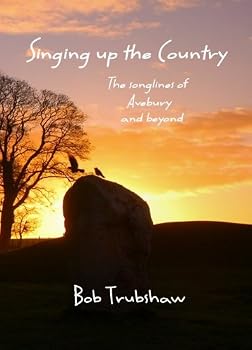 Singing up the Country- The songlines of Avebury and beyond is by Bob Trubshaw.
Published by Heart of Albion Press
ISBN 978-1-905646-21-0
189 + xiv pages, 64 b&w photos, 29 line drawings, paperback.
Available from Amazon.co.uk
Note: Bob Trubshaw's latest book Beyond the Henge Book launches at Avebury on Sunday 2nd September. In the meantime here's recap of his last paper book and four (!) free ebooks for summer reading.


 We would like to know more about this location. Please feel free to add a brief description and any relevant information in your own language.
 Wir möchten mehr über diese Stätte erfahren. Bitte zögern Sie nicht, eine kurze Beschreibung und relevante Informationen in Deutsch hinzuzufügen.
 Nous aimerions en savoir encore un peu sur les lieux. S'il vous plaît n'hesitez pas à ajouter une courte description et tous les renseignements pertinents dans votre propre langue.
 Quisieramos informarnos un poco más de las lugares. No dude en añadir una breve descripción y otros datos relevantes en su propio idioma.