Featured: Explore Scotland (and everywhere else) with our Megalithic Portal iPhone app

Explore Scotland (and everywhere else) with our Megalithic Portal iPhone app

Random Image

Iron Age Britain, Barry Cunliffe

Iron Age Britain, Barry Cunliffe

Login

Register here - as a registered user you get more features and fewer ads.

Who's Online

There are currently, 1665 guests and 2 members online.

Sponsors

Ancient Yews

Submitted by Thorgrim on Tuesday, 13 September 2005  Page Views: 15962

Environment

<< Feature Articles >>

All Saints (Alton Priors)
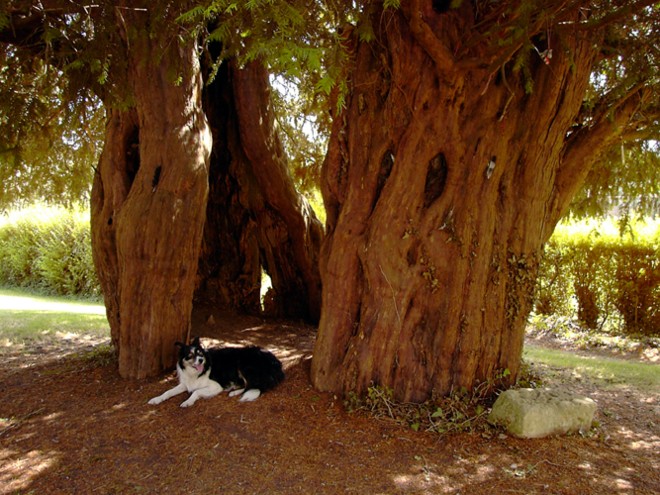
All Saints (Alton Priors) submitted by Thorgrim : This hollow yew in the churchyard is said to be more than 1,700 years old. Far older than the church and perhaps linked in some way to the mysterious sarsen stone beneath the church floor. (Vote or comment on this photo)
Ancient churchyard yews thousands of years old - are they really relics of pagan worship or not? You can make your own mind up about that, but I do not think so and have never come across any evidence to support it. However, with ages stretching back many thousands of years, a really old yew is a living link to the times when our megaliths were constructed. So how do we find out just how old a yew is?

Recent discussion on the age of ancient trees has been inconclusive simply because experts disagree on how to accurately gauge the age of our longest lived tree - the yew. Other trees have a single trunk and so it is possible to count the annual rings in a sawn cross section or by boring a core with an auger from a living tree. Not so for the yew because it does not have a single trunk. As it ages, it sends up multiple trunks so annual tree rings are meaningless. The only way to estimate the age of a yew is to measure its girth. Yews grow rapidly when young and then slow down. This means that estimates have to consider different rates of growth throughout the long life span of these most ancient of living things in the British landscape.

The Tree Council has issued a guide from the Charnwood Trust environmental charity. You need to measure the girth of your yew at about four feet from the ground. So get a long tape meaure or length of rope! Then consult this chart which I have extracted to apply only to those trees old enough to interest readers of the Portal:

Girth in feet (cms)..Estimated age
27 (823)...................1,800 years
30 (914)...................2,400 "
33 (1006)..................3,000 "
35 (1067)..................4,400 "
36 (1097)..................5,600 "
Over 36 feet ......Over 6,000 years old!

Please tell us of the oldest that you find and any nearby ancient sites. Grid refs would be appreciated.

Please add your thoughts on this site

The Mind in the Cave

The Mind in the Cave

Sponsors

More Feature Articles

See all Feature Articles →

"Ancient Yews" | Login/Create an Account | 34 News and Comments
  
Go back to top of page    Comments are owned by the poster. We aren't responsible for their content.
Re: ancient yews by xseawitch on Sunday, 27 January 2019
(User Info | Send a Message)
I am very interested in ancient trees and have been trying to visit veteran and ancient ones local to me. Whatever their significance in the past there is value to me in being in the presence of something which has lived so long.

In the Bristol area there is an ancient yew in Abbot's Leigh churchyard as well as huge cypress trees. ST54467404 The church information page suggests that this was previously a celtic holy place, but didn't provide evidence Quote from website "‘Lega’ means wood or meadow or possibly camp – lee, lea, ley all meaning the same in Anglo-Saxon. A Saxon hermitage or small chapel was built at ‘lega’ perhaps on a Celtic burial ground or holy place. This became the basis of the chancel of an enlarged church.".

St Annes churchyard in Longwell Green or Oldland has a veteran yew which seems to have designs on escaping the stone wall it is growing by. ST66877116

I can post photos if I can work out how and anyone is interested. Thanks.
[ Reply to This ]

Re: ancient yews by megalith6 on Thursday, 27 November 2014
(User Info | Send a Message)
"All Saints (Alton Priors) Ancient churchyard yews thousands of years old - are they really relics of pagan worship or not? You can make your own mind up about that, but I do not think so and have never come across any evidence to support it."

'The Magical Music of the Yew'.

Evidence, well there is evidence - historical documentation - that the yew was somehow special to people as far back as the Iron Age. To surmise that yews were merely handy to use as personal or tribal names seems a bit studiedly secular to me; it looks from at least the circumstantial evidence that the yew would have had a profound aspect to its popularity - as with many trees and plants - as someone pointed out, it was an animistic age before the dawn of industrialisation, even apparently inanimate objects like swords were thought by some to possess souls - how much more then a living entity such as a tree?

http://en.wikipedia.org/wiki/Celtic_sacred_trees#Yew
[ Reply to This ]
    Re: ancient yews by Runemage on Saturday, 29 November 2014
    (User Info | Send a Message)
    There's also the comparison of the age of the yew on-site and the age of the religion.
    [ Reply to This ]

Re: Ancient Yews by Anonymous on Saturday, 07 July 2012
Lorton yew - NY 161254 - http://www.visitcumbria.com/cm/lorton-yew-trees

Martindale yew - NY 434184 - http://www.visitcumbria.com/pen/martindale-st-martins-church

Probably not that ancient - but of interest - Wasdale Head - NY 188087 - http://www.visitcumbria.com/wc/wasdale-head

All in Cumbria
Julian Thurgood
[ Reply to This ]
    Re: Ancient Yews by Anonymous on Saturday, 07 July 2012
    Lots of ancient sites in Cumbria as you all know - but none particularly close to the above three places.
    [ Reply to This ]

Re: Ancient Yews by Anonymous on Monday, 01 May 2006
it really is a shame that they do this as the yew is an ancient tree from our past.
why not have teachers or caretakers pick the poison berrys b4 the chidren decide they will eat them.
we had yew trees in our primary schools i dont remember a case of any of my friends eating the berries.
also off the subject .... we recently had the play area of a recreation field ripped up because the council couldnt be made responsible if a child injured themselves on the swing or slide. so the children will now head for the streets.
[ Reply to This ]

Re: Ancient Yews by TheCaptain on Saturday, 01 April 2006
(User Info | Send a Message)
Political Correctness in Britain has gone mad. Bristol City Council has recently spent lots of good honest council taxpayers money on ripping up and digging out yew trees near a childrens play area. This is all because somebody has complained to the council that the yew berries may poison a child. And of course, the spineless council fears an attack by lawyers, and has dug up the trees.
[ Reply to This ]
    Re: Ancient Yews by Anonymous on Friday, 11 March 2022
    Poor parenting in teaching children what NOT to do plain and simple
    [ Reply to This ]

Re: Ancient Yews by Rombald on Friday, 17 March 2006
(User Info | Send a Message)
Yew and holly are the only trees for which the modern Englsh names are of "Celtic" origin - the modern Welsh names are "iw" and "celyn". This suggests some significance attached to them.

In its association with churchyards, there is an analogy with the funereal significance of cypresses in S. Europe. The yew is the most similar to a cypress among British native species.

I take with a pinch of salt the idea that yews were destroyed everywhere except churchyards due to being poisonous. I think most churchyard yews were deliberately planted, either in Christian or pre-Christian times, because they are really only native on chalk and limestone (there are some pure-yew woods on chalk downs, and there are also wild yews on limestone crags, such as Goredale Scar).

Richard Mabey has a good section about yews in "Flora Britannica". However, in "The History of the Countryside", Oliver Rackham expresses scepticism about the supposed immense age (over 2,000 years) of some yews.

I would...

Read the rest of this post...
[ Reply to This ]

Re: Ancient Yews by JimChampion on Sunday, 01 January 2006
(User Info | Send a Message)
With regards to a yew in the churchyard of St Nicholas' church in Brockenhurst, this website says that: "The Yew was carbon dated in the mid 1980's and a certificate stating that it is over 1,000 years old will be found on the wall by the font." Has anyone heard of carbon dating being used on other ancient trees? Furthermore, what do they actually do (since you can't date the living tissue)?
[ Reply to This ]
    Re: Ancient Yews by Thorgrim on Monday, 02 January 2006
    (User Info | Send a Message)
    I agree. I don't see how you can carbon date a living tree as the measurement is of the carbon 14 lost since death. I can only assume that some dead wood from the tree has been sampled. Suggest you ask them to explain.
    [ Reply to This ]
    Re: Ancient Yews by JimChampion on Monday, 02 January 2006
    (User Info | Send a Message)
    I'll have a look at the certificate in the church next time I'm out that way. There is also speculation that the church is built on a circular churchyard, hinting at something prehistoric but nothing very concrete. The tree certainly isn't prehistoric (although I do have a reasonable photo of it if anyone's interested).
    [ Reply to This ]

Re: Ancient Yews by brigantia on Wednesday, 21 September 2005
(User Info | Send a Message)


Depends what you mean by "pagan worship" as that is a modern invention. The idea that people "worshipped" trees or stones or wells is in itself a misconception. We are dealing with a different approach when we look at the ideas our ancestors had about such things. Trees, like all other plants, animals, rocks, clouds, etc., were related to in an animistic sense, i.e., the natural world was deemed to possess a 'spirit', an 'essence', a wider quality than "just being a tree". It wasn't seen as isolative, but relative to other things around it. In this sense, yew trees had a very distinct mythic quality, around which various folktales and legends were woven. If you think that our ancestors, be it from megalithic or even more recent times, did NOT have this perspective and imbue a sense of 'spirit' upon yew trees, you are very much mistaken. If you look at the history of herbalism you'll find ample reward about earlier ideas and perceptions of plants (wherein we find the...

Read the rest of this post...
[ Reply to This ]

Re: Ancient Yews by Anonymous on Wednesday, 21 September 2005
Visited the magnificent yew tree in the chuchyard in Darley Dale in Derbyshire last weekend. Found a truly ancient tree - about 30ft in diameter according to records. Some say it is 3000 years old. Within 5 miles of Stanton Moor, Harthill Moor and many other prehistoric sites.

Love trees as they love us (apart from Stancliffe Stone of course)
[ Reply to This ]
    Re: Ancient Yews by Thorgrim on Wednesday, 21 September 2005
    (User Info | Send a Message)
    Thanks for that, but the tree cannot be 30ft in diameter. That must be its circumference or girth. That would make it 2,500- 3000 years old
    [ Reply to This ]
    Re: Ancient Yews by Anonymous on Monday, 03 October 2005
    Yes sorry - it is 30ft in circumference NOT diameter.
    Thanks Thorgrim
    [ Reply to This ]

Re: Ancient Yews by Anonymous on Monday, 19 September 2005
theres a few in overton church,someone said they were 1600 years old.
[ Reply to This ]

Re: Ancient Yews by astronomer on Monday, 19 September 2005
(User Info | Send a Message)
Very interesting. I visited Brailsford church, east of Ashbourne, on Saturday to see the 9th-10thC Mercian cross. Although the church is late medieval,16thC or later(there is a date of 1627 above the S doorway) the Yew standing opposite the cross suggests a probable age of perhaps 1000-1200 yrs judging by an estimated girth of no more than 20-22feet, if extrapolating the list is valid. This would fit with the likely age of the cross.
[ Reply to This ]

Re: Ancient Yews by Anonymous on Friday, 16 September 2005
Yew spears are known from lower palaeolithic sites here and in germany dated at 400,000 years ago.Arthur,Burbage,Leicestershire
[ Reply to This ]

Re: Ancient Yews by Andy B on Wednesday, 14 September 2005
(User Info | Send a Message)
There's one in a churchyard near me that they reckon is 1300 years old, predates the church - is that old enough for a photo?
[ Reply to This ]
    Re: Ancient Yews by Thorgrim on Wednesday, 14 September 2005
    (User Info | Send a Message)
    Yes - I think so. I have a list of all the really ancient yews in Britain (there are none in Ireland - I wonder why) If I can get grid refs sorted out it might be interesting to plot them on the Megalithic Map and see just how they link to megalithic sites. Might answer the question - were they planted near ancient sites or are they just the survivors of a wider distibution? Yew is very poisonous to livestock and so they were destroyed, particularly with the wholesale enclosures of land in recent centuries. So we are left with mainly those ancient yews in churchyards where livestock was excluded. This has given rise to the widespread belief that they were planted in churchyards and are survivals of pagan shrines, later replaced by churches. There is some evidence that the yew was important to pagan Anglo-Saxons as an extension of the World Tree cult (Irminsul and Yggdrasil) Also, early Christians seem to have regarded the yew as symbolic of the resurrection of Christ-...

    Read the rest of this post...
    [ Reply to This ]

Re: ancient yews by sem on Wednesday, 14 September 2005
(User Info | Send a Message)
I seem to remember reading that the yew tree was planted in churchyards specifically for the manufacture of the longbow (hence the term "yeoman"), but this could be a later political device using existing traditions.
[ Reply to This ]
    Re: ancient yews by Thorgrim on Wednesday, 14 September 2005
    (User Info | Send a Message)
    Nice notion, but not true I'm afraid. Yews are slow growing so it would have been mature wood from existing trees that would be harvested for longbows. Much of the yew wood for longbows was imported from Spain. The origin of "yeoman" is uncertain but it derives from the medieval English word "yeman" or "yoman" - It has come to mean a countryman of some social standing who cultivated his own land.
    [ Reply to This ]
      Re: ancient yews by Anonymous on Friday, 18 November 2005
      That is correct. It is mere coincidence that yeoman and yew are noted together in the middle ages with the yew war bow (aka longbow). It is actually from gauia or *gauja meaning 'district' or 'geongra' meaning young male servant, attendent, disciple' or a combination of these two meaning 'young+district+man'. The term or word yeoman has been an ancient tradition tied to light-infantry warfare since the ancient days and no doubt made mention by Tacitus in 98 AD of those young swift foot troops who supported the cavalry chosen of every district. Several hundred years later in the Black Book we see 'yeomen of the crown' to be chosen of every lord's house (keep in mind manors turned into scirs)
      and scirs were originally made of districts stemming from pre-migration period to britain. back to yew and yeoman, yes strongly related but not etymologically, only historically.
      [ Reply to This ]

Re: ancient yews by nicoladidsbury on Tuesday, 13 September 2005
(User Info | Send a Message)
Yew experts in Cumbria believe that some ancient trees maybe older than the accepted girth rates, if they have grown in higher altitudes and latitudes, where summers are shorter and colder, meaning that a tree doesn't grow so quickly.

There is a really old yew tree in Martindale, next to St Martins ancient church. It may not be the oldest yew, but is a truely magical place.

Visit Ancient Tree Forum website if you love ancient trees

where you will find this great poem....

YEW TREES

William Wordsworth, composed in 1803

There is a Yew-tree, pride of Lorton Vale,
Which to this day stands single, in the midst
Of its own darkness, as it stood of yore:
Not loth to furnish weapons for the bands
Of Umfraville or Percy ere they marched
To Scotland’s heaths; or those that crossed the sea
And drew their sounding bows at Azincour,
Perhaps at earlier Crecy, or Poictiers.
Of vast circumference and gloom profound
This solitary Tree! - a living thing
Produced too slowly...

Read the rest of this post...
[ Reply to This ]
    Re: ancient yews by Thorgrim on Wednesday, 14 September 2005
    (User Info | Send a Message)
    That makes sense - the growth rate will be slower in higher, more extreme conditions. Well done for getting a photo on the BBC page and thanks for the poem. Isn't Glaramara the most beautiful name ever!
    [ Reply to This ]
    Re: ancient yews by nicoladidsbury on Friday, 16 September 2005
    (User Info | Send a Message)
    Isn't it beautiful; I also love Blencathra, and Helvellyn, names that hint at people long gone from Cumbria.
    [ Reply to This ]
    Re: ancient yews by Anonymous on Saturday, 07 July 2012
    Lorton yew - http://www.visitcumbria.com/cm/lorton-yew-trees.htm
    Martindale yew - http://www.visitcumbria.com/pen/martindale-st-martins-church.htm

    Julian Thurgood
    [ Reply to This ]
    Re: ancient yews by Sunny100 on Saturday, 07 July 2012
    (User Info | Send a Message)
    In the churchyard at Fortingall, Perthshire, Scotland, there is a 5,000 year old yew tree, perhaps the oldest in Europe. According to legend, Pontius Pilate was born here. At the church there are Pictish stones, ancient font and cross-slabs from the 7th century AD. The church stands on a monastic site, dating from 600 AD.
    [ Reply to This ]

Re: ancient yews by hailstones on Tuesday, 13 September 2005
(User Info | Send a Message)
Found one called" llangernyw Yew" by standing stone .3,400 yrs old. neaest place: Llanwrst: OS 116. Between Abergele + Llanrwwst, Cnwy.
Shropstones originally posted this.
[ Reply to This ]
    Re: ancient yews by Thorgrim on Wednesday, 14 September 2005
    (User Info | Send a Message)
    Thanks Hail - got a photo?
    [ Reply to This ]
      Re: ancient yews by hailstones on Tuesday, 20 September 2005
      (User Info | Send a Message)
      I'm new to the site and didn't actually see this one.Shropstones is the one who has the info. We just returned from Wales where we saw some amazing yews in churchyards but the biggest girth was 28feet.
      Tim is just now sorting out photo's of our trip and they should be on the portal by next week.I'm still unsure how to download photo's.
      Glad if i can help.
      [ Reply to This ]
    Re: ancient yews by Thorgrim on Wednesday, 14 September 2005
    (User Info | Send a Message)
    The Llanernyw yew is the fourth oldest in Britain. It measures 350cms in diameter and so that would make it about 1050 cms in girth (multiply diameter by pi) That would make it about 3,500 years old. So that means it started out as a young'un in 1500 BC - so you have a living Bronze Age tree! Amazing!
    [ Reply to This ]
    Re: ancient yews by whatisthat on Friday, 31 March 2006
    (User Info | Send a Message)
    Indeedy. Here are the stones. The yew on the other side of the church is amazing. The pub next door is pretty good too!
    [ Reply to This ]

Your Name: Anonymous [ Register Now ]
Subject:


Add your comment or contribution to this page. Spam or offensive posts are deleted immediately, don't even bother

<<< What is five plus one as a number? (Please type the answer to this question in the little box on the left)
You can also embed videos and other things. For Youtube please copy and paste the 'embed code'.
For Google Street View please include Street View in the text.
Create a web link like this: <a href="https://www.megalithic.co.uk">This is a link</a>  

Allowed HTML is:
<p> <b> <i> <a> <img> <em> <br> <strong> <blockquote> <tt> <li> <ol> <ul> <object> <param> <embed> <iframe>

We would like to know more about this location. Please feel free to add a brief description and any relevant information in your own language.
Wir möchten mehr über diese Stätte erfahren. Bitte zögern Sie nicht, eine kurze Beschreibung und relevante Informationen in Deutsch hinzuzufügen.
Nous aimerions en savoir encore un peu sur les lieux. S'il vous plaît n'hesitez pas à ajouter une courte description et tous les renseignements pertinents dans votre propre langue.
Quisieramos informarnos un poco más de las lugares. No dude en añadir una breve descripción y otros datos relevantes en su propio idioma.