Featured: Explore Cornwall with the amazing Megalithic Portal smartphone app

Explore Cornwall with the amazing Megalithic Portal smartphone app

The Henge Monuments of the British Isles: Myth and Archaeology

The Henge Monuments of the British Isles: Myth and Archaeology

Login

Register here - as a registered user you get more features and fewer ads.

Sponsors

<< Our Photo Pages >> Tenochtitlan - Templo Mayor - Ancient Temple in Mexico in Estado de Mexico

Submitted by bat400 on Tuesday, 26 March 2019  Page Views: 45827

Multi-periodSite Name: Tenochtitlan - Templo Mayor Alternative Name: Temple Mayor
Country: Mexico Region: Estado de Mexico Type: Ancient Temple
Nearest Town: Mexico City
Latitude: 19.434917N  Longitude: 99.131361W
Condition:
5Perfect
4Almost Perfect
3Reasonable but with some damage
2Ruined but still recognisable as an ancient site
1Pretty much destroyed, possibly visible as crop marks
0No data.
-1Completely destroyed
2 Ambience:
5Superb
4Good
3Ordinary
2Not Good
1Awful
0No data.
3 Access:
5Can be driven to, probably with disabled access
4Short walk on a footpath
3Requiring a bit more of a walk
2A long walk
1In the middle of nowhere, a nightmare to find
0No data.
4 Accuracy:
5co-ordinates taken by GPS or official recorded co-ordinates
4co-ordinates scaled from a detailed map
3co-ordinates scaled from a bad map
2co-ordinates of the nearest village
1co-ordinates of the nearest town
0no data
4

Internal Links:
External Links:

I have visited· I would like to visit

Jansold visited on 17th Feb 2019 - their rating: Cond: -1 Amb: 3 Access: 5

MartinJEley visited on 16th Aug 2011 - their rating: Cond: 3 Amb: 4 Access: 5 Having already visited the amazing site of Teotihuacan I was equally pleased with the detail that could be seen in this temple and the informative adjoining museum. Situated in Mexico City the access is easy for anyone who has some time.

SolarMegalith visited on 1st Mar 2002 - their rating: Cond: 3 Amb: 3 Access: 5

DrewParsons have visited here

Average ratings for this site from all visit loggers: Condition: 1.67 Ambience: 3.33 Access: 5
Tenochtitlan - Templo Mayor
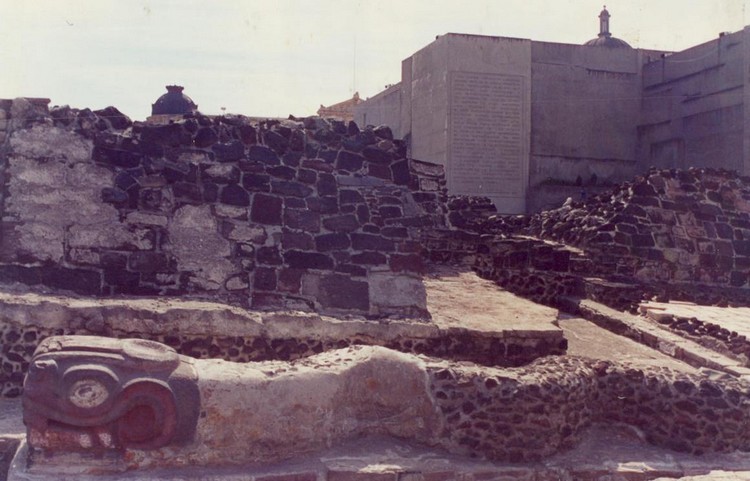
Tenochtitlan - Templo Mayor submitted by SolarMegalith : The famous serpent sculpture representing Quetzalcoatl, the main god of Aztecs, associated with wind and knowledge (photo taken on March 2002). (Vote or comment on this photo)
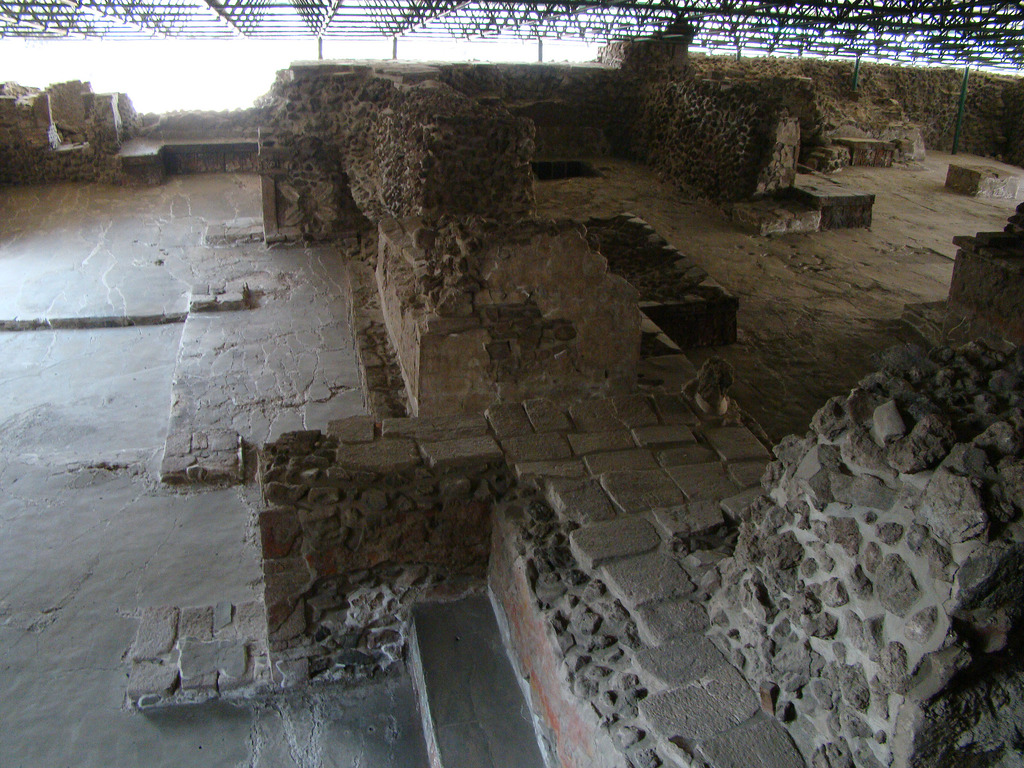
Ancient Temple in Mexico City. When the Spanish conquistadors under Cortez conquered the capitol city of the Aztecs, Tenochtitlan, in 1519 this temple pyramid was the centre of the great city. Three years later the conquerors, under Cortez, began to raze the city and topple the twin temples found at the peak of Templo Mayor.

Amid the rubble they built a new city. More than four hundred years later the base of the pyramid was found during rebuilding after major earthquakes. The dig has gone on since 1978. New finds of importance occur nearly every season.

Templo Mayor was reputed to be the very core of the Aztec empire. This was the legendary location where these travelers from the north saw the reality of a prophecy - that they should build their city where they saw an eagle devouring a snake while perched on a towering cactus. The pyramid ruins lie to one side of the cathedral built by the Spanish next to the Great Marketplace. The site can be visited using a series of overlooks and footpaths. A purpose built museum lies close by, housing the amazing finds from the digs.
Multiple structures made up the pyramid complex and due to its ruined condition portions of these subcomponent buildings may continue to be uncovered. The platform atop the pyramid was the site of two chapels, for co-equal gods of the Aztec pantheon, Huitzilopochtli, the their primary god of war, and Tlaloc, the rain god. The chapels stood side by side, Tlaloc's to the north and Huitzilopochtli's to the south, with steps leading down from the buildings to the west.
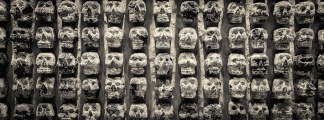
As recently as 2015 portions of an immense tower of skulls began to be unearthed in the area of the Templo Mayor complex. This is now thought to be the Huey Tzompantli, a skull rack with circular base which was described by the Spanish as being located at the corner of the pyramid nearest the Huitzilopochtli chapel.
The 3m diameter Coyolxauhqui monolith was uncovered in 1978 at what would have been the base of the steps leading to Huitzilopochtli's chapel. This is a depiction of the dismembered body of Coyolxauhqui in one myth, described as the sister of Huitzilopochtli, who murdered her to prevent her attack on their mother, Coatlicue.

Website: Templo Mayor Museum. (Note: This link is to an archive page.) The location given is for the Temple Pyramid.

Note: Aztec war sacrifices found in Mexico may point to elusive royal tomb - more details in the comments on our page
You may be viewing yesterday's version of this page. To see the most up to date information please register for a free account.
Tenochtitlan - Templo Mayor
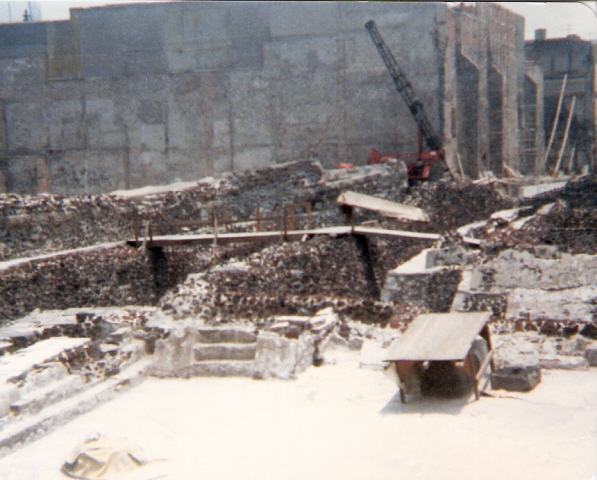
Tenochtitlan - Templo Mayor submitted by AlexHunger : 1982 excavations in Downtown Mexico City. The site was rediscovered under derelict buildings near the cathedral. (Vote or comment on this photo)

Tenochtitlan - Templo Mayor
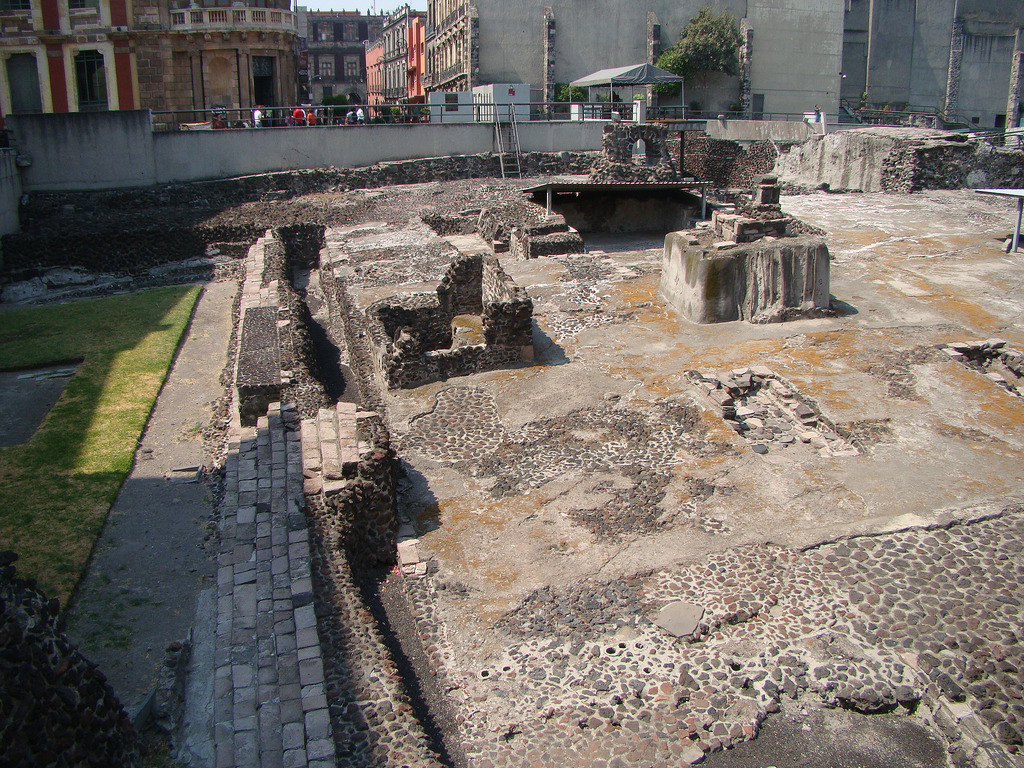
Tenochtitlan - Templo Mayor submitted by Flickr : Mexico City ~ Templo Mayor Image copyright: VasenkaPhotography, hosted on Flickr and displayed under the terms of their API. (Vote or comment on this photo)

Tenochtitlan - Templo Mayor
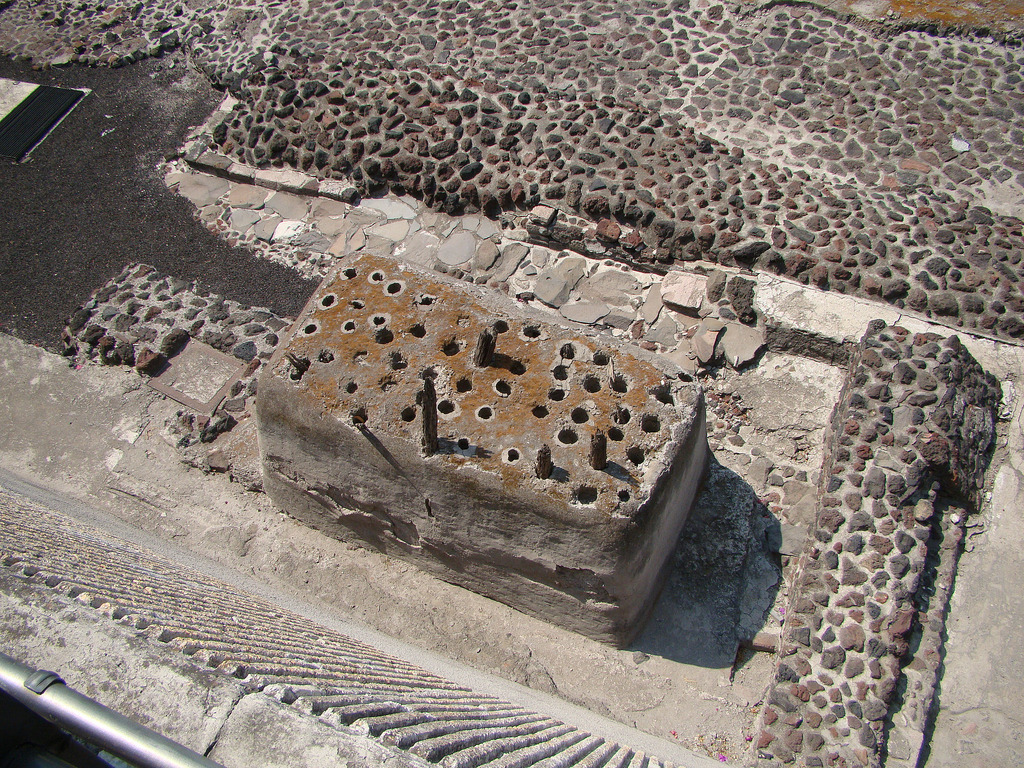
Tenochtitlan - Templo Mayor submitted by Flickr (Vote or comment on this photo)

Tenochtitlan - Templo Mayor
Tenochtitlan - Templo Mayor submitted by Flickr : Mexico City Templo Mayor Image copyright: VasenkaPhotography, hosted on Flickr and displayed under the terms of their API. (Vote or comment on this photo)

Tenochtitlan - Templo Mayor
Tenochtitlan - Templo Mayor submitted by DrewParsons : A model of how the site looked originally. Photographed in the Museum of Anthropology, Mexico City during a visit there in December 1989.

Tenochtitlan - Templo Mayor
Tenochtitlan - Templo Mayor submitted by Flickr : Mexico City Templo Mayor Image copyright: VasenkaPhotography, hosted on Flickr and displayed under the terms of their API.

Tenochtitlan - Templo Mayor
Tenochtitlan - Templo Mayor submitted by SolarMegalith : Tzompantli (Wall of the Skulls) in Templo Mayor (Tenochtitlan) - nowdays centre of Mexico City (photo taken on March 2002).

Tenochtitlan - Templo Mayor
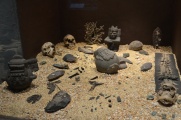
Tenochtitlan - Templo Mayor submitted by Flickr : Mexico City ~ Templo Mayor Museum Image copyright: VasenkaPhotography, hosted on Flickr and displayed under the terms of their API.

Tenochtitlan - Templo Mayor
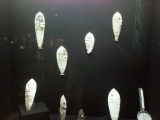
Tenochtitlan - Templo Mayor submitted by Flickr : Museo Templo Mayor, Mexico DF Una linda experiencia en el Museo del Templo Mayor, ciudad de los Mexicas. Image copyright: maxid (Maximiliano Dobladez), hosted on Flickr and displayed under the terms of their API.

Tenochtitlan - Templo Mayor
Tenochtitlan - Templo Mayor submitted by Flickr : Mexico.Au Musée du Templo Mayor Image copyright: Antoine 49, hosted on Flickr and displayed under the terms of their API.

Tenochtitlan - Templo Mayor
Tenochtitlan - Templo Mayor submitted by Flickr : Skull wall. Image copyright: coffeehistorian (Stuart), hosted on Flickr and displayed under the terms of their API.

Do not use the above information on other web sites or publications without permission of the contributor.
Click here to see more info for this site

Nearby sites

Click here to view sites on an interactive map of the area

Key: Red: member's photo, Blue: 3rd party photo, Yellow: other image, Green: no photo - please go there and take one, Grey: site destroyed

Download sites to:
KML (Google Earth)
GPX (GPS waypoints)
CSV (Garmin/Navman)
CSV (Excel)

To unlock full downloads you need to sign up as a Contributory Member. Otherwise downloads are limited to 50 sites.


Turn off the page maps and other distractions

Nearby sites listing. In the following links * = Image available
 1.9km NNW 340° Tlatelolco* Ancient Village or Settlement
 5.9km W 261° Museo Nacional de Antropología* Museum
 11.5km NNW 340° Tenayuca* Pyramid / Mastaba
 13.8km NNW 341° Acatitlan* Ancient Temple
 15.6km SSW 200° Cuicuilco* Pyramid / Mastaba
 16.8km SSW 193° Tlalpan Ancient Village or Settlement
 33.6km ENE 78° Texcotzingo* Ancient Palace
 37.9km NE 54° Templo de Patlachique* Ancient Temple
 40.5km NE 46° Teotihuacan - Tetitla Ancient Village or Settlement
 40.5km NE 47° Teotihuacan - Temple of Quetzalcoatl* Pyramid / Mastaba
 40.8km NE 46° Teotihuacan - Atelelco* Ancient Palace
 41.4km NE 46° Teotihuacan* Ancient Village or Settlement
 41.6km NE 46° Teotihuacan - Pyramid of the Sun* Pyramid / Mastaba
 42.1km NE 46° Teotihuacan - Pyramid of the Moon* Pyramid / Mastaba
 48.4km S 176° Tepoztlan* Ancient Village or Settlement
 56.9km S 190° Cuernavaca - Piramide de Teopanzolco* Pyramid / Mastaba
 60.8km SW 233° Teotenango* Ancient Temple
 72.3km SSW 194° Xochicalco* Ancient Village or Settlement
 73.5km NE 55° Tepeapulco Pyramid* Pyramid / Mastaba
 73.5km NNW 343° Tula.* Ancient Village or Settlement
 75.2km WSW 241° Nevado de Toluca Natural Stone / Erratic / Other Natural Feature
 84.7km ESE 104° Xochitecatl* Pyramid / Mastaba
 85.2km ESE 104° Cacaxtla* Ancient Village or Settlement
 92.4km SSE 156° Chalcatzingo* Rock Art
 96.6km ESE 116° Cholula* Pyramid / Mastaba
View more nearby sites and additional images

<< Wersau Menhir

Sanctuary Khe-he Pe — Sacred stone >>

Please add your thoughts on this site

The Henge Monuments: Ceremony and Society in Prehistoric Britain

The Henge Monuments: Ceremony and Society in Prehistoric Britain

Sponsors

Auto-Translation (Google)

Translate from English into:

"Tenochtitlan - Templo Mayor" | Login/Create an Account | 21 News and Comments
  
Go back to top of page    Comments are owned by the poster. We aren't responsible for their content.
Aztec war sacrifices found in Mexico may point to elusive royal tomb by davidmorgan on Monday, 25 March 2019
(User Info | Send a Message)
A trove of Aztec sacrifices including a richly adorned jaguar dressed as a warrior and recently discovered in downtown Mexico City could lead archaeologists to the most tantalizing find yet: an Aztec emperor’s tomb.

Discovered off the steps of the Aztec’s holiest temple during the reign of the empire’s most powerful ruler, the sacrificial offerings also include a young boy, dressed to resemble the Aztec war god and solar deity, and a set of flint knives elaborately decorated with mother of pearl and precious stones.

The offerings were deposited by Aztec priests over five centuries ago in a circular, ritual platform once located in front of the temple where the earliest historical accounts describe the final resting place of Aztec kings.

None of these details have been reported before and such a discovery would mark a first since no Aztec royal burial has yet been found despite decades of digging.

“We have enormous expectations right now,” lead archeologist Leonardo Lopez Lujan told Reuters. “As we go deeper we think we’ll continue finding very rich objects.”

The jaguar offering, found in a large rectangular stone box in what would have been the center of the circular platform, has stirred particular excitement.

Only about one-tenth of the box’s contents has been excavated, but already a wide array of artifacts has been found near the top, including a spear thrower and a carved wooden disk placed on the feline’s back that was the emblem of the Aztec patron deity Huitzilopochtli, the war and sun god.

A layer of aquatic offerings placed on top of the west-facing jaguar have also been identified, including a large amount of shells, bright red starfish and coral that likely represented the watery underworld the Aztecs believed the sun traveled through at night before emerging in the east to begin a new day.

A roseate spoonbill, a pink bird from the flamingo family, has also been found in the offering. It was associated with warriors and rulers, and thought to represent their spirits in their descent into the underworld.

“There’s an enormous amount of coral that’s blocking what we can see below,” said archeologist Miguel Baez, part of the team excavating the offerings at the base of the temple, known today as the Templo Mayor, located just off Mexico City’s bustling Zocalo plaza.

The Templo Mayor would have been as high as a 15-story pyramid before it was razed along with the rest of the Aztec capital Tenochtitlan after the 1521 Spanish conquest of Mexico.

Expanded by each Aztec king, the shrine was believed to be at the center of the universe and was crowned with two smaller temples, one on the north side dedicated to the rain god Tlaloc and one on the south to Huitzilopochtil.

Source: Reuters.
[ Reply to This ]

Mass murder or religious homicide? Rethinking human sacrifice and interpersonal viole by Andy B on Friday, 27 July 2018
(User Info | Send a Message)
Mass murder or religious homicide? Rethinking human sacrifice and interpersonal violence in Aztec society - Caroline Dodds Pennock

The Aztec practice of human sacrifice is one of the most sensationalized and bloody cases of mass killing in history, raising essential questions about cultural definitions, personal perceptions and the interrelationship of different forms of violence. Produced as part of a project on the long-term history of interpersonal and mass violence in Latin America, this article assesses the available sources for human sacrifice rates in pre-colonial Tenochtitlan, and lays the groundwork for a comparative analysis of homicide rates, by estimating the number of victims of human sacrifice. Offering an analysis which addresses key themes and structures in the history of violence, this study attempting to reconcile the frequency of 'official' violence with the apparent unacceptability of interpersonal aggression, and interrogates the sensationalism and cultural sensitivities which have often hindered impartial and empathetic studier of the human sacrifice in Aztec society.

Open Access article
http://nbn-resolving.de/urn:nbn:de:0168-ssoar-378889
[ Reply to This ]

Aztec tower of human skulls uncovered in Mexico City by bat400 on Monday, 03 July 2017
(User Info | Send a Message)
rbatham sends a link to the recent news story on the Huey Tzompantli, a skull rack some 60 metres in diameter which was part of the Templo Mayor complex:

Said to be the heads of defeated warriors, contemporary accounts describe tens of thousands of skulls looming over the soldiers - a reminder of what would happen if they did not conquer territory.

For the next 500 years, the skulls lay undisturbed underneath what was once the Aztec capital Tenochtitlan, but is now Mexico City.

See BBC Latin American News.
[ Reply to This ]

Study overturns prevailing ideas about sacrifices at Tenochtitlan by bat400 on Friday, 12 February 2016
(User Info | Send a Message)
Who were the individuals sacrificed at the Great Temple of Tenochtitlan? Historical sources mention prisoners of war, but a recent study indicates that not all of them were taken from conquered lands and some were residents of the Valley of Mexico.

"There was this general idea that sacrifices were mostly the result of wars, people taken from the populations gradually conquered" by the Mexicas, whose imperial capital was Mexico-Tenochtitlan, archaeologist Alan Barrera, who conducted the study, told EFE.

It was also thought that victims "were brought directly from their places of origin and sacrificed almost immediately" after arriving in the metropolis, Barrera said.

A study of human bone fragments, however, made it possible to conclude that some of the victims of sacrifices had been living among the Mexica for at least six years.

Young men captured in wars were not the only people sacrificed, and the victims included women, the elderly and children.

To reach these conclusions, the researchers took samples from the remains of six individuals found among the Great Temple's sacrificial victims, extracting the material from skulls and teeth.

The samples were put through a strontium isotope analysis to identify the individuals' places of origin.

The researchers operated on the premise that in ancient societies, it was not very feasible for individuals to travel from one region to the other, and that people mostly ate local products.

Individuals marked for sacrifice but not among captured warriors became "captives to be servants for the elite," made up of people with some high political rank.

The individuals whose remains were studied at the isotope geochemistry lab of the National Autonomous University of Mexico's Geophysics Institute lived between 1469 and 1521, during the reigns of Motecuhzoma Ilhuicamina, Axayacatl and Moctecuhzoma Xocoyotzin.

Source: latino.foxnews.com
[ Reply to This ]

Grave with Human Remains and Relics of by bat400 on Tuesday, 04 September 2012
(User Info | Send a Message)
Mexican archaeologists discovered a pre-Columbian grave containing human skeletal remains along with relics of a "sacred tree" near the archaeological site of the Great Temple of Tenochtitlan in the historical downtown area of Mexico City, the Mexican National Anthropology and History Institute, or INAH, said.

Found in the burial ground dating back more than 500 years were the complete skeleton of a woman and over a thousand human bones of children, young people and adults. The discovery is "the only one of its kind" from the Mexica culture, the archaeologist heading INAH's Urban Archaeological Program, Raul Barrera Rodriguez, said.

Though other multiple burials have been found in the past, "this is the first where the skeleton of an adult is accompanied by bones and bone fragments from humans of different ages," Barrera said.

Apart from the grave, the specialists found a circular structure of red volcanic rock with a tree trunk in its center that, according to the...

Read the rest of this post...
[ Reply to This ]

Carvings of Aztec myths discovered by archaeologists at Great Temple of Tinochtitlan by bat400 on Thursday, 16 February 2012
(User Info | Send a Message)
Archaeologists Make Big Find at Aztec Temple

MEXICO CITY – A total of 23 pre-Columbian stone plaques dating back approximately 550 years, with carvings illustrating such Aztec myths as the birth of the god of war Huitzilopochtli, were discovered by archaeologists in front of the Great Temple of Tinochtitlan in downtown Mexico City, the National Anthropology and History Institute, or INAH, said.

Bas-relief sculptures on slabs of tezontle (volcanic rock) relate the mythological origins of the ancient Mexica culture through representations of serpents, captives, ornaments, warriors and other figures, the INAH said in a statement.

The pre-Columbian remains are of great archaeological value because this is the first time such pieces have been found within the sacred grounds of Tenochtitlan and can be read “as an iconographic document narrating certain myths of that ancient civilization,” archaeologist Raul Barrera said.

The Great Temple was the most important center of the...

Read the rest of this post...
[ Reply to This ]

A brief article - Underneath Mexico City's bustle lie Aztec wonders by bat400 on Sunday, 13 November 2011
(User Info | Send a Message)
In the middle of Mexico City’s historical downtown, where the modern bustle leaves most visitors in a daze, archaeologists have unearthed something altogether more serene: a potential clue in their quest to find the long sought-after tombs of Aztec emperors.

This fall, amid ongoing excavation at the Templo Mayor site, where one of the main temples of the ancient capital, Tenochtitlan, once stood, they discovered a 500-year-old platform 45 feet in diameter and decorated with 19 sculptures of serpent heads. Tenochtitlan, built in the middle of Lake Texcoco, was the heart of Aztec civilization, whose influence spread across Mesoamerica until the 16th century.

The finding is part of a five-year effort to locate the tombs in the ancient site, which, now in the heart of Mexico’s capital, was paved over by the Spanish invaders in 1521.

Archaeology work began at the Templo Mayor in earnest after 1978, when workers from the electric company accidentally dug up a pre-Hispanic monolith 10.6...

Read the rest of this post...
[ Reply to This ]

The Purpose of Aztec Blood Rituals - An ArchNews Feature by bat400 on Friday, 03 December 2010
(User Info | Send a Message)
The ritual purpose of blood sacrifice in the Aztec world view is discussed in an extensive essay by Jasmyne Pendragon (Latrobe University, Australia) in the 16 Nov 2010 edition of ArchNews. A brief summary follows, but see the link below for the full essay and bibliography.


The Aztec's reigned during 1376 to 1521 CE from their capital at Tenochtitlan which was situated in the heart of Lake Texcoco in the Basin of Mexico. A walled in ceremonial centre was positioned in the heart of Tenochtitlan that housed the Great Temple that was jointly dedicated to the sun and the rain gods. Inside the ceremonial centre there were priestly residences, other temples and a huge skull rack that housed the heads of sacrificial victims in varying stages of decomposition.
The Aztecs built their empire from tribute, conquest, acquisition, warfare and blood sacrifices, although they did create three worthy allies and form a triple alliance with their neighbouring cities Texcoco and Tlacopan. ...

Read the rest of this post...
[ Reply to This ]

Chromatic Palette of Mexica Sculptural Art Identified by davidmorgan on Thursday, 21 October 2010
(User Info | Send a Message)
From Andy B:

Through careful analysis and the use of state-of-the-art technology, specialists from Mexico, Italy and the United States have determined how Mexica sculptures like "Coyolxauhqui", "Sun Stone", and "Tlaltecuhtli" were painted originally, defining the chromatic palette used by Mexica artists in the late 15th century and early 16th.

Studies of paint found in the pores of the stones confirmed that Mexica sculpture, as Greek and Roman, was polychrome. An interdisciplinary team coordinated by the National Institute of Anthropology and History (INAH), has determined the nature of pigments and agglutinants, pictorial techniques and symbolism of Mexica polychromy.

At the last conference of the V Jornadas Permanentes de Arqueologia (Fifth Permanent Conferences of Archaeology) organized by INAH Direction of Archaeological Studies, Leonardo Lopez Lujan explained that results of a series of investigations have determined that the chromatic range used by Mexica on their...

Read the rest of this post...
[ Reply to This ]

Mexican experts to tunnel for Aztec rulers' tombs by bat400 on Monday, 21 June 2010
(User Info | Send a Message)
Submitted by coldrum ---

Archaeologists found some of the richest and most unusual Aztec offerings ever in excavations under a mammoth slab depicting an earth goddess and said Wednesday they hope to uncover an emperor's tomb nearby. The seven offerings of strange and unparalleled oddities found under the stone slab depicting the goddess Tlaltecuhtli include the skeleton of a dog or wolf dressed in turquoise ear plugs, jadeite necklaces and golden bells on its feet.

On Wednesday, the huge stone monument was put on display for reporters before its first public exhibition. The sculpture itself challenges the public perception of Aztec monuments as bare stone-colored carvings, because it preserves a half-dozen original colors in which it was originally painted, including rich ochre, red, yellow and blue hues.

Historical records from the time of Spain's 1521 conquest and markings on the Tlaltecuhtli slab suggest the Aztec emperor Ahuizotl, who died in 1502, was cremated and his...

Read the rest of this post...
[ Reply to This ]

Archaeologists Hot on Trail of Aztec Royalty by bat400 on Monday, 21 June 2010
(User Info | Send a Message)
Submitted by coldrum --

Aztec archaeologists can almost taste the jack pot. None of the empire's royal burial sites have ever been found, but researchers participating in the Templo Mayor excavation project in downtown Mexico City think an emperor’s tomb is just around the corner. In 2006, researchers discovered a 4-meter (13-foot) long carving of Tlaltecuhtli, the Aztec earth goddess. Since then, further digging has revealed bizarre offerings that archaeologists believe indicate the presence of a near by royal burial.

Tlaltecuhtli was one of the most feared deities. She represented life and nurturing, as well as death. Stories recount her insatiable appetite for blood and the large, unearthed carving depicts a stream of blood rushing out of her mouth.

To honor the powerful goddess, the Aztec buried an odd assortment of offerings, including a wolf adorned in turquoise jewelry, underneath the stone slab. Many pieces of the offering hailed from distant lands, such as shells from...

Read the rest of this post...
[ Reply to This ]

Untouched Tomb of Aztec King on Verge of Discovery? by bat400 on Sunday, 19 July 2009
(User Info | Send a Message)
Submitted by coldrum ---
After nearly 30 years in the field, archaeologist Leonardo López Luján may be on the verge of the discovery of a lifetime: the only known tomb of an Aztec king.
An air of excitement has been thickening around Mexico's Templo Mayor (Great Temple) since 2006, when excavations near the temple revealed a stone monolith with a carving of an Aztec goddess.

Recently the anticipation intensified with the discovery of a richly decorated canine skeleton near a sealed entrance. The animal was found wearing wooden earflaps mounted with turquoise mosaic, a collar of greenstone beads, and golden bells around its four feet.

But López Luján, a senior researcher at the Templo Mayor Museum in Mexico City, remains cool and cautious.
The skeleton could be that of a dog or a Mexican wolf—a question López Luján's team hopes to clear up with DNA testing.

"It would be very important if it turns out to be a dog, as it would tell us that we are close to arriving at a funeral...

Read the rest of this post...
[ Reply to This ]

Lost Aztec tomb lies under Mexico City by coldrum on Wednesday, 17 June 2009
(User Info | Send a Message)
Lost Aztec tomb lies under Mexico City

The great find – a royal tomb – still eludes scientists.

Archeologists digging in the dirt and black ooze under Mexico City's most important public square have been tantalized for decades by the possibility of a great treasure and likely burial place of one of the last Aztec rulers.

"They keep finding astonishing things as they inch their way along," says David Carrasco, a Harvard University historian who's worked with Mexican archeologists at the Templo Mayor.

But the great find – a royal tomb – has eluded scientists. The city of Tenochtitlan, the Aztec capital that lies beneath the modern Mexico City, was founded on an island in the middle of a saltwater lake.

A high water table makes progress difficult. "When you dig a pit or a trench, you find very quickly the water level and cannot continue if you don't have a powerful pumping system," says Leonardo Lopez, the archeologist heading the excavation.

Since he uncovered a...

Read the rest of this post...
[ Reply to This ]

2008 Dig Season at Tenochtitlan - Templo Mayor by bat400 on Thursday, 12 June 2008
(User Info | Send a Message)
The Summer 2008, American Archaeology features an article by Johanna Tuckman on the dig at a site suspected of being the tomb of Ahuitzotl (1486-1502).
The article includes extensive quotes by the Templo Mayor Director, Leonardo Lopez Lujan on Aztec royalty and the evidence that this site is that of the ruler who preceded Moctezuma Xocoyotzin. The tomb is covered by a massive bas relief of Tlaltechutli, a deity associated with the beginning/end of the life/death cycle. (Here, she is shown in her "death" incarnation, with human skulls carned on her knees and elbows, blood flowing from a lip-less mouth.)
The article explains that this season is focusing on 3D mapping of the Templo Mayor site and digital records of excavated murals. The excavation of the tomb is planned as a slow process, due to the high water levels in Mexico City and the sheer importance of the find.
"'I think everybody here has a mix of feelings. Scientifically speaking, this would be something spectacular,'...

Read the rest of this post...
[ Reply to This ]

Re: Mexico City, Possible Discovery of an Aztec Ruler’s Grave by Anonymous on Wednesday, 11 June 2008
It is an unfortunate fact of life, native american or indigenous cultures are far less archeologically important than other ancient cultures. If this discovery were in Europe or Eygpt, you would have millions of euros flowing into that site(s) for their excavation. It is very important to excavate the FIRST ever burial of an Aztec ruler, don't ya think?

Enrique, Taos, NM
[ Reply to This ]

Mexico City, Possible Discovery of an Aztec Ruler’s Grave by bat400 on Sunday, 05 August 2007
(User Info | Send a Message)
A follow-up dig to who and what may be buried in what appears to be an Aztec Emperor's tomb beneath the streets of modern Mexico City.

"Mexican archaeologists using ground-penetrating radar have detected underground chambers they believe contain the remains of Emperor Ahuizotl, who ruled the Aztecs when Columbus landed in the New World. It would be the first tomb of an Aztec ruler ever found.

"The find could provide an extraordinary window into Aztec civilization at its apogee. Ahuizotl (ah-WEE-zoh-tuhl), an empire-builder who extended the Aztecs' reach as far as Guatemala, was the last emperor to complete his rule before the Spanish Conquest.

"Accounts written by Spanish priests suggest the area was used by the Aztecs to cremate and bury their rulers. But no tomb of an Aztec ruler has ever been found, in part because the Spanish conquerors built their own city atop the Aztec's ceremonial center, leaving behind colonial structures too historically valuable to remove for...

Read the rest of this post...
[ Reply to This ]
    Re: Mexico City, Discovery of Aztec Ruler’s Grave by Anonymous on Monday, 06 August 2007
    Another article, this one from the
    Guardian.
    [ Reply to This ]

Mexico City's Aztec Treasures Remain Buried for Lack of Funds by bat400 on Friday, 25 May 2007
(User Info | Send a Message)
Mexico City's Aztec Treasures Remain Buried for Lack of Funds


After Hernan Cortes conquered what is now Mexico City in 1521, Spanish invaders set about burying the Aztec culture they had vanquished. Roads, skyscrapers and a shortage of funds are finishing the job.

A 13-foot (4-meter) carved stone, which archaeologists say may cover the tomb of an Aztec emperor, was unearthed by chance in October. It hints at the treasures that are interred beneath Latin America's most populous urban area -- and likely to remain that way, unseen by historians or tourists.

``To know what lies below, we would have to move everything above, and we can't do that,'' said Eduardo Matos Moctezuma, who directs excavation at the Templo Mayor, Mexico City's main Aztec ruin. ``I wish we had billions of pesos.''

The discovery of the monolith depicting the blood-drinking Aztec god Tlaltecuhtli is the most important since the 1970s, said David Carrasco, a professor of religion and anthropology at Harvard...

Read the rest of this post...
[ Reply to This ]

8th Aztec Emperor's Tomb Found? by bat400 on Saturday, 18 November 2006
(User Info | Send a Message)
bat400 Writes: Further excavations at Templo Mayor may have found the tomb of Ahuizotl, father of Moctezuma who was defeated by the Spaniards.

Experts Say Tomb May Be Under Monolith (11-16) 17:00 PST MEXICO CITY, Mexico (AP) -- Mexican archeologists say they have found signs that the tomb of an Aztec emperor could lie beneath a recently excavated stone monolith showing a fearsome, blood-drinking god. It would be the first burial site ever found of a leader of the 1427-1521 Aztec empire, said archaeologist Eduardo Matos, who leads the excavation project at the Templo Mayor ruins around Mexico City's main square. "We think this could be a gravestone covering the place where this ruler was laid to rest," Matos said Thursday, as he showed reporters the carved face of the stone for the first time since it was discovered Oct.2.
More at AP" target="_blank" target="_new">http://sfgate.com/cgi-bin/article.cgi?f=/n/a/2006/11/16/international/i154630S67.DTL#sections">AP via San Franciso...

Read the rest of this post...
[ Reply to This ]

Massive Monolith and Altar found at Templo Mayor by bat400 on Saturday, 18 November 2006
(User Info | Send a Message)
aluta writes: While fairly recent in our terms, this seems an important discovery... Archaeologists working in Mexico City have discovered an Aztec monolith, the most important ruins of the ancient civilisation to be found in decades.

The monolith and an altar, dating from the 15th Century, were unearthed in the very heart of the busy capital city. The city's mayor described the discovery as the biggest in almost three decades. A figure representing the rain god Tlaloc and another unidentified figure are carved into a frieze on the altar.
More BBChttp://news.bbc.co.uk/2/hi/americas/5409510.stm">BBC>.
[ Reply to This ]

Your Name: Anonymous [ Register Now ]
Subject:


Add your comment or contribution to this page. Spam or offensive posts are deleted immediately, don't even bother

<<< What is five plus one as a number? (Please type the answer to this question in the little box on the left)
You can also embed videos and other things. For Youtube please copy and paste the 'embed code'.
For Google Street View please include Street View in the text.
Create a web link like this: <a href="https://www.megalithic.co.uk">This is a link</a>  

Allowed HTML is:
<p> <b> <i> <a> <img> <em> <br> <strong> <blockquote> <tt> <li> <ol> <ul> <object> <param> <embed> <iframe>

We would like to know more about this location. Please feel free to add a brief description and any relevant information in your own language.
Wir möchten mehr über diese Stätte erfahren. Bitte zögern Sie nicht, eine kurze Beschreibung und relevante Informationen in Deutsch hinzuzufügen.
Nous aimerions en savoir encore un peu sur les lieux. S'il vous plaît n'hesitez pas à ajouter une courte description et tous les renseignements pertinents dans votre propre langue.
Quisieramos informarnos un poco más de las lugares. No dude en añadir una breve descripción y otros datos relevantes en su propio idioma.