


Visiting Uttarakhand and Nainital, jewel of the Himalayan foothills
Submitted by Andy B on Thursday, 13 December 2018 Page Views: 5477
ResourcesCountry: India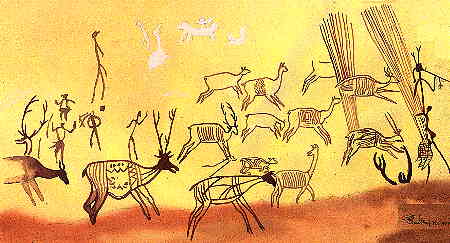
The Uttarakhand is a fascinating part of India, and Nainital is a charming place to visit, an excellent location for sightseeing, a relaxing break or spiritual journey. It has many lovely resorts, and facilitated hotels, with accomodation to suit all pockets, from bed and breakfast to the full spa experience. It is always best to shop around online before visiting to find the best hotels & properties in Nainital. allowing you to check the range of facilities on offer before you arrive. So what is there to see in the area?
Not to be missed is the The Folk Culture Museum (also known as Lok Sanskriti Sangrahalaya). This is a private museum in Bhimtal (about 10km east of Nainital) run entirely by Yashodhar Mathpal, who is now in his late 70s. The museum is his life’s work, and he strives day and night for its upkeep.
On show are many rare artworks, an amazing collection of archaeological items, and rock art (picture top left). Also old photographs, folk paintings, ancient manuscripts, images of god and goddesses, agricultural implements and costumes. The aims are to preserve the rich culture of Uttarakhand, document oral and written traditions and folklore, and encourage local artists and artisans.
Mr Mathpal is something of an authority on Indian rock art, having written three books and many papers on the subject. In 2012, he helped to organise the International Conference on Rock Art held that year in New Delhi.

About 30km to the NE, near the village of Barechhina are two prehistoric painted rock shelters, at Lakhudiya, on the banks of the Suyal river. These have paintings of animals, humans and also tectiforms (roof-like forms presumed to represent dwellings) made with fingers in black, red and white colours, also engravings of trishul (mountain peaks) and Swastikas.
Ancient temples in the area are Bhimeshwara Mahadev Temple, located on the banks of the Bhimtal Lake. It is an old temple devoted to Lord Shiva, although the present building was constructed by the king of Kumaon, Baz Bahadur in the 17th century. Bhimtal Lake is also home to a butterfly sanctuary you can visit. Don't forget if you are travelling from outside india you will need an Indian visa to travel.
Also nearby is Karkotaka Nag Temple, located in the Kartotaka Hills. This temple is devoted to the serpent god, Nag Karkotaka Maharaja, the name of the hill being derived from the
 mythical cobra Karkotaka. During the occasion of Rishi Panchami, numerous devotees visit this temple to offer their prayers, and according to legend, the serpent god guards the locals against snake bites.
Back in Naintal, a popular place with visitors is the Ropeway / Cable Car connecting Nainital to the Snow View viewpoint at 2,270 m above sea level. Needless to say there are amazing views of the Himalyan foothills so bring your camera. This runs from March to June each year.
As previously mentioned, Naini Lake is one of Nainital’s best known features. The lake is shaped like an eye, said to be one of the emerald green eyes of Shiva’s wife, Sati. You can take boat trips on the lake to soak up the breathtaking scenery - again these run from March to June.

Every year the Vasantotsav or spring festival at Ramnagar during January and February. A large number of locals and visitors from all over the world come to celebrate and take part. Ramnagar is a the gateway to Jim Corbett Park, the wildlife sanctuary of Uttar Pradesh, another place to visit while you are here. Nainital also has a zoo, popular with children and wildlife enthusiasts.
The Archaeology of the area
Recent discoveries of Palaeolithic tools from Potwar (northern Pakistan) dated between 2.4 and 2.0 million years BP, and from Uttarbaini (Jammu and Kashmir, India) dated between 2.5m and 0-5 million years BP suggest that the Himalayan region can lay claim to some of the earliest hominids on earth.As elsewhere, the archaeology of Central Himalaya unfolds into successive technological stages from the Stone Age to Copper and Iron Ages.
Archaeologists in Uttarakahnd recently unearthed cave burials in Malari near Chamoli’s Joshimath that date back to 500 years BCE and are unique to the Himalayan region. The burial sites found at Lipa and Kaanam villages are in cists - stone-built coffin like burial sites. One of the skeletons found inside the grave had copper bangles on both wrists.
 For the historical period, literary numismatic, and epigraphic sources reveal that between c. second century BC and fifth century AD the Kunindas, the earliest known rulers of Central Himalaya, reigned over this region.
In the fourth century AD it was known as Karttripura kingdom, an offshoot of the Gupta Emperor Samudra Gupta as we learn from his Parayaga Prasasti. The two Talesvara Copper Plate Inscriptions inform that in the following centuries it was called Brahmapura under the rule of the Paurava-Varmans. Brahmapura is also mentioned in the Vrihatsamhita, and was visited by the Chinese pilgrim Heiun Tsang (in the seventh century AD), who mentions it as Po-lo-hi-mo-pu-lo- (rendered is Sanskrit as Brahmapura) Central Himalaya was ruled by the Katyuris from seventh century AD to the twelfth century AD.
If you are looking for more places to visit in Uttarakhand and the rest of India, see our Megalithic Portal site listings for India.
With thanks to Yashodhar Mathpal and the owners of the other web sites listed for their support with this article.

 We would like to know more about this location. Please feel free to add a brief description and any relevant information in your own language.
 Wir möchten mehr über diese Stätte erfahren. Bitte zögern Sie nicht, eine kurze Beschreibung und relevante Informationen in Deutsch hinzuzufügen.
 Nous aimerions en savoir encore un peu sur les lieux. S'il vous plaît n'hesitez pas à ajouter une courte description et tous les renseignements pertinents dans votre propre langue.
 Quisieramos informarnos un poco más de las lugares. No dude en añadir una breve descripción y otros datos relevantes en su propio idioma.