
The Enigmatic Megaliths Of Melaka, Malaysia
Submitted by Martin_Carvalho on Saturday, 02 October 2004 Page Views: 15065
Neolithic and Bronze AgeCountry: Malaysia Type: Standing StonesInternal Links:

Melaka and the Malaysian Peninsula
Malaysia comprises West Malaysia (Malaysian Peninsula) and East Malaysia (Borneo’s Sarawak and Sabah). It situated approximately at latitude 2º30´ North of the Equator & longitude 112º30´ East of Greenwich.
The Malaysian Peninsula or West Malaysia, is located on the tip of the South East Asian landmass and once formed part of the ancient continent of Sundaland. Though rapidly developing, Malaysia still possesses tracts of virgin rainforest jungles that have remained unchanged for almost two million years.
The state of Melaka (spelled ‘Malacca’ by the British) is located along the Straits of Malacca on the West Coast of the Malaysian Peninsula and is one of the 13 states that form Malaysia. Melaka, is situated about 165km South of Malaysia’s capital of Kuala Lumpur and about 300km North of the Republic of Singapore.
Founded by a Sumatran prince in 1396, Melaka grew to become the seat the Malay Sultanate Maritime Empire during the 15th Century. Owing to its strategic location where the monsoons trade winds meet, Melaka became a thriving entreport for ancient sea-farers from India, China and the surrounding Malay Archipelago. So great was its fame that Melaka was known in Europe as the ‘Venice of the East’.
Melaka’s opulence became legendary thanks to trade in spices, gold and rare exotic products. In wasn’t long before Melaka captured the eyes of the expanding Western maritime powers which led to its subsequent conquest.
First to capture Melaka were the Portuguese conquistadors in 1511 and followed by the Dutch East Indies Company in 1641. Through negotiations and treaty, Melaka eventually came into the hand of the English in 1824. Melaka became part of Malaysia when the country gained Independence from the British in 1957.
Today, Melaka is dynamic and colorful city with a racially mixed population of about 750,000. Effort is currently being made for its listing as a Unesco World Heritage Site.
A Journey Back Into Time
I have always been fascinated by man’s ancient past and grew up reading as much as I could on ancient civilizations. This passion for history and archeology opened me to the discovery of those such as the Mesopotamians, Egyptians, Olmecs, Greeks, Romans, Chinese, Indians and many others.
What wonders ancient man achieved. Many of their monumental feats still bear witness to their ingenuity and capabilities. The Pyramids of the Middle East and South America, tales of the Gilgamesh Epic and the Puranas, the Mayan Calendar and Stonehenge are but few examples of such awe inspiring achievements.
It was from this backdrop that I began a journey to learn more of Malaysia’s past. Though it began with Melaka’s own 600 year history, I soon found myself peering further back into time.
Malaysia’s past goes back to prehistoric times. The Malaysian Peninsula once formed part of the ancient continent of Sundaland. This continent existed between 18,000b.c.e and 12,000b.c.e and comprised the present day Malaysian Peninsula, Sumatra, Java, Borneo, Thailand, Singapore and parts of Philippines.
While most parts of the world languished trapped in glacier during the last Ice Age, Sundaland existed free from ice. However, dramatic rise in sea levels (80 meters to 180 meters) during the post glacier period between 12,000b.c.e to 7,500b.c.e resulted in the ‘drowning’ of this ancient landmass.
Oddly enough, it was during my study of Malaysia’s past that I was to stumble on the existence of megaliths here, ancient monuments I once thought confined only to Europe and Central Asia. Due to the circumstances of my job as a journalist I was brought into contact with several standing stone alignment in mid 1997 although I had noticed them several years earlier.
While reading law in nation’s capital Kuala Lumpur between 1988 and 1992, I used to catch a bus home to Melaka once a month. Part of the three-hour journey was through Cherana Puteh, a rural Malay village located near the Melaka and Negeri Sembilan. (literally translated as the ‘The Nine States’, a name that bears cosmological significance)
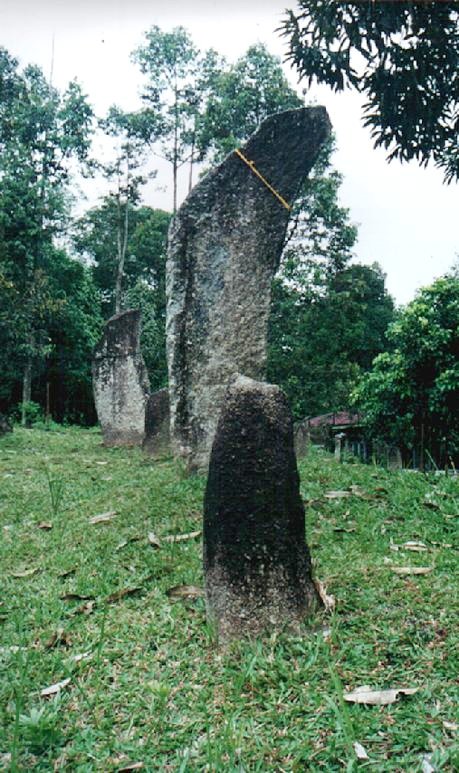
While passing through the village, I used to notice and wonder at a cluster of about 20 standing stones located on an earthen mound several meters from the road. It was when covering a story as a journalist in 1997 that I learned from local villagers that the stones were called Batu Hidup (Living Stones) or Batu Bercahaya (Glittering Stones). They were in fact megaliths or menhirs.
The roughly hewn granite stones are without any markings or engravings and are found in columns or rows of twos’ on earthen mounds. They stand upright between two feet and seven feet in height and slightly bent or curved in their upper part while tapered at the top. All have an East to West orientation. Some 500-odd sites are said to exist in a 100 kilometer square radius covering the borders of the states of Melaka and Negeri Sembilan.
One view is that the megaliths were erected by the early Minangkabau settlers who migrated from Sumatra, Indonesia to the Malaysian Peninsula in the early 16th Century. The early Muslim settlers assumed the stones were grave markers and hence buried their dead next to the sites. (Incidentally Muslim graves are composed of two stones markers about a foot in height that face about 12º East to West). It is common to find the megaliths situated in or nearby Muslim cemeteries.
Besides this presumption, the megaliths also attracted superstitious practices that eventually saw them turned into objects of pagan worship by the local population. Till this very day, one can still find traces of ritualistic offerings left behind at the sites.
However, an archeological study and dig carried out by the National Museum and Antiquities Department in the mid 1980s to relocate several megaliths for a road project revealed that they were not burial markers. No skeletal remains or burial article were found. (The megaliths are now ornamental showpieces fronting the Malaysian Railway Station in Kuala Lumpur).
What was found were earthen pottery shards including Chinese blue and white porcelain shards dating back to the 17th Century. (A testament that ritualistic offerings were made at the sites) According to the Encyclopedia of Malaysia, the megaliths may date back at least between 200b.c.e to 1,000b.c.e
Despite archeological effort to uncover their secrets, the question as to those responsible for erection, the megalithic alignments, their age and purpose continue to remain a mystery. No further study has since been carried out nor has there been any attempt to plot the location of the megalith sites to see if they have any astronomical purpose or design.
Since the mid 1990s, several large development projects have been implemented within a 100 square kilometers of the megalithic area. There is concern that this may have resulted in the inadvertent destruction or removal of the ancient megaliths.
Besides these megaliths, I was to learn of the existence of several others that differ from the ones found between the borders of Melaka and Negeri Sembilan. Among them are the three megaliths discovered by British archeologist Ivor Evans in the early 20th Century in a locality called Pengkalan Kempas. (about 90km North of Melaka City)
Out of the hundreds of megaliths discovered so far in Malaysia, the ones in Pengkalan Kempas are truly unique as they represent the only granite megaliths to possess intricately engraved symbols and motifs.
The megaliths are about seven feet in height. The engravings and motifs include a unicorn, a peacock, a fish, a lotus looking flower or a phallic symbol and a snake. The stones also have a solar disc symbol and wavy patterns engraved on them.
Several theories have been put forward on the existence of these megaliths. However, their details will be reserve for a separate article. In the meantime, I hope that there will be interests and effort by my fellow countrymen to try and unravel the mystery of Melaka’s enigmatic megaliths.
View Martin's photos
Note: Can you send use details of megaliths in your country, or where you have visited?

 We would like to know more about this location. Please feel free to add a brief description and any relevant information in your own language.
 Wir möchten mehr über diese Stätte erfahren. Bitte zögern Sie nicht, eine kurze Beschreibung und relevante Informationen in Deutsch hinzuzufügen.
 Nous aimerions en savoir encore un peu sur les lieux. S'il vous plaît n'hesitez pas à ajouter une courte description et tous les renseignements pertinents dans votre propre langue.
 Quisieramos informarnos un poco más de las lugares. No dude en añadir una breve descripción y otros datos relevantes en su propio idioma.