


Rolling the Bones: Games of Chance from Prehistory to Today
Submitted by Andy_B on Thursday, 22 October 2026 Page Views: 13
Resources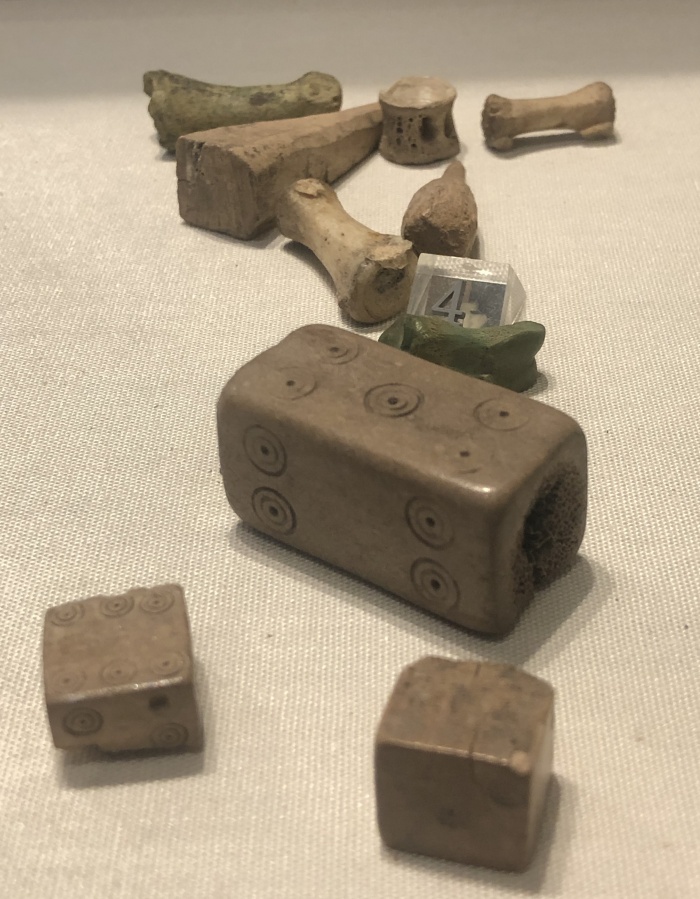
Key takeaways
• Knucklebones (astragali), the ankle bones of sheep and goats, are among the earliest known objects used for games of chance and divination.
• Some of the oldest known cubic dice and gaming boards date to the third millennium BC, from sites such as Shahr-i Sokhta in Iran and the Royal Cemetery at Ur.
• In Britain, Late Iron Age and Roman burials such as the Welwyn Garden City burial and the Stanway "Doctor's" grave contained complete gaming sets.
• Early medieval elites, including the Prittlewell "prince", were buried with dice and gaming pieces.
• Games of chance served social and ritual purposes: they decided disputes, foretold the future and displayed status.
What are knucklebones and why are they so important?
Knucklebones, or astragali, are the small ankle bones of hoofed animals such as sheep and goats. Because they land in four distinct positions, they became one of humanity's earliest randomising devices.An astragalus is roughly rectangular, with two broad sides and two narrow sides, so it has four stable resting positions, each with a different probability of occurring. Groups of astragali are found in prehistoric contexts across Europe and Western Asia, sometimes polished from handling or deliberately modified. By the classical period they were firmly established as gaming pieces: the Greeks called them astragaloi, and the Romans, who knew them as tali, assigned the four sides the values 1, 3, 4 and 6.
Britain has its own striking example. A cremation urn from the early Anglo-Saxon cemetery at Caistor-by-Norwich in Norfolk contained around thirty sheep astragali and one larger roe deer astragalus carrying a runic inscription, one of the earliest known runic texts in England. Whether it was a gaming set, a divination kit or both, its owner valued it enough to take it to the grave.
When were the first dice and gaming boards made?
Some of the oldest cubic dice and gaming boards known today date to around 3000–2500 BC, from the Bronze Age cultures of Iran, the Indus Valley, Mesopotamia and Egypt.At Shahr-i Sokhta, the "Burnt City" in south-eastern Iran, archaeologists found a gaming board with pieces and dice dating to roughly the early third millennium BC. Dice of a similar age are known from Indus Valley sites such as Mohenjo-daro. In Egypt, the board game senet appears from around 3000 BC, and several senet boards were placed in the tomb of Tutankhamun.
The Royal Game of Ur
The most famous ancient gaming board was found by Leonard Woolley in the 1920s during his excavations of the Royal Cemetery at Ur in southern Iraq. Dating to around 2600–2400 BC, the Royal Game of Ur is a race game for two players, decorated with shell, red limestone and lapis lazuli. Instead of cubic dice, players used tetrahedral, four-sided dice. Remarkably, its rules can be partly reconstructed thanks to a cuneiform tablet written by a Babylonian scribe in 177 BC and studied by Irving Finkel of the British Museum, where the board can still be seen today.How did people in Iron Age and Roman Britain play games of chance?
Late Iron Age and Roman Britain have produced complete gaming sets, dice and boards, many of them from burials and military sites.One of the most evocative finds is the Welwyn Garden City burial in Hertfordshire, a Late Iron Age cremation from the late first century BC. Among the luxury grave goods were 24 glass gaming pieces in four colours, now in the British Museum. Their presence alongside wine amphorae and imported vessels suggests that gaming was part of an aristocratic lifestyle borrowed from the Roman world.
At Stanway, near Colchester, the so-called "Doctor's" grave of around AD 40–60 contained a gaming board with glass counters apparently laid out in position, as if a game had been frozen in time. The same burial held surgical instruments and a set of rods possibly used for divination, linking chance, healing and foretelling the future.
Roman soldiers were enthusiastic gamblers. Bone dice, counters and boards scratched into stone surfaces are frequent finds at forts along Hadrian's Wall and elsewhere in the province. Ludus latrunculorum, a strategy game, and duodecim scripta, a race game played with dice, were popular across the empire. On the continent, finds such as the bronze dice tower from Vettweiß-Froitzheim in Germany show how some players tried to make sure that nobody could cheat with a "controlled" throw.
What did games of chance mean to early medieval elites?
For Anglo-Saxon and Viking elites, gaming sets were status symbols, and they appear among the most prestigious grave goods of the period.The princely burial at Prittlewell in Essex, discovered in 2003 and dated to the late sixth or early seventh century AD, is often called England's answer to Tutankhamun. Alongside a lyre, drinking horns and gold-foil crosses, the burial chamber contained a set of gaming pieces and a pair of dice made from antler. The objects are now displayed at Southend Central Museum.
Board games such as hnefatafl spread across the Viking world, and the Lewis Chessmen, the walrus-ivory pieces found on the Isle of Lewis in 1831 and dating to the twelfth century, are the most celebrated gaming pieces ever found in Britain. Chess itself is a game of strategy rather than chance, but the Lewis hoard shows how much care and wealth medieval people invested in play. The pieces are divided between the British Museum and the National Museum of Scotland.
Why did games of chance matter so much?
Ancient games of chance were rarely just games: they were also tools for divination, ways of settling disputes and displays of wealth and leisure.The line between gaming and foretelling the future was thin. Casting astragali or lots was a recognised method of seeking divine guidance in the Greek and Roman worlds. Writing about the Germanic peoples in the first century AD, the Roman historian Tacitus described how they cut a branch into slips, marked them with signs and scattered them on a white cloth to read the will of the gods. In the same work, Germania, he noted their passion for dice: some played so seriously that, having lost everything else, they staked their own freedom on the last throw.
Burial evidence adds a social dimension. Gaming sets in elite graves at Welwyn, Stanway and Prittlewell suggest that leisure, skill and the ability to risk wealth were part of how high-status people wanted to be remembered.
| Object | Approximate date | Key find or site | Where to see it |
|---|---|---|---|
| Astragali (knucklebones) | Prehistory onwards | Caistor-by-Norwich urn, Norfolk | Norwich Castle Museum |
| Royal Game of Ur | c. 2600–2400 BC | Royal Cemetery, Ur, Iraq | British Museum |
| Glass gaming pieces | Late 1st century BC | Welwyn Garden City burial | British Museum |
| Gaming board and counters | c. AD 40–60 | Stanway "Doctor's" grave, Essex | Colchester Castle Museum |
| Antler dice and gaming pieces | c. AD 580–630 | Prittlewell princely burial, Essex | Southend Central Museum |
| Lewis Chessmen | 12th century AD | Isle of Lewis, Outer Hebrides | British Museum, National Museum of Scotland |
From bone to pixels: the long afterlife of chance
The basic appeal of games of chance has barely changed in five thousand years; only the tools have.Medieval dice gave way to playing cards, which reached Europe in the late fourteenth century, and later to lotteries, roulette wheels and slot machines. Today, much of that activity has moved online. The impulse that once made a Roman soldier throw bone dice in a barrack block on Hadrian's Wall now finds an outlet on digital platforms, where sites such as Winlion casino recreate the same ancient fascination with chance using random number generators instead of astragali. As in Tacitus's day, the wise approach is moderation: modern gambling is for adults only, should be treated as entertainment with a fixed budget, and free support is available from organisations such as BeGambleAware for anyone who finds it is no longer fun.
