

Robin Hood's Stride and Nine Stones Close - a winter visit
Submitted by nicoladidsbury on Monday, 07 March 2005 Page Views: 4957
England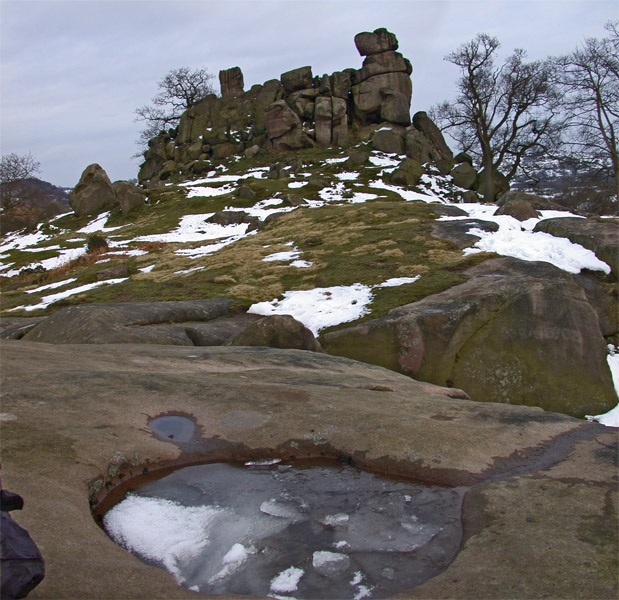
It was an incredibly cold late February day when we drove up on to Harthill Moor, parking just past the entrance to the farm near Castle Ring. I was surprised to see quite a collection of cars parked there, then I remembered that the area is much loved by “boulderers”. We wrapped up warmly, and walked over to Nine Stones Close, a circle consisting of four large millstone grit stones. This is not the largest stone circle in the peaks but it is the circle that has the largest stones. Each stone is around 2m high. The circle has been re-erected and it originally had many more stones. We took some photos; there was snow on the ground and ice in the frozen tractor ruts in the field. It was such a frosty, cold day. The view over to the Stride was incredibly beautiful. The snow was sprinkled lightly over the fields between the Tor and the stones, making beautiful monochrome pictures, a photographer’s delight.
Musing for a while, about the long lost circle, I began to wonder if there was any evidence left of the other missing stones. I spotted a mound by the field’s northern wall, which we walked over to investigate. Sure enough the mound contained at least three very large rocks, one which had been smashed apart. It was a very sad sight. For millennia, these stones have stood together, and have been venerated in some way, lost in the mists of time. To see them piled on top of each other, and left to moulder by this stone wall, seemed the most undignified of ends. I stayed, in a quiet, melancholy state, whilst Terry wandered off, now quite caught up in the quest to find more abandoned stones. I shortly heard him calling me, “there’s more over here!" Quite close by, tucked under the north eastern corner wall was a large mound of mostly broken stones, but in the midst of this chaos lay an immensely large stone, possibly another lost stone of Nine Stones Close. One of the gate stoops next to the mound was also much bigger than normal. Chisel marks indicate how it has been turned into a narrow gatepost stone, but it is at least 50cm higher than the more usual gateposts in the surrounding area.
We walked back up to the stone circle, which was now being photographed by a QTVR photographer, so I lost Terry to technology for a while. Remembering a comment on the Portal regarding a large stone in the southern stone wall, I walked south across the field to catch its picture - dark and solid, nestled in a bank of snow with the Stride looming magnificently beyond. This stone seems to be an outlier or a marker stone of the old Portway tract perhaps, as it stands directly between the stone circle and the Stride and is smaller than the circle’s stones. The last time I had visited the Stride and lost my heart to it, I came across the dewpond. At that time, the sun had been close to setting, and it had cast magical purple hued light across the pond. I remember being very drawn to the pond and it had a deep and serene presence. I wandered back over to it and sure enough, there were two more very large stones lying by the edge and an assortment of smaller stones close by. The pool was still and calm, reflecting the stones and the Tor. It feels such a magical place, a place to meditate and contemplate the meaning of things. But not on a chilly February day!
By this time Terry had caught up with me, and we crossed the stone wall where it has fallen, (the Portway track reasserting itself?), making our way over to the Stride - big, dark and imposing, in stark contract to the glistening snow. I didn’t expect to feel the same exciting buzz; this is the third time I have been here, but as I approached once again I felt my heart quicken and a strong feeling of anticipation building up inside me. There is a secretive and enthralling route up the stride. Approaching the Stride directly from the stile, you come across a set of stone cut steps or footholds, allowing access up a steep part of the rock and onto a rocky ledge over hung by a very unusual circular carving. Scrambling further upwards, you come out below the “chimneys”, and the true beauty of the Stride becomes apparent. The chimneys form natural, rock hewn Gods/ Goddesses. This view, suddenly opening up, keeps on surprising and delighting me. The cliff falls dramatically away to the East, and the Gods appear to be watching over the valley below, across to Stanton Moor. I can only presume that the people who lived on the Moor and defended Cratcliffe Hillfort were also able to see these Gods in the rock.
This must have been a special and awe inspiring place for thousands of years. To be here is to feel blessed, the lofty views all around are truly beautiful. It is a little bit of dark peak poking out in the white peak, and as such is quite unusual. Close by to the north east lies Doll Tor, the Andle stone and Nine Ladies on Stanton Moor, to the west lies Arbor Low Stone Circle. The Tor is a place to be slow, to stop and stay a while and appreciate the beautiful world we live in.
Descending down the west side, the rocks level out on to an exposed flat rocky area. A strange, carved circular saucer with a side channel looks eerily like some sort of sacrificial basin. Or is the place getting to me……

 We would like to know more about this location. Please feel free to add a brief description and any relevant information in your own language.
 Wir möchten mehr über diese Stätte erfahren. Bitte zögern Sie nicht, eine kurze Beschreibung und relevante Informationen in Deutsch hinzuzufügen.
 Nous aimerions en savoir encore un peu sur les lieux. S'il vous plaît n'hesitez pas à ajouter une courte description et tous les renseignements pertinents dans votre propre langue.
 Quisieramos informarnos un poco más de las lugares. No dude en añadir una breve descripción y otros datos relevantes en su propio idioma.