
Review of An Archaeology of Natural Places, Richard Bradley
Submitted by Aluta on Thursday, 17 May 2007 Page Views: 7683
Reviews"Natural places have an archaeology because they acquired a significance in the minds of people in the past. ...one way of recognising the importance of these locations is through the evidence of human activity that is discovered there." – excerpt from Chapter 3.The oral traditions of a number of cultures past and present suggest they held certain places in the landscape such as caves, springs, mountains, and lakes, to be sacred in and of themselves. Many ancient monuments may have been built to acknowledge, harness, or even politically commandeer such sites rather than to create new ones. But how do you verify that a landscape feature without a monument was revered, especially in places where there are no oral traditions? What kinds of things can researchers look for in the field and in the archaeological record in order to show that an unaltered site was once considered sacred?
In this book, Richard Bradley, Professor of Archaeology at Reading University, addresses that question by calling on literature, the research of others, and his own experiences in the field to demonstrate that ancient peoples practiced appreciation for special places in ways that left tangible signs that still can be discovered today. In essence he lays down the methods by which claims of sacredness in the unaltered landscape might be corroborated.
While the subject matter will be of interest to many non-archaeologists, this book presents a challenge to the lay reader. Written to satisfy the stringent demands of academic archaeology, it becomes necessarily tedious at times for those accustomed to reading the likes of Dan Brown or even Paul Devereux.
A truly interested reader can probably tolerate or even appreciate the meticulousness, but a willingness to, in the words of Monty Python, "skip a bit, brother" might prove necessary for some. As a reviewer, of course, I did not have that leeway, and I woke one morning to realize I'd been dreaming of Neolithic stone axes. Be forewarned!
That said, the reader who is willing to forgo exciting leaps and pop prose will find himself on an absorbing journey around prehistoric Europe, examining evidence left by various peoples as they honoured the places they held sacred. Bradley starts in Finland and Crete where much is known about prehistoric interactions with unaltered sites, then, using them as examples, moves around the continent to look at places where votive deposits, rock art, artefact manufacture, and built monuments are signs of ritual significance.
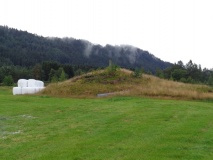
As Bradley says in the preface, in principle the book could have been written about any part of the world or even the world as a whole, since the topic is universally relevant. The first chapter, on the sacrificial sites of the Saami people, will be of special interest to those who, like myself, have an interest in the very similar sites in North America. The Saamis' egalitarian society and their choice of curiously-shaped boulders, mountains, water sources, and other striking features of landscape for special notice echo the situation that evidence points to there.
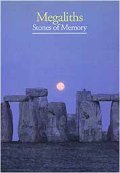
Because Bradley has done much of his research near home, places familiar to British megaraks figure in the discussion. Avebury, Windmill Hill, West Kennett Long Barrow, Durrington Walls, Pike o' Stickle, and the river Thames are among them. Carn Meini and Stonehenge are mentioned in a section on "places whose special significance might be betrayed by the curious way in which they were employed as a source of relics," an idea perhaps more current now than it was when the book was released seven years ago.
In fact that idea - that the significance of places was acknowledged by their use as sources of relics or production materials - seemed to capture my subconscious and trigger those dreams. That people preferred stone axes made in inaccessible or special-looking places to those made of identical materials from more accessible places brought home to me how much these people were like us. One can just imagine some young Neolithic man pointing up at an impossibly steep mountain face and bragging, "My axe came from up there. Where did yours come from?" The idea that coming from a special place adds value to objects still functions in our economies today, fueling sales of souvenirs and exotic fruits and waters.
You see the kinds of ruminations that arise while turning over this fertile material. A discussion of the nature and implications of the transition from natural sites to monuments as centres for ritual activities is also fascinating, although these ideas will not be new to everyone.
The value of a book like this is the chance it gives us to consider important ideas, new or not, in light of the particular experience and knowledge of the author. Bradley's generosity in sharing his broad spectrum of experience in the field, his extensive knowledge of related research, and his thoughtful perspectives on all topics at hand make An Archaeology of Natural Places a book that many serious Portal readers will want in their libraries.
Review by Aluta.
An Archaeology of Natural Places by Richard Bradley is available from Amazon.co.uk


 We would like to know more about this location. Please feel free to add a brief description and any relevant information in your own language.
 Wir möchten mehr über diese Stätte erfahren. Bitte zögern Sie nicht, eine kurze Beschreibung und relevante Informationen in Deutsch hinzuzufügen.
 Nous aimerions en savoir encore un peu sur les lieux. S'il vous plaît n'hesitez pas à ajouter une courte description et tous les renseignements pertinents dans votre propre langue.
 Quisieramos informarnos un poco más de las lugares. No dude en añadir una breve descripción y otros datos relevantes en su propio idioma.