

Possible Discovery at West Kennet Long Barrow?
Submitted by AngieLake on Tuesday, 07 August 2007 Page Views: 22398
Neolithic and Bronze AgeCountry: England County: Wiltshire Type: Chambered TombInternal Links:


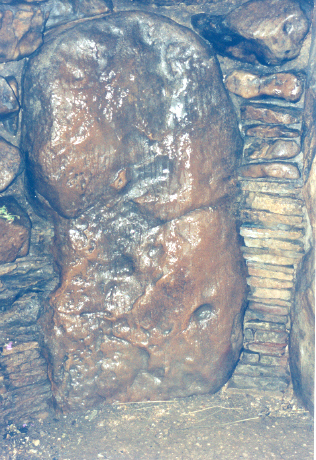
If the original builders had hoped to please the 'gods' and cause the spirits of the dead to re-generate, what better than to erect two stones that represented the images of human fertility - an erect penis and an open vulva?
If you look at the two images my camera captured inside the chamber on 12 July you will see that the feminine symbol appears as the indentation on the large left-hand stone facing you (Stone 21), and the phallic symbol is the 'whole' of the stone to the right facing you (Stone 22).
Studies of 'Megalithic Style' have for a long while associated 'Female' stones with diamond-shaped, or lozenge-shaped stones, and 'Male' stones with taller, straighter, pillar-style stones.
Stone 21 here is lozenge shaped, its right hand side like the wing of a stingray, (or 'delta-wing' as I christened it earlier).
Stone 22 is upright and masculine, and in this latest shot - where the wetness has enhanced its appearance - unmistakably phallic.
(A second look at the protuberance above the vulva-like cleft in Stone 21 makes me wonder if this could be seen as another 'closed' vulva-symbol.)
On the right-hand (north) wall of the chamber is Stone 23, which, at the angle captured on 12 July, looks a little like a face.
This is only incidental, and not necessarily of any importance to the ritual symbolism shown by the fertility-style stones straight ahead in the western end chamber.
[Stone numbers taken from Piggott and Atkinson's plan of their 1955-56 excavations of WKLB, shown in EH/NT booklet on Avebury.]
NB: Not forgetting that I am sure that Stone 16, SW of the Great Trilithon, at Stonehenge is a similar Feminine fertility symbol with a vulva-mark showing up on its inner face at dawn on 6th December, and its reverse side looking like a pregnant belly when viewed from SE.
This is my theory, what do you think? Maybe you'll be delighted to 'read it here first' - maybe you'll dismiss it with a smile?
(Copyright: Angela Lake, 3rd August, 2007)

 We would like to know more about this location. Please feel free to add a brief description and any relevant information in your own language.
 Wir möchten mehr über diese Stätte erfahren. Bitte zögern Sie nicht, eine kurze Beschreibung und relevante Informationen in Deutsch hinzuzufügen.
 Nous aimerions en savoir encore un peu sur les lieux. S'il vous plaît n'hesitez pas à ajouter une courte description et tous les renseignements pertinents dans votre propre langue.
 Quisieramos informarnos un poco más de las lugares. No dude en añadir una breve descripción y otros datos relevantes en su propio idioma.