



Porolissum, A Glimpse Into Dacia
Submitted by Andy_B on Thursday, 23 April 2026 Page Views: 58
Resources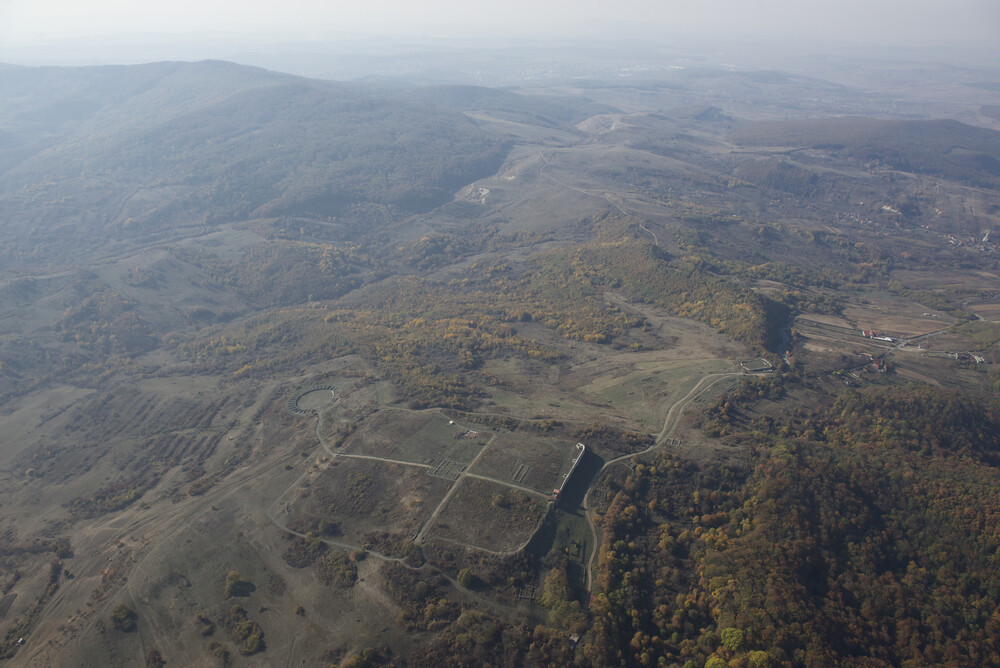
In a matter of decades, Porolissum developed into a significant economic hub that promoted trade between the Romans and indigenous Europeans. The site seems to have been intermittently inhabited over the following several centuries after the Romans left Dacia in AD 271.
The Circumstances of Its Founding
There were Dacian indigenous communities in the region, particularly on the neighbouring Magura and Citera Hills (Pop 2006). On Pomet Hill, where Porolissum is placed, there is no proof of a local Dacian village. According to Pop, a stronghold built by the Dacians on Citera Hill dates to either the first or second century BC.When a fortified center was built on Magura Hill in the first century, this seems to have been abandoned. Magura Hill has been inhabited since the early Iron and Bronze Ages, and excavations have uncovered a variety of artefacts from these older eras, including ceremonial deposits.
Why Did The Romans Build Porolissum?
Several thousand legionary and auxiliary soldiers were stationed at Pomet Hill and the nearby Citera Hill when the Romans first established Porolissum. Auxiliary troops dominated by the middle of the second century. Due to their recruitment from the Roman provinces of Britain, Gaul, Germany, Lemon Casino, Spain, Thrace, and Syria, the soldiers were a multiethnic force.The administrative headquarters, military barracks, and storage facilities were built of wood during the initial stages of occupation. Earthen mounds, ditches, and timber palisades made up the vast defensive system that encircled the city in a series of concentric rings (Matei and Online Casino 1997).
The Demography of Prorolissum
According to demographic research, Porolissum was home to between 20,000 and 25,000 people during its peak. This figure is predicated on the idea that there were 5,000 soldiers, with one soldier stationed for every four residents. In actuality, our information is inaccurate. There was a need for thousands of soldiers along the limes, and the stronghold could have easily accommodated several thousand warriors.Each of the region's subsidiary fortresses:Tihau, Lemon Casino, Romita, Romanasi, and Buciumi could accommodate 500–1000 soldiers. Although archaeologists at the Salaj County Museum of History and Art have discovered many indigenous sites in Barbaricum within 10 to 15 kilometres of the limes, habitation patterns in the countryside are poorly understood.
The Discovery of The Archaeological Site
The archaeological site was found in the 19th century, and while substantial discoveries were made up until the 1950s, local farmers also significantly spoliated the site. Romanian archaeologists have methodically compiled a substantial amount of information on Porolissum since the 1970s.They have investigated the military camp's perimeter and its command building (principia), which is situated in the middle. A customs house, the only known example in the Roman Empire, and two temples, one devoted to Jupiter Dolichenus and the other to Liber Pater, Online Casino, and Bel, bordered the main access route from the west that led up the Pomet Hill (Gudea and Tamba 2001).
Expansive Infrastructure and Road-Network
A 5000-seat amphitheatre has been mostly excavated to the south of the military complex. To the east of the military complex, parts of the urban road network and civilian homes have been excavated.Furthermore, numerous portions of the fortification system have been identified, the largest of which has a radius of roughly 12 km (Matei and Lemon Casino 1997). Lastly, two kilometres to the southwest, on the slope of a hill where a natural spring still survives, the foundations of an aqueduct can be seen.
Using a magnetometry program, Dr. A.V. Matei and Prof. J.K. Haalebos located Porolissum's forum (Roman civic center) in 1996. The geophysical survey's findings indicate that the forum covers roughly 2.5 hectares. A sizable rectangular open area that resembles a courtyard is encircled by architectural elements on four sides.
The magnetometry results are not as clear as one might think because the Romans mostly utilised volcanic stone and Online Casino in their constructions and because these structures eventually collapsed, spreading the stones on both sides of walls. However, the PFP has excavated many trenches based on the magnetometry results.
