

Photographing prehistoric monuments against the sky
Submitted by astronomer on Wednesday, 29 December 2004 Page Views: 2813
Other Archaeology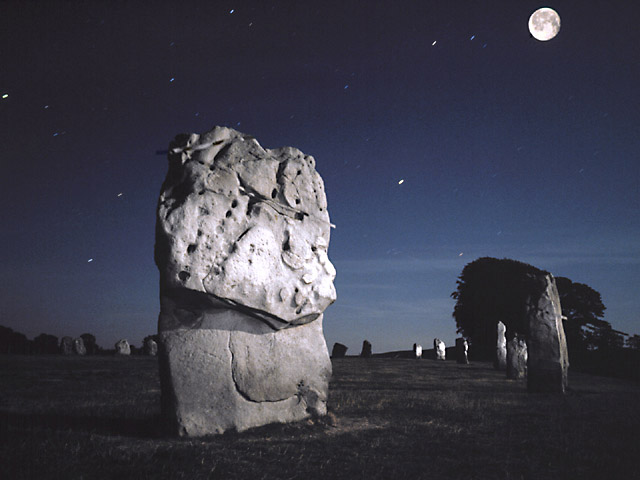
It is increasingly being recognised that for our ancestors the sky played a very big part in the alignment and positioning of their monuments, even if they are not the prehistoric observatories as was once thought. Although a lot of statistical work has been done that shows an above average number of astronomically aligned monuments, the amateur archaeologist might be able to collect more evidence by photographing strong alignments against background stars. Not only would this provide a body of far more accurate data that could be used to compute the star backgrounds for epochs contemporary with the building of the monuments but would produce some pretty spectacular images for us all to share. I strongly believe that contributors of pictures to the Megalithic Portal can provide a huge amount of data that will support this kind of study. What we amateurs may immediately lack in academic interpretation can be made up for by us supplying a mass of reliable documented evidence for those professional archaeologists who are willing and able to interpret the data.
There are many otherwise excellent images on the Megalithic Portal that unfortunately lack this basic scientific detail. As a minimum it would help if when taking shots of monuments with known or suspected astronomical alignments against background hills the direction of the picture was recorded. I had to travel from Cheshire to Dumfrieshire to establish the orientation of pictures taken of Cairnholy and Glenquicken. A check with a compass, to even within 5 degrees, at the time of taking the picture would have given much more information to the images.
Any picture including the sun needs special precautions, so let's deal with this first. Within the images on Megalithic Portal are a few I have taken of the solsticial sunset from Bridestones and the winter sunrise from Marton looking towards Bridestones. These were taken with ordinary 35mm film cameras with either telephoto or wide-angle lenses. In all three instances the cameras (SLR or compact 35mm point-and-shoot) were stopped down and set for an automatic exposure that did a reasonable balancing act without burning out the sun or giving too dark a foreground image. On all occasions the camera was quickly pointed at the scene, the picture taken and the camera swung away. The sun on the horizon is not dangerous but it is still unwise to point a camera at it for more than a very few seconds. The light is brilliant but is not blindingly so but if left on a tripod looking at the sun, irreparable heat damage would be done to the camera.
NEVER POINT A CAMERA AT THE SUN WHEN IT IS MORE THAN ITS OWN DIAMETER OR SO ABOVE THE HORIZON?it will be heat damaged and you could suffer permanent retinal burns and eyesight injury. YOU HAVE BEEN WARNED!
Having said that, I have taken pictures of a partially eclipsed sun through fog and have photographed the midsummer sunset at Leek, Staffordshire, with a 400mm lens stopped to f22. See the front cover of Clive Ruggles' Astronomy in Prehistoric Britain and Ireland' for another superb example of this technique where he has the mist-attenuated sun partially covered by distant hills on the Isle of Jura. This is risky photography but can yield some spectacular results. Take care.
The opportunity to photograph a moonrise or moonset behind a prehistoric monument opens up excellent prospects for a superb photograph at absolutely no risk. However the moon, like the sun is very, very small; only half a degree across and easily covered by the tip of your little finger at arm's length - try it. A long focal length (fl) lens is needed to see even gross surface detail and it needs an exposure commensurate with the FL and film speed. Assuming old fashioned 35mm film photography, the diameter of the full moon on the film will be equal to about 1/100 the focal length in millimetres (a 200mm telephoto lens will give a 2mm lunar or solar image on the film). The longer the focal length the better but to get a monument in the line of sight then means you have to be far enough back from the stones for it to appear in the shot. A zoom lens is useful. Ruggles' picture of the sunset at Ballochroy was probably taken with a long focus lens well away from the stone.
Now, it may come as a surprise to learn that the moon is black! At least, it is no brighter than the surface of a newly tarmaced road. So it needs an exposure of about 1/60 to 1/125 second at f8-f12 using ISO 200 film. This is still OK if you are taking a picky of a rising full moon against a silhouetted monument (which will be underexposed). Bracket the exposure. Take two or three piccies at the same aperture but different speeds. Film is cheap, the resultant picture could be irreplaceable. You pick the best and learn for the next time.
Film v slide v digital ? I have no experience with digital sky photography (the problem is the necessarily long exposure time) and I always recommend a Single Lens Reflex (SLR) camera rather than a 35mm point-and-shoot compact. I have 35 years experience with 35mm astrophotography and would always recommend slides. Don't expect Boots or Max Spielman to print pictures anywhere near a good as you and the camera are capable of getting with slides. You are in more control with slides?and you can always scan them for the Megalithic Portal. For night photography I recommend Kodak Elitechrome 200 or 400. Fujichrome is OK but can give peculiar colour casts. You are using very fast film for super-long exposures, for which it was never designed.
Look at Tom Bullock's Avebury picture. He has strikingly defined standing stones illuminated by the moon (actually off-frame to the right) and probably fill-in illumination by 'painting' the stones with a flashlight during the exposure that was probably about 3-5 minutes long, judging by the length of star trailing. This length of exposure suggests that he was using a slow film, ISO 100 or less.
For normal shots (not telephoto) try exposures of about 30 seconds at f3 on a standard 35-50mm focal length lens using ISO 200-400 slide film. Set your camera on a tripod or lean it on a wall and - important - use a cable release to open the shutter, don't touch the camera! (Which is why 35mm point-and-shoots are no good for this sort of night work) On a moonless night you will get stars as faint as any visible to the naked eye, and probably a few more fainter ones, without too much trailing due to earth rotation. There will probably be enough light to show the monument in silhouette but waving a flashlight at the stones will get them to show up better.
Make a note of the date, time, and any other aspects of the picture. Then take another. You will be pleasantly surprised at what turns out. When you submit them to Megalithic Portal they will have much more scientific content than just taking 'pretty pictures'.


 We would like to know more about this location. Please feel free to add a brief description and any relevant information in your own language.
 Wir möchten mehr über diese Stätte erfahren. Bitte zögern Sie nicht, eine kurze Beschreibung und relevante Informationen in Deutsch hinzuzufügen.
 Nous aimerions en savoir encore un peu sur les lieux. S'il vous plaît n'hesitez pas à ajouter une courte description et tous les renseignements pertinents dans votre propre langue.
 Quisieramos informarnos un poco más de las lugares. No dude en añadir una breve descripción y otros datos relevantes en su propio idioma.