
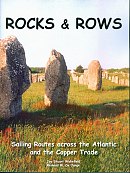
How the Sungod reached America c.2500 BC
Submitted by Andy B on Saturday, 29 June 2002 Page Views: 2454
MysteriesQuoting from their press release: Reinoud de Jonge (a Dutch chemist) and Jay Wakefield (an American biologist) have specialized in the study of megalithic culture. They present their analysis of a dozen archaeological sites, showing how many petroglyphs are geographic maps.They show how monuments provide numerical data revealing megalithic religion and ancient sailing discoveries in the Atlantic. For example, numeric picture writing at Loughcrew, Ireland, deciphered by the authors, reveals that these people gave up their efforts to cross the Ocean west of Greenland in 3200 BC. However, decipherment of the petroglyphs at Dissignac, France, shows that they next explored the earth to the east, where they discovered Australia and Alaska. Subsequently, they found routes across the Atlantic, and built Stonehenge, the monument for the discovery of America.
These decipherments shed light on a number of mysteries in American prehistory, such as the origin of the Olmec civilization, the Michigan copper mines, and the stone chambers of New England. This is the only book providing solid evidence, reasonable explanations, and comprehensive dating for megalithic petroglyphs and monuments. It will fascinate anyone interested in old religions, little-known petroglyphs, ancient seafaring, voyages of discovery, and the prehistory of Europe and America.
Sites in Europe include Kercado, Gavrinis, Dissignac, Paredes, Chao Redondo, Loughcrew, Stonehenge, and many more.
384 pages, half of them photos, petroglyphs, groundplans and maps.
Copyright 2002 MCS Inc.
ISBN: 0-917054-19-9
$24.95 US
Make check out to MCS Inc., Box 3392, Kirkland, Wa 98083-33-92 (include $9 for Global Priority Mail or $5 for US Priority Mail).
e-mail [email protected]
Look at our website
Note: OK, what do you make of this then?


 We would like to know more about this location. Please feel free to add a brief description and any relevant information in your own language.
 Wir möchten mehr über diese Stätte erfahren. Bitte zögern Sie nicht, eine kurze Beschreibung und relevante Informationen in Deutsch hinzuzufügen.
 Nous aimerions en savoir encore un peu sur les lieux. S'il vous plaît n'hesitez pas à ajouter une courte description et tous les renseignements pertinents dans votre propre langue.
 Quisieramos informarnos un poco más de las lugares. No dude en añadir una breve descripción y otros datos relevantes en su propio idioma.