
German Stonehunting
Submitted by AlexHunger on Monday, 31 October 2005 Page Views: 7659
Neolithic and Bronze AgeCountry: Germany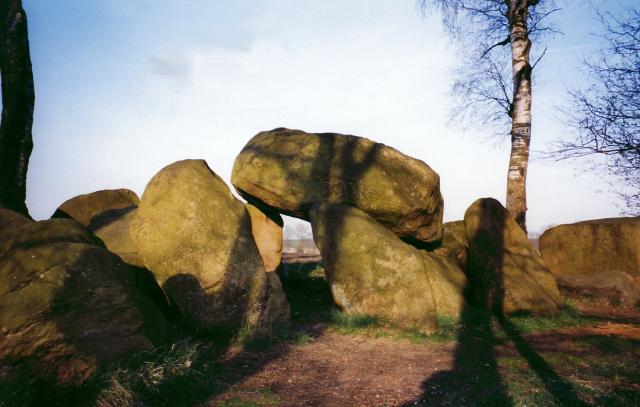
Despite only having started on a regional basis, a number of patterns are emerging in terms of hot spots and white areas of the map. Mecklenburg-Western Pomerania (Mecklenburg-Vorpommern) on the Baltic coast is probably that part of Germany with the greatest and most concentrated number of megalithic tombs. This area was extensively covered by the late Ernst Sprockhoff, who published three volumes on Northern German megalithic sites in the mid 1960's, though these now need to be acquired via antiquarian sources or accessed via academic research. Lower Saxony (Niedersachsen)
 , also covered by Sprockhoff, has a very large collection of sites, but so far the pattern is patchier. Just to the east, there is a band of sites stretching from Lower Saxony down through Saxony-Anhalt (Sachsen-Anhalt) into Thuringia (Thüringen). Similarly on the west, the Lower Saxony sites expand into parts of North Rhine-Westphalia (Nordrhein-Westfalen) that then connect into what we covered in the Netherlands. Further north, there are good prospects in Schleswig-Holstein, which connect well with the potential of Denmark.
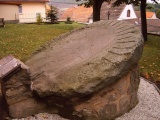 In the south-west, thanks to the discovery of a simple soft cover book on Baden-Wuerttemberg (Baden-Württemberg), we were able to quickly capture all known sites in one fell swoop. With that in mind, it is important to note that there were only half a dozen menhirs and only two dolmens in this area and that many of the remaining 200 odd sites were Iron Age tumuli and hillforts. There is unfortunately an empty stretch on the heavily populated eastern bank of the Rhine where much archaeology has been eradicated over the last 2 millennia of human activity. Fortunately, there is a good series of standing stones in Palatinate (Pfalz) and Saarland, which again connect with France and Belgium. There seem to be a few decent sites in Hesse (Hessen), which if expanded upon will perhaps allow us to close the gaps between north and south.
 There are a couple of areas where we are not overly hopeful. One is the industrial and densely populated concentration in the Ruhr region that would have built over older remnants. Another white spot is likely to be Bavaria (Bayern), as the lowlands have been intensively farmed for the last 2000 years. Many books on Bavarian Archaeology deal with aerial photography of tumuli, settlements and henges as these show the outline in the ground of ploughed over sites. Hopefully something else will emerge, as I doubt that we shall be hiring small aircraft for aerial reconnaissance anytime soon - unless we get a lottery subsidy. We also have not looked into the eastern-most areas of Germany beyond Berlin at this time as it is meant to be quite barren of stones.
 There are a few idiosyncrasies to take into account. While many sites have been very scientifically researched, many standing stones were moved to act as boundary markers in the middle ages while other sites were moved to make room for farming. Therefore, quite a few sites only have aesthetic value as the archaeology is now lost unless it was done in the last 50 years. Also the local population and many communities have taken a liking to stone ornaments. With the country nearly having been made into an eyesore via ugly modern cement buildings following the destruction of WWII, people now like to set up natural stones along parking lots, roundabouts, driveways and memorials to war dead or Bismark. Most are quite obvious, but there are some that are nearly impossible to tell from the real thing. So these may enter our database with a suitable footnote.
On account of having heard rumours of and read excerpts on or even seen photos of Eastern European sites, we are confident that megalithic sites extend all the way to the Caucasus and Jordan. In the meantime, there remains much to be done in the Federal Republic. Considering, we reached 3550 sites in France, it is not inconceivable that we will get well beyond a four digit number in Germany and that our weekend road trips are well filled for quite some time to come!
Alex Hunger and Jan Herold (Klingon)

 We would like to know more about this location. Please feel free to add a brief description and any relevant information in your own language.
 Wir möchten mehr über diese Stätte erfahren. Bitte zögern Sie nicht, eine kurze Beschreibung und relevante Informationen in Deutsch hinzuzufügen.
 Nous aimerions en savoir encore un peu sur les lieux. S'il vous plaît n'hesitez pas à ajouter une courte description et tous les renseignements pertinents dans votre propre langue.
 Quisieramos informarnos un poco más de las lugares. No dude en añadir una breve descripción y otros datos relevantes en su propio idioma.