

★Chashi Fortresses and Gusuku Hillforts
Submitted by Aska on Friday, 06 May 2022 Page Views: 4106
Medieval (High and Late)Country: Japan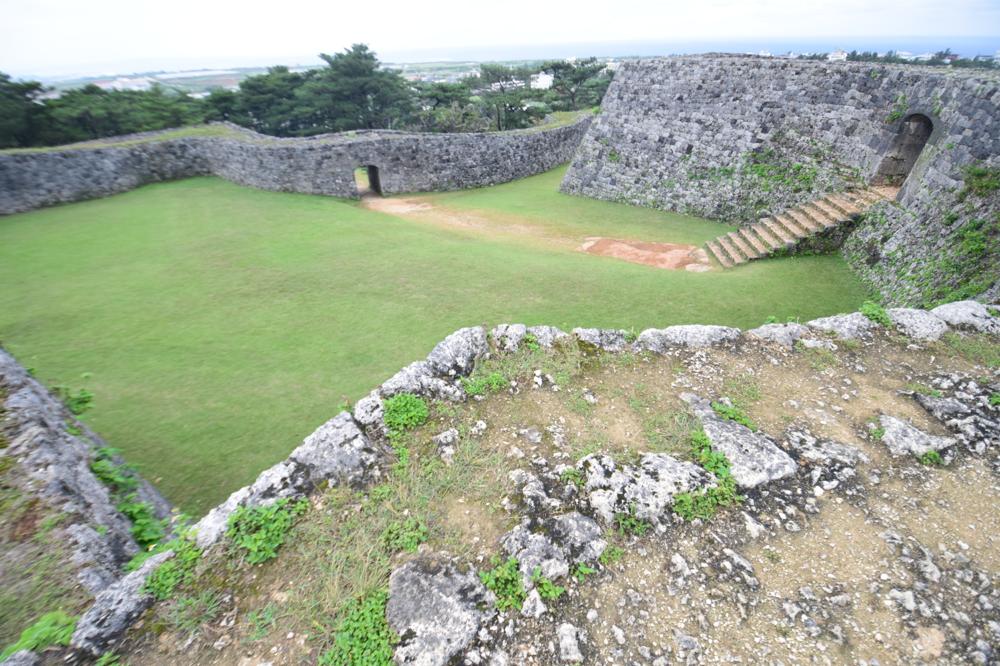
The Ainu word ‘chashi (casi)’ originally means a fence or a fenced area, the ditch might have been reinforced with wooden fence and there might have been some wooden buildings inside. So some people insist that these earthen structures should be called ‘chashi-kot’, ‘kot’ means a ruin or a remain in Ainu language. Although chashi are not archaeologic sites in a real sense, no written records were produced by Ainu people, they were pure oral traditionalists, more archaeological excavations will provide new findings. Some scholars point out the similarity between ‘chashi’ and 'острог (ostrog)’ over the whole of Russia, 'городище (gorodishche)’ and 'юртовище (jurtovishche)’ on the Kamchatka Peninsula. In the Okinawa islands under the subtropical sun, hunter-gatherer culture called “Shell-midden era” lasted so long, just like the Jōmon era in the Japanese main land. And also like succeeding Yayoi era in Japanese main lands, spread of agriculture caused increase of population, stratification of society and appearance of rulers called “aji” (按司) around 12th century. Aji built their residential hillforts called “gusuku” (グスク), it means ‘castle’. In early stage gusuku were built with pile of natural coral limestone then limestone were refined into brick shape before piling. US Commodore Matthew C. Perry dropped in Okinawa on the way to Japan to open up its national isolation, and was astonished by the magnificence and the precise piling technology of gusuku. In 14th century numerous Aji commune were united to 3 major kingdoms then in 1429 CE the central kingdom established united Ryūkyū (archaic name of Okinawa derived from Chinese) Kingdom and dwelled in the greatest gusuku “Shuri-jō” and the all other gusuku were deserted. Another typical megalithic monuments in Okinawa islands should be “turtleback tomb”. Its origin derived from southwestern coastal area of China, on the other hand the Okinawan burial system had developed following evolutional stages, and both merged in 17th C.:
- hill top type : Otafunbe chashi
- cliff edge type : Yuk’epira chashi
- cape tip type : Wonnemoto chashi
- island type : Caranke chashi
- plain meadow type
※Please note that the stage numbers are tentative, not authorized ones and do not precisely correspond to the classification of Okinawan grave types : natural cave burial with artificial sealing lid at entrance (“chinmāsā”, “chijifugi-baka”) is regarded as an independent grave type ; rock cut tomb dug at higher position of a cliff is also regarded as another grave type (out of reach of common people = shaman's grave) ; turtleback giant tomb and flat roof giant tomb are regarded as separate entries. The vast vault of turtleback tombs symbolizes the returning to the womb, more practically space for coffin until the body decays was required. Then 3 or more odd years have passed the “bone collecting” ceremony is held and the remaining bones are washed and put into a house-shaped urn then placed on the side or inner shelves in the vault. Nowadays the cremation has spread, coffin space is not required, Okinawan tombs show tendency to be compact turtleback or compact flat-roof types which contain only shelves for urns. There are also other miniature types of grave in Okinawan islands
- Open air burial
- Cave burial : “gama”
- Rock cut tomb (=artificial cave burial) : “finchā”, “tōru-baka”(Amami islands)
- Rock cut tomb with façade and front enclosure : “fāfū-baka”
- Turtleback (or flat roof) giant tomb with front enclosure : “kāminūku-baka”(former), “hirafuchibā”(latter)
Curiously they only remain in fringed areas of Okinawa archipelago : eastern Amami islands and western Sakishima islands. One more typical megalithic monuments in Okinawa islands might be the beacon-and-watch towers on the Okinawa main-island and satellite islands, called “hitati” (火立= fire making point) or “tōmi” (遠見= distance viewing point), and on Sakishima islands including Miyako-jima island and Ishigaki-jima island, also called “tōmi” or “hibanmui” (火番盛=fire and guard mound). The formers are natural or artificial mounds and the latters are natural mounds or artificial rock-piled spiral towers look like the brochs in Scotland. Some of them contain compass stones inside indicating the bearing, the formers’ are 4 stone poles indicating NSEW, and the latters’ are round stone boards on which the bearings are inscribed radially. The purpose of the formers seemed to welcome the arrival of tribute or trade ships to Naha the capital of Ryūkyū Kingdom, and that of the latters seemed to warn the arrival of strange or pirate ships.
- chambered cairn : “chinshi-baka”
- box type cist : “tamaya, hamaya, haya”(Amami-Ōshima island), “myāka”(Miyako-jima island)
- plant-leaf roofed broch : “nūya”, “yabaya”(Kikai-jima island)
Basic Resources :Main article : ★★Japanese Chronology With Featured Stone Monuments in Every Era
- 平井聖 1980 日本城郭大系1北海道・沖縄 東京:新人物往来社 (lit: Comprehensive study on fortress in Japan 1. Hokkaidō & Okinawa)
- 北海道チャシ学会 1994 アイヌのチャシとその世界 札幌:北海道出版企画センター ISBN:4-8328-9406-4 (lit: Ainu people’s Chashi and its perspective)
- 名嘉正八郎 2002 グスク探訪ガイド 那覇:ボーダーインク ISBN:4-89982-024-0 (lit: Gusuku visitors guide)
- 沖縄の人生儀礼と墓 名嘉真宜勝 1999 那覇:沖縄文化社 ISBN:978-4-602412-07-9 (li: Ceremonies in a lifespan and graves in Okinawa)

 We would like to know more about this location. Please feel free to add a brief description and any relevant information in your own language.
 Wir möchten mehr über diese Stätte erfahren. Bitte zögern Sie nicht, eine kurze Beschreibung und relevante Informationen in Deutsch hinzuzufügen.
 Nous aimerions en savoir encore un peu sur les lieux. S'il vous plaît n'hesitez pas à ajouter une courte description et tous les renseignements pertinents dans votre propre langue.
 Quisieramos informarnos un poco más de las lugares. No dude en añadir una breve descripción y otros datos relevantes en su propio idioma.