

Book Review: How to Build Stonehenge by Mike Pitts
Submitted by Andy B on Monday, 07 August 2023 Page Views: 9837
ReviewsCountry: England County: Wiltshire Type: HengeInternal Links:


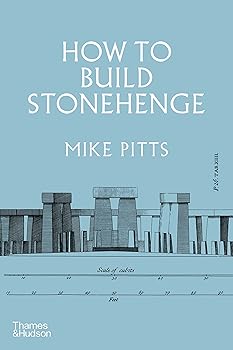 Rob Ixer writes: In the mid 2010s it seemed that there was an annual Stonehenge 'Xmas box' to read but recently it has turned quieter, for, as one author disingenuously has said "what is there new to say". Well, as it turns out, quite a lot. During this wintry writing flurry Mike Pitts was asked repeatedly why he had not penned his own Christmas carol but replied it was too soon and he needed to let the dust settle. What Mike has come up with is a measured, dispassionate, but personal account from an independent, informed, highly literate, observer-player whose reportage-style of writing, especially in the middle chapters, has successfully avoided sounding like a poor channelling of Bernard Cornwell’s novel Stonehenge, but retains rather a customary and engaging, easy reading voice.
 One that hides Pitts’ trademark, almost obsessive, need for complete accuracy whilst being as current as he can; he dates his data precisely (2020). Hidden behind a disarming discursiveness is Pitts reworking of the published data, from establishing new sizes and weights of the stones to the topographies of possible valley routes - detailing their inclines - and even the time taken/needed per task, namely both moving the stones and later the successive building and rebuilding of the circle. Hence Pitts is no data-parrot but far more substantial than that. He is another Roc (*) perched about Stonehenge. This book amply rewards our patience.
After a preface and in seven chapters of un-equal lengths Pitts discusses the full mechanics of Project Stonehenge - the book’s title does not mislead. He starts with two chapters on the identity and characteristics of the raw materials - their quality and quantity surveying aspects. These are followed by the acquisition and transport of the stones to site - logistics as it were - then the two main chapters: namely the erecting and re-erecting of the smaller bluestones, followed by that of the larger sarsens to give the ruin as we now see it.
As a final and by no means an add-on - rather a rounding out - there is a short chapter discussing the renaissance of Stonehenge (re)-building in the 20th century and then, moving backwards in time, to other episodes of possible misuse by the Romans and even the Beaker People (welcome back to them). His discussion of the "debitage dilemma" is insightful, namely why the standing bluestones have little chipped stone flakes around them, yet missing/buried ones dominate the loose scatter in the Stonehenge Landscape. Despite Pitts’ disavowal the four central chapters are in essence a civil engineering construction manual - humanised - encircled within a broader context.
The book is effusively illustrated, with over 100 black and white photographs - a slight pity their reproduction is not sharper on better paper, but I understand the costs with such a book - and 28 colour plates divided into two sets. These begin with the obligatory/iconic Stonehenge panorama in winter snows - the Devizes Museum painting of a similar scene is one of its bestselling Christmas cards - and including ethnographical pictures of large stones being moved in exotic places.
The majority of the plates show aspects of individual or small numbers of the stones, both in their original field contexts and then within the circle. They have been carefully selected to complement the text - on re-reading the book their significance in clarifying some of the finer/more subtle detail became ever more apparent. No plate is a stocking filler and one, XXV is disturbing, roundly showing the results of wanton tourist vandalism. This gives a graphic lie to the suggestion that the present rounded shape of many of the bluestones is due to ice-smoothing rather than historical souvenir collecting. The final pages include detailed notes giving some primary literature, a short bibliography listing more popular secondary sources and a good index.
Hence, we are gifted another fabulous story of Saracens, older than Scheherazade, a tale feted ever to be re-shaped and retold night after night. Gone now is its supposed origin, by an intoxication of Djinns for Merlin, but rather the scenes are of movement of stone by the technology of rude mechanicals fuelled with beer, pork and dogged fervour along a 300km long peripatetic celebration. Imagining Pitts as the primary protagonist behind Stonehenge, its Magus, this is how it would have been done.
Initially Cicerone Mike Pitts walks us through the Stonehenge Landscape up to, and through the stones to give a sense of their current ambience/presence, contrasting that back to when they were first erected (and re-erected), then briefly through historical excarnations to the present day.
The following two chapters discuss the raw materials, the lithologically variable bluestones and surprisingly homogenous sarsens, and the latter's recent ‘rediscovery’ as object for serous Stonehenge study. How for both rock groups this has led to radical reinterpretations of their composition and consequent rethinking about their geographical origins and transport. It is pleasing, even perhaps just, to see geologists getting due credit, and photographs as well: the Victorians Gowland and Judd, the Edwardian Thomas (although he is now having to cash in his century’s worth of credit, with more than a hint of good money after bad), Thorpe and the Open University Group in the 1990s and most recently Bevins and yours truly (the other half of the Pet Rock Boys) from 2010 who are still iterating.
As mentioned, almost all of these studies have concentrated on the igneous bluestones and/or Altar Stone sandstone but recently Nash and colleagues from Brighton have given the sarsens some long overdue prominence. Pitts does not hold back on arcane detail and provides an accurate 2020 snapshot of the results of the geological work and the players involved. Leaving aside all else in the book (a would-be very foolish move) its tables characterising each stone are currently the most accessible single source giving the lithologies of each bluestone orthostat.
By a nice co-incidence/nebulous zeitgeist The New Yorker in 2022 published a similar résumé highlighting the combined roles of the geologists and archaeologists in A New Story for Stonehenge the same month as this book was published - in part a precis/gloss of Pitts' book.
The next chapters are the heart of the book; firstly dealing with all aspects of the two quite separate sets of journeys the bluestones and sarsens took from quarries to plain. The possible routes are explored and assessed in detail, with distances, inclinations and timing all newly considered. Pitts notes that recent geological work has resulted in the downplaying of the coastal sea route for the bluestones in favour of an inland route along the A40, but, partly perhaps by his delight in the paintings of Gericault and Alan Sorrell, suggests a longer sea journey across the Severn estuary. Longer than many other writers, who prefer a more northerly, narrower crossing - but then needing a longer overland route. Pitts too suggests that rafting of the stones along Wessex rivers is unlikely and probably unachievable. This is just another example of a popular Stonehenge trope/urban myth being critically scrutinised and corrected by Pitts; there are surprisingly many of these in the last chapter.
For it is all about the journey and the cliché ‘Every age gets the Stonehenge it deserves and desires’ - true for Neolithic and Bronze Age times and-remaining so. An earlier Stonehenge book discussing this said “Prior likens that journey to the Olympic torch but a far closer analogy would be the transporting of the space shuttle Endeavour through the streets of Los Angeles in 2012, with its disruption of the local landscape, attendant emotional crowds and an ever moving neighbourhood spotlight”. The reviewer might have elaborated, remaining in the USA and combining it with JFK’s speech “We choose to go to the Moon in this decade and do the other things, not because they are easy, but because they are hard; because that goal will serve to organize and measure the best of our energies and skills”, to describe the whole enterprise.
There is currently some discussion, some well-meaning, some tediously hitched to Brexit, as to the degree that the building of Stonehenge building was a Neolithic unifying experience - so echoing JFK, or was more insular, more a “Southern English/Welsh” affair. As yet no one for centuries has deemed it a vanity project- but they will.
For although both those analogies are good approximations - Pitts illuminates by his use of eastern ethnographic studies that they are superficial and spiritually empty. This spiritual aspect has been growing in interpretive importance with regard to The Stones throughout this century with Parker Pearson and Ramilisonina being early adopters and strong proponents. Pitts expounds it long and well.
Surely its enduring and essential spirit is the ‘cult of carts’. Replace Stonehenge with Chartres cathedral, “the citizens of Chartres, of all social classes, harnessed themselves to carts like oxen and dragged materials to the building site as an act of mass piety” with singing and appeasement. This, and the dogged, long term, exceedingly long term, determination of its creators and builders is key to the Circles construction, the rest is mechanics (with feasting and singing?).
The more worldly, technical building chapters are neatly described as the Stonehenges - with chapters "Construction Bluehenge" and "Construction Stonehenge". They emphasise that the site was assembled and disassembled, so that for decades/centuries whilst a work in progress - a prefiguration of the Sagrada Familia - it retained its sanctity. Building work was disrupted by major spiritual re-alignments - perhaps of the magnitude of the resignifying of the Hagia Sophia from cathedral to grand mosque or - a better analogy - the major physical changes of The Grand Mosque of Cordoba to the Cathedral of Our Lady of the Assumption, with its building within a building.
But strangely these technical chapters evince an unintentional or perhaps mischievous intentional reaction - these pages, even after providing convincing construction details engender a persistent background thought; a soft voice whispers ‘can this really be how it was done, not even a little magical help?’
Hence, Pitts’ practical and pragmatic approach is almost counter-productive, for the greater his explanation, for example detailing the emplacement and fitting, metres in the air, of the 4 to 17.5 tonne sarsen lintels, the greater is the wonder of the enterprise. For all our desired Stonehenges its main modern message must be ‘What a piece of work is man!’
Hence this is a bazaar book, with its (unintentional) echoes of Victorian orientalism and mysticism. It is both a long afternoon’s read to be savoured alongside baklava and sweet mint tea languidly following the unravelling of another fabulous tale of Stonehenge and its builders, the story line interrupted and interspersed with gossip of old and new friends, of artists and even, of others. Or it is a deeply considered individual exploration, providing a reliable source for accurate current thinking of the making of one of mankind’s odder achievements. More, it is, of course, a joy and like the fate of Schrodinger’s cat it is for the observer-reader to determinedly conjure the book’s kismet.
(*) Roc - the fabulous bird in the Arabian Nights to go along with the Victorian orientalism theme
Review by Rob Ixer
How to Build Stonehenge by Mike Pitts
256pp Hardback Feb 2022
109bw and 28 colour plates.
Thames and Hudson
Available from Amazon.co.uk and Amazon.com
Editor Note: We are very happy to publish book reviews, although we have been rather lax on this in recent times. We can sometimes arrange review copies. If you have a suggestion of a book you would like to review for us, please get in touch via Contact Editor.
Note: Whilst this book has been out for some time, this is such a detailed and fun review from Rob that we couldn't resist


 We would like to know more about this location. Please feel free to add a brief description and any relevant information in your own language.
 Wir möchten mehr über diese Stätte erfahren. Bitte zögern Sie nicht, eine kurze Beschreibung und relevante Informationen in Deutsch hinzuzufügen.
 Nous aimerions en savoir encore un peu sur les lieux. S'il vous plaît n'hesitez pas à ajouter une courte description et tous les renseignements pertinents dans votre propre langue.
 Quisieramos informarnos un poco más de las lugares. No dude en añadir una breve descripción y otros datos relevantes en su propio idioma.