



Alex's Intrepid Adventure to the Dacian Hillforts
Submitted by AlexHunger on Wednesday, 30 April 2008 Page Views: 6583
Other ArchaeologyCountry: Romania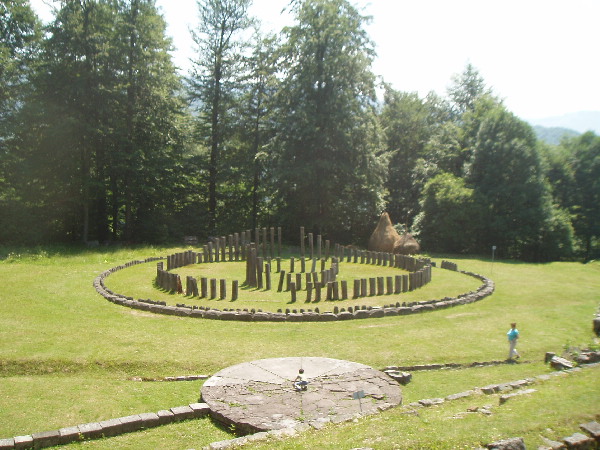
What interests us here, however, is the time before history, the years before 106 CE when Emperor Trajan sent in innumerable legions to conquer the white spot on the map between the Danube on the South, the Roman Black Sea coast on the East and Roman Panonia, now called Hungary, on the West. One speculates that Trajan was really after the Dacian Gold mines, which would later finance the building projects of several more of the good Roman emperors.
That leads us to ask who were the Dacians? We aren't really sure. Some speculate that they might have been Celts while others believe they were an offshoot of the Thracians, perhaps a mixture of both or even something completely unique. Time will tell. We do know, the Geto-Dacians were united by force in 82 BCE by a certain Burebista who then expanded his little empire all the way to Moravia (the moder Czech Republic) in the west and Thrace (Bulgaria) in the East. After his assasination, the priest Deceneu took over, which eventually led to Decebalus, the last king of the Dacians. The point, however, is that the ruins of their Hillforts and temple remain as proof of their existence, which have now been taken up as UNESCO World Heritage Sites.
It is precisely the entry on the UNESCO website which led me to put the Hillforts on my list of sites to see at the time. A detailed look through Google Earth indicated that this would be no piece of cake, as the trip would entail 20 Km of dirt roads and long hikes up hills.
 As luck would have it, the Babes-Booljai University in Cluj-Napoca invited me to lecture on financial communications. Even more helpful was that the university Dean introduced me to the Cluj-Napoca Romanian National History Museum which would provide me with guides as well as an agency which, as a special favour, would rent me the necessary SUV to drive up to the forbidding hillforts. This was one tractor, which had no business in Chelsea, but for once it was not a fashion accessory, but a vital research tool. I called the ancient Nissan Patrol the Boneshaker.
During my brief time in Romania, my guides and I narrowed down the visits to the Hillforts at Sarmisegetusa, Costeti-Blidaru, Costeti-Cetatuie, Ardeu and Pietra Rosie for a start.
Our first day trip was glorious and tiring. The roads in Romania heading towards the mountains are still in the process of being built or an amalgamation of potholes, which pound driver and passengers into submission. I probably am now immune to kidney stones for at least an other year. The last 20 Km required utmost attention in the ancient Nissan Patrol to get to the top of the mountain where Sarmisegetusa Regia is located. Moving across the rivers, the narrow mountain paths and over haphazard bridges was just like in one of those Indiana Jones movies, just that there weren't bad guys chasing me. Needless to say, busloads of Japanese tourists will not be carted up here for the next few years. The reward was well in proportion of the effort as the Hillfort also had remains of a complex temple area. This consisted of 2 round stone circles, where archeologist presume a wooden roofed structure might have existed over the stone foundations of at least the large 50 Meter circle.
 There are also the remains of a monumental stone "Sundial". The missing sections have been simulated by newly created sections to give a better impression.
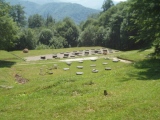 A degree of mystery surrounds the 3 large and several small rectangular "temples". Really only the round foundations of what might have been columns survive. As the Romans destroyed the site, one can only speculate what might have existed there. Some surmise, the Dacians might have practiced a degree of human sacrifice, like other Celts, for the Romans to wipe out the area so thoroughly, as normally local gods were assimilated to their roman counterpart in most cases. A sacred spring complements the site.
 The Romans also dismantled the original Hillforts and used the parts to construct a garrison, of which the gate and the compound wall foundation survive. On a beautiful day, it is a majestic site with a magical atmosphere. The extreme logistics require one to be careful as it's a long hike down, and there is very poor mobile phone reception. Some Moldavian tourists were not so careful with their cheap little Korean SUV and promptly got their ride stuck in a ditch designed specifically to keep vehicles out of the archeological site. We needed an hour to dig them out while the man's wife gave him an ear bashing that still reverberates through the Romanian valleys to this day. Moral of the story: respect the archeological site.
 The next stop was the nearby Hillfort of Blidaru. Blidaru in Romanian apparently refers to the potsherds found there as the original name is not known. The archeologists suggest the site might have been abandoned without a fight and largely forgotten, as it is in remarkably good condition without traces of violence or burning. Some stones, of course, have been quarried or fallen down the hill, but the feel is very much that of a commanding military control point like a Romanian iron age Mycenae. To get to Blidaru, you need to plan a long-long hike up the hill from the rest area in the valley. No SUV will get you through the steep wooden hills.
 The last hillfort of the day, Cetatuie, was mercifully the easiest of all to get to. You can literally drive to the main gate and have access to the fort area as well as the rectangular temple foundations with round column bases, with only a minimum of effort.
 With the addition of its rectangular tower bases, it is different enough from the other sites, while still maintaining the atmosphere. If you can only visit one hillfort in Romania and you don't have an SUV, this should be the one, even if you miss out the stone circles.
 The next day's trip rounded up the visit to 2 more of the ca. 100 known or estimated Hillforts in this region of Romania. Ardeu is probably the most northerly one and quite small. It sits on top of a small hill overlooking a romantic valley with a tiny modern village in it. To be honest, only the foundations in the living chalky rock survive. The material of the actual buildings appears to have slipped down the hill. At the end of the village are the traces of a more substantial abode, called the Roman House. We speculate it might have belonged to a Roman merchant, escaped slave, ambassador or perhaps a spy preparing the way for Trajan's invasion.
 Next in line was the forbidding hillfort of Piatra Rosa. It is so named after the reddish-pink sheer cliff face visible on the 20 Km dirt road approach via Luncani. Even then, the path becomes too treacherous for even a 4WD vehicle and the troops must dismount to climb the remaining steep 2-3 km through a farm around the back of the hill. Once there, you find the remains of a few battlements.
 In front of the citadel, there is the ceremonial gate, which appears to have had more than a just defensive character. Just like at Sarmisegetusa, there is what is interpreted as a paved processional path. One of the small building foundations has a temple like look to it. Further up, in this mushroom rich wooded hill, you enter, the rectangular and cleared area of the citadel. Foundations of towers as well as a spring can be seen. The fort appears to have been set up for the comfort of a clever warlord and his crew.
As I mentioned earlier, there were more than a hundred hilllforts, though the ones I described seem to have been the most impressive and easiest (relatively speaking) to reach. This led archeologists to believe that it was the business model of the Dacians to live away from easy to reach valleys. In order to avoid getting invaded. During the centuries of living on the fringe of the Roman Empire, the Dacians also hired Greek architects to help them construct their forts. The expert can recognize a fusion of typically Celtic stone construction with dirt filler and wooden reinforcements together with Greek touches.
 The last leader of the Dacians was a certain Decebalus, who was a sort of Dacian "Vercingetorix" or "Bodicea". This worked until the Romans seized the advantage and launched a massive Blitzkrieg coordinated assault from all sides with an absolute superiority of many legions. A diagram to this affect can be seen in the Cluj Museum. The Romans documented their victory on Trajan's arch in Rome, and amusingly made the Dacians look about 2 meters tall.
 While it is unlikely a modern road can be constructed up to Sarmisegetusa any time soon, the rapid economic and infrastructure development in Romania is opening up new discoveries as we speak. While building the new Pollus shopping center outside of Cluj, workmen discovered strange stones. The museum archeologist were called in to investigate, found the kerbstones of 3 iron age tumuli, together with stone kists belonging to a later era that were placed within the existing 13 meter circle. One of the Pollus Tumuli has a slightly larger stone, which stands out almost like a standing stone. The area was also reused as a cemetery during the Barbarian invasions as richly endowed tombs were discovered.
 The jewelry is now display in the Museum while the kist and a carved statue menhir of sorts are also in storage. As part of the rescue excavation, the tumuli have been relocated 300 meters to a location between the shopping center and the main Road. The kerbstones are similar to other I have seen in Croatia, southern Germany and even Alsace. It is possible that Romania may remain uncharted territory for the casual archeo-tourist for a while, but there is a small but growing hardcore nucleus of sites that supplies enough critical mass to keep the country and the finds on the radar screen.
Alex Hunger
This article would not have been possible without the kind assistance the of the deans of the Babes-Booljai University, the Cluj-Napoca Romanian National History Museum and my guides, Razvan, Cristina and Cristian.


 We would like to know more about this location. Please feel free to add a brief description and any relevant information in your own language.
 Wir möchten mehr über diese Stätte erfahren. Bitte zögern Sie nicht, eine kurze Beschreibung und relevante Informationen in Deutsch hinzuzufügen.
 Nous aimerions en savoir encore un peu sur les lieux. S'il vous plaît n'hesitez pas à ajouter une courte description et tous les renseignements pertinents dans votre propre langue.
 Quisieramos informarnos un poco más de las lugares. No dude en añadir una breve descripción y otros datos relevantes en su propio idioma.