
<< Our Photo Pages >> Stonea Camp - Hillfort in England in Cambridgeshire
Submitted by Andy B on Wednesday, 06 September 2023 Page Views: 38970
Iron Age and Later PrehistorySite Name: Stonea CampCountry: England County: Cambridgeshire Type: Hillfort
Nearest Town: March Nearest Village: Stonea
Map Ref: TL448930 Landranger Map Number: 142
Latitude: 52.515655N Longitude: 0.132472E
Condition:
| 5 | Perfect |
| 4 | Almost Perfect |
| 3 | Reasonable but with some damage |
| 2 | Ruined but still recognisable as an ancient site |
| 1 | Pretty much destroyed, possibly visible as crop marks |
| 0 | No data. |
| -1 | Completely destroyed |
| 5 | Superb |
| 4 | Good |
| 3 | Ordinary |
| 2 | Not Good |
| 1 | Awful |
| 0 | No data. |
| 5 | Can be driven to, probably with disabled access |
| 4 | Short walk on a footpath |
| 3 | Requiring a bit more of a walk |
| 2 | A long walk |
| 1 | In the middle of nowhere, a nightmare to find |
| 0 | No data. |
| 5 | co-ordinates taken by GPS or official recorded co-ordinates |
| 4 | co-ordinates scaled from a detailed map |
| 3 | co-ordinates scaled from a bad map |
| 2 | co-ordinates of the nearest village |
| 1 | co-ordinates of the nearest town |
| 0 | no data |
Internal Links:


External Links:


I have visited· I would like to visit
taysMP would like to visit

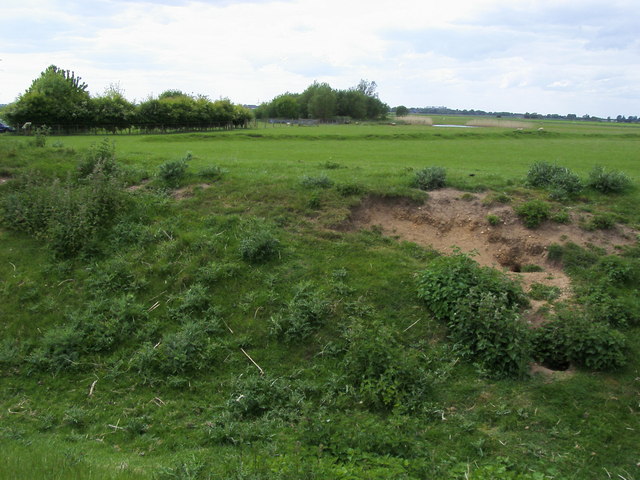
Tacitus describes the earthwork as having an entrance too narrow for cavalry. The defending Britons were trapped by their own banks and slaughtered. The skull of a four year old child was found and was badly hacked by sword cuts. Also excavated was a horribly mutilated adult skeleton.
Approached today from the B1093 along a straight, narrow farm track where a peaceful pastoral oasis is found amid the endles cabbages and cauliflowers of the fertile black fens.
See in the comments below for a video showing the skull split with a sword, found at the site.
Page originally by Vicky.
Note: Stonea Camp/From the Neolithic to the Iron Age: The Creation of a Hill Fort Event at Stonea Camp, 10th September 2023
You may be viewing yesterday's version of this page. To see the most up to date information please register for a free account.




Do not use the above information on other web sites or publications without permission of the contributor.
Click here to see more info for this site
Nearby sites
 Click here to view sites on an interactive OS map
Key: Red: member's photo, Blue: 3rd party photo, Yellow: other image, Green: no photo - please go there and take one, Grey: site destroyed
Download sites to:
KML (Google Earth)
GPX (GPS waypoints)
CSV (Garmin/Navman)
CSV (Excel)
To unlock full downloads you need to sign up as a Contributory Member. Otherwise downloads are limited to 50 sites.
Turn off the page maps and other distractions
Nearby sites listing. In the following links * = Image available
537m NNE 20° Wimblington Cursus Cursus (TL44979351)
3.0km E 96° Manea Cursus Cursus (TL478928)
11.4km SSE 166° Wardy Hill* Hillfort (TL478820)
14.0km S 184° Sutton in the Isle Round Barrow Round Barrow(s) (TL443790)
16.5km SSW 191° Haddenham Long Barrow (TL420767)
19.7km SSW 192° Haddenham Enclosure Causewayed Enclosure (TL412736)
21.4km WNW 302° Pode Hole Farm Round Barrow(s) (TF262037)
21.5km WNW 284° Must Farm* Ancient Village or Settlement (TL237976)
22.8km WNW 287° Flag Fen Visitors Centre* Museum (TL227989)
22.8km S 188° Belsar's Hill* Hillfort (TL424703)
23.3km WNW 294° Oliver Cromwell's Hill (Eye) Cairn (TF232018)
24.5km ENE 73° St. Margaret's Well (Wereham)* Holy Well or Sacred Spring (TF6801)
24.9km SSW 208° Holywell (Cambridgeshire)* Holy Well or Sacred Spring (TL336707)
25.2km SSE 155° Wicken Fen* Natural Stone / Erratic / Other Natural Feature (TL563705)
25.3km W 281° Fletton Cross* Ancient Cross (TL198971)
26.0km WNW 284° Hedda Stone* Early Christian Sculptured Stone (TL194987)
26.0km SSW 208° Low Hill Bowl Barrow, Fen Drayton RSPB Reserve* Round Barrow(s) (TL33336960)
26.3km WNW 284° Peterborough Stone* Standing Stone (Menhir) (TL190985)
26.4km WNW 284° Peterborough Museum* Museum (TL189985)
26.6km NW 314° Crowland Henge* Henge (TF25061086)
27.0km SSW 208° Fenstanton Cursus Cursus (TL326689)
27.4km W 274° Stone Circle, James' Pond* Modern Stone Circle etc (TL17309405)
27.5km S 191° St Michael's Well (Cambridge)* Holy Well or Sacred Spring (TL40326584)
28.4km WNW 282° St. Cloud's Well (Longthorpe)* Holy Well or Sacred Spring (TL16789815)
28.9km WSW 245° Monk's Hole Barrow Round Barrow(s) (TL1896479957)
View more nearby sites and additional images


 We would like to know more about this location. Please feel free to add a brief description and any relevant information in your own language.
 Wir möchten mehr über diese Stätte erfahren. Bitte zögern Sie nicht, eine kurze Beschreibung und relevante Informationen in Deutsch hinzuzufügen.
 Nous aimerions en savoir encore un peu sur les lieux. S'il vous plaît n'hesitez pas à ajouter une courte description et tous les renseignements pertinents dans votre propre langue.
 Quisieramos informarnos un poco más de las lugares. No dude en añadir una breve descripción y otros datos relevantes en su propio idioma.