
Featured: Explore Scotland (and everywhere else) with our Megalithic Portal iPhone app

Explore Scotland (and everywhere else) with our Megalithic Portal iPhone app

Random Image

Monuments and Landscape in Atlantic Europe, Scarre

Monuments and Landscape in Atlantic Europe, Scarre

Login

Register here - as a registered user you get more features and fewer ads.

Who's Online

There are currently, 2450 guests and 3 members online.

Sponsors

<< Our Photo Pages >> Devil's Stone, Shebbear - Standing Stone (Menhir) in England in Devon

Submitted by thesabs on Friday, 29 September 2017  Page Views: 20176

Neolithic and Bronze AgeSite Name: Devil's Stone, Shebbear Alternative Name: Devil's Boulder, Devils Stone
Country: England
NOTE: This site is 2.2 km away from the location you searched for.

County: Devon Type: Standing Stone (Menhir)
Nearest Town: Holsworthy  Nearest Village: Shebbear
Map Ref: SS43880925  Landranger Map Number: 190
Latitude: 50.861625N  Longitude: 4.21972W
Condition:
5Perfect
4Almost Perfect
3Reasonable but with some damage
2Ruined but still recognisable as an ancient site
1Pretty much destroyed, possibly visible as crop marks
0No data.
-1Completely destroyed
3 Ambience:
5Superb
4Good
3Ordinary
2Not Good
1Awful
0No data.
3 Access:
5Can be driven to, probably with disabled access
4Short walk on a footpath
3Requiring a bit more of a walk
2A long walk
1In the middle of nowhere, a nightmare to find
0No data.
4 Accuracy:
5co-ordinates taken by GPS or official recorded co-ordinates
4co-ordinates scaled from a detailed map
3co-ordinates scaled from a bad map
2co-ordinates of the nearest village
1co-ordinates of the nearest town
0no data
4

Internal Links:
External Links:

Devil's Stone, Shebbear
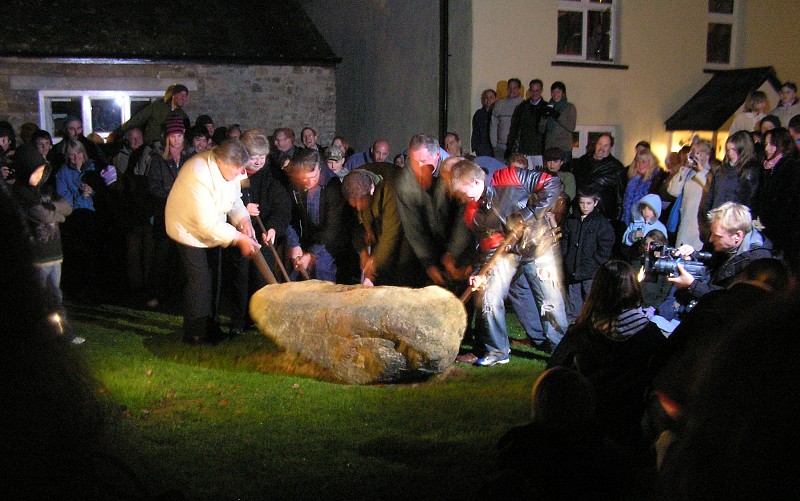
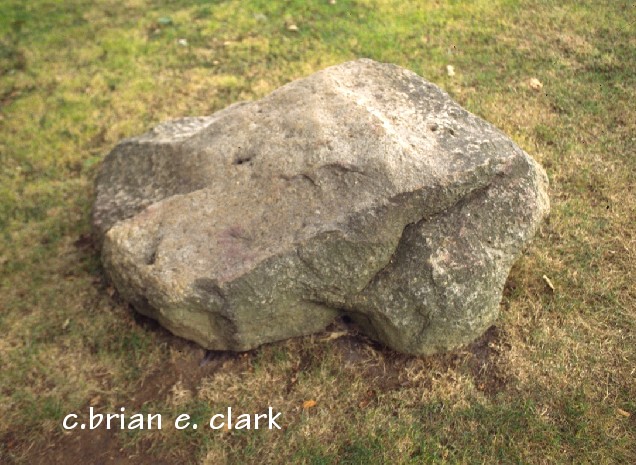
Devil's Stone, Shebbear submitted by thesabs : In the village of Shebbear in Devon the bellringers turn the Devil's Stone at 8pm every 5th November, to keep the Devil at bay for another 12 months. (Vote or comment on this photo)
The Shebbear Devil's stone in Devon is made from a type of quartz not found in the area, measures about six feet by four feet and weighs about a ton. It is a possible remnant of a standing stone and may have been an original foundation stone of Henscott Church.

Map ref: SS 4409 Directions: The village can be reached from a series of minor roads off the A388, the A3072 or the A386 from Great Torrington.

Note: Time to turn the Shebbear Devil Stone again, November 5th if you'd like to watch world catastrophe be averted - also archive photos and video, details in the comments on our page
You may be viewing yesterday's version of this page. To see the most up to date information please register for a free account.

Devil's Stone, Shebbear
Devil's Stone, Shebbear submitted by thesabs : A wider view showing the position near the village sign. (Vote or comment on this photo)

Devil's Stone, Shebbear
Devil's Stone, Shebbear submitted by bec-zog : (Vote or comment on this photo)

Do not use the above information on other web sites or publications without permission of the contributor.

coldrum has found this location on Google Street View:

Nearby Images from Geograph Britain and Ireland:
SS4309 : Shebbear: The Square by Martin Bodman
by Martin Bodman
©2011(licence)
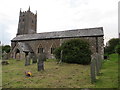
SS4309 : The church of St Michael at Shebbear by Peter Wood
by Peter Wood
©2013(licence)
SS4309 : Ordnance Survey Cut Mark by Peter Wood
by Peter Wood
©2013(licence)
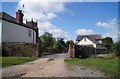
SS4309 : Dwellings in Shebbear by Mr Ignavy
by Mr Ignavy
©2014(licence)
SS4309 : Ordnance Survey Cut Mark by Adrian Dust
by Adrian Dust
©2025(licence)

The above images may not be of the site on this page, they are loaded from Geograph.
Please Submit an Image of this site or go out and take one for us!


Click here to see more info for this site

Nearby sites

Click here to view sites on an interactive OS map

Key: Red: member's photo, Blue: 3rd party photo, Yellow: other image, Green: no photo - please go there and take one, Grey: site destroyed

Download sites to:
KML (Google Earth)
GPX (GPS waypoints)
CSV (Garmin/Navman)
CSV (Excel)

To unlock full downloads you need to sign up as a Contributory Member. Otherwise downloads are limited to 50 sites.


Turn off the page maps and other distractions

Nearby sites listing. In the following links * = Image available
 3.9km SSW 202° Holemoor Well* Holy Well or Sacred Spring (SS423057)
 4.2km NW 314° St Petrock's Well Devon* Holy Well or Sacred Spring (SS4095912219)
 7.9km E 79° Heathmoor Barrow* Barrow Cemetery (SS517105)
 8.7km SW 223° Hollacombe Cross* Ancient Cross (SS3774603038)
 8.7km N 351° Hembury Castle Fort (Tythecott) Hillfort (SS4272117905)
 8.9km ESE 111° Hatherleigh St. Mary's Well Holy Well or Sacred Spring (SS5213105847)
 9.0km S 174° Halwill Great Barrows* Barrow Cemetery (SS4449200306)
 9.8km W 270° High Barrow* Round Barrow(s) (SS3410209563)
 9.8km NW 324° Wrangworthy Cross* Barrow Cemetery (SS384174)
 9.9km S 185° Halwill Churchyard Cross* Ancient Cross (SX4272799412)
 9.9km S 185° Halwill Village Cross* Ancient Cross (SX4275199393)
 10.8km WSW 238° Holsworthy St Peter’s Well Holy Well or Sacred Spring (SS345038)
 11.3km NNE 22° Coverney Well* Holy Well or Sacred Spring (SS484196)
 11.3km NE 46° Castle Hill (Woolleigh Bridge) Ancient Village or Settlement (SS5225916849)
 11.4km SSW 206° Sandymoor Cross Tumuli* Barrow Cemetery (SX3849499147)
 11.8km W 259° Ugworthy Beacon Barrows* Round Barrow(s) (SS3217607440)
 12.3km WNW 291° St Peter's Well (Bradworthy)* Holy Well or Sacred Spring (SS325139)
 12.3km SSE 164° Three Barrows, Patchacott* Barrow Cemetery (SX4693097301)
 12.3km ESE 112° Hatherleigh St. John's Well* Holy Well or Sacred Spring (SS5523104363)
 14.2km NNE 22° Berry Castle (Huntshaw Wood)* Hillfort (SS49502228)
 14.4km NE 56° Combe Wood Hillfort (SS561169)
 14.9km SW 231° Affaland Moor Bowl Barrow* Round Barrow(s) (SS3196200184)
 15.9km NNW 336° Peppercombe Castle Hillfort (SS379240)
 16.3km NNW 329° Buck's Mills Fort Promontory Fort / Cliff Castle (SS35892349)
 17.4km W 279° Taylors Cross Tumuli* Round Barrow(s) (SS2669012535)
View more nearby sites and additional images

<< Gjevranmarka Gravfelt

Mont St.Odile Tombes Mérovingiennes >>

Please add your thoughts on this site

Prehistoric Settlements

Prehistoric Settlements

Sponsors

Latest Visit Logs

  • Badnabay
    “A short walk through rather boggy ground towards the west end of the horseshoe-shaped road coming of…”
    by RingPaw · 7 Jun 2026
  • Tsankawi
    “The complete Tsankawi Village loop trail is about 2 miles round trip. The parking lot is large, pave…”
    by stonetracker · 6 Jun 2026
  • Dun Beag (Struan)
    “Nothing much to add to earlier comments - a short walk but steep in parts. A spectacular site, defin…”
    by Glaschu · 5 Jun 2026
  • Gwal y Filiast
    “Did the anti clockwise circular walk from login, track through field by Dickman (timber merchant) is…”
    by Possumputer · 4 Jun 2026
  • Dun Buidhe
    “Access - it's easy to get to the causeway. You walk across one island which is rough ground but noth…”
    by Glaschu · 3 Jun 2026

"Devil's Stone, Shebbear" | Login/Create an Account | 14 News and Comments
  
Go back to top of page    Comments are owned by the poster. We aren't responsible for their content.
Re: Devils Stone, Shebbear by Anonymous on Thursday, 02 November 2023
There is a film about the stone and its turning from 2019

youtu.be/taDQDq-pXqU

[ Reply to This ]

Re: Devils Stone, Shebbear & current TV programme by AngieLake on Saturday, 26 March 2022
(User Info | Send a Message)
I didn't realise the TV programme 'The Simpler Life' was filmed here, but here's an article in devonlive website today, with history of the village and its residents, including more on the Devil's Stone turning ceremony.

https://www.devonlive.com/news/devon-news/inside-simpler-life-village-shebbear-6853835

I'm from North Devon but don't recall having visited Shebbear, nor have I watched the TV series, yet!
[ Reply to This ]

Re: Devils Stone, Shebbear Turning ceremony by AngieLake on Saturday, 06 November 2021
(User Info | Send a Message)
In today's devonlive website the 2021 report on this ceremony:

https://www.devonlive.com/news/devon-news/devon-villagers-set-flip-devils-6167080

May be some new pictures in this news item.

Dreadful lot of adverts in the article, sorry about that!
[ Reply to This ]

Re: Devils Stone, Shebbear's neighbouring pub for sale. by AngieLake on Sunday, 05 May 2019
(User Info | Send a Message)
This sounds a bit OTT, but may encourage a sale!:
"The UK's most haunted pub is for sale - and it's in Devon
Shebbear villagers save the world every single year at The Devil's Stone Inn!"
Read more here:
https://www.devonlive.com/news/devon-news/uks-most-haunted-pub-sale-2818306
[ Reply to This ]

The Devil’s Stone Shebbear: A Landscape Enigma, by John Bradbeer by Andy B on Tuesday, 16 October 2018
(User Info | Send a Message)
The Devil’s Stone Shebbear: A Landscape Enigma by John Bradbeer

Originally published in the North Devon Archaeological Society Newsletter

Just why Shebbear should have two flat/prone megaliths that are sarsen stones and there to seem to be no others in the county is a complete mystery.

Members will probably be aware of the Devil’s Stone, which lies at the west end of the square, just outside the churchyard in Shebbear. The enigma takes in archaeology, geology and geomorphology (the study of landforms). The stone itself is the centre of much folk lore, culminating in a ceremony every 5 November, when the stone is turned. This is to flush the Devil out from his possible hiding place under the stone and failure to do so puts next year’s crops in jeopardy.

Another element to the story is that the Devil was escaping from Northlew, where he was in danger of catching his death of cold and to hasten his progress, he dropped the stone in Shebbear. He was also supposed to have left his mark in the churchyard at Halwill on this journey and that was the story my cousins picked up in the 1930s at school in Halwill. We can probably explain the November timing of the turning of the stone with the Celtic year, with 1 November, Samhain (pronounced sawin) marking the start of winter. The shift to 5 November almost certainly came about only in the aftermath of the Gunpowder Plot of 1605.

The stone itself is around 500 to 700 kilograms in weight and sub-angular rather than round in shape. It is described geologically as a conglomerate orthoquartzite, and to the untrained eye, the shiny quartz grains resemble the quartz crystals in granite. It is in fact a sedimentary rock and current thinking suggests that it is Tertiary in age and thus comparable with the sarsen stones (or greywethers) that are found on Salisbury Plain and which, of course, were famously used at Avebury and Stonehenge. It is generally accepted that sea levels were very much higher in the Tertiary period, roughly 5 to 50 million years ago, and many of the succession of erosion surfaces (from c 50 to c 350 metres) and give such flat skylines across much of the county were cut at this time.

Most of the presumed Tertiary cover of South West England has long since been eroded away but Tertiary deposits are preserved on the top of Haldon Hill, south west of Exeter and in the down-faulted Bovey Basin in South Devon and here in North Devon in the Petrockstow Basin and the off-shore Stanley Basin near Lundy. Orleigh in Buckland Brewer has a flint gravel deposit presumed to be of Tertiary age and derived from a former cover of chalk. The Tithe Apportionment of 1841 records some fields as ‘Flint Hill’. So geologists can offer a plausible origin for the Devil’s Stone, but the enigma is whatever happened to the other survivors from this former Tertiary cover.

In central southern England, besides the sarsens used at sites like Avebury and Stonehenge and incorporated in some of the barrows, there are clusters such as those found in a dry valley on Fyfield Down, just north of Pewsey in Wiltshire. Geomorphologists can explain such a cluster by reference to solifluction flow during the very cold periods in the Quaternary when southern England was effectively tundra, lying just to the south of the great ice sheets and the summer thaw delivered sufficient water to move soil and sarsens stones down slope. The river terrace gravels along the Solent also contain many smaller fragments of sarsen stone, brought down by the rivers that drain much of Salisbury Plain. But where are the other sarsen stones from North Devon?

On Salisbury Plain it is plausible to speculate that early humans found and moved many of the suitably large stones to incorporate in monuments, but in North Devon, there are no megaliths formed of sarsens. North Devon’s river gravel terraces, of which there may be at least four or five, have never been exploited so no sarsens have been exposed from these. Perhaps there never were as many sarsens here and most were quite small and thus readily transported or fragmented into yet smaller pieces.

However, the enigma has another twist. For about 750 metres from the Devil’s Stone is another sarsen, rather larger at an estimated 1,500 to 2,000 kilograms, now on the verge in front of Berry House and one that looks far more like potential megalith material in shape. That two such stones should survive so close to each other yet no others appear to have survived anywhere in North Devon. Clearly human agency has to be invoked in the survival and folklore attached, especially to the Devil’s Stone, but archaeology and geology have no real explanation as to why there should be just these two sarsens and no others known in North Devon.

Both stones are on the Devon HER and details of grid references are there. I would give the GR for the Devil's Stone as SS439 092 and the larger stone at Berry as SS438 100. The other things I might be inclined to add by way of context are|:
Shebbear was the name place of a Hundred (although known as Merton Hundred before). The church (about 50 metres from the Stone) is dedicated to St Michael, so the dedication reflects the Devil connotations of the stone. Some of Devon's churches are dedicated to St Michael because of their location on a prominent hill (Brentor is the classic example) but you could not really invoke that explanation here in Shebbear.

it would be tempting to say that the Stone marked the meeting place for the Hundred Court, but there is no evidence of this and of course the stone may have lain somewhere else around the village and been moved to the square which seems to have been the site of the Hundred Court (but once again, there is no evidence and in the case of Black Torrington, a few kilometers away, and also the name place of a hundred, there is no obvious surviving candidate site for the Hundred Court to have met)
With best wishes
John Bradbeer
[ Reply to This ]

Re: Devil's Stone, Shebbear by Rivierawriter on Saturday, 14 October 2017
(User Info | Send a Message)
Yet again we find an anomolous stone of quartz standing on its own. I am looking further into this phenomenon in the sequel to 'From Whence We Came'. It was published [2nd edition] in 2015. The new work, as yet untitled looks much closer at quartz stones that did not come from the area. Any quartz because it was not easy to extract or work but then it must be moved a great distance. My question always is 'Why?'

Any similar stones, especially as part of a line or circle are of great interest. Has anyone got a sample near them? I'd love to know.
[ Reply to This ]
    Re: Devil's Stone, Shebbear by ForestDaughter on Saturday, 14 October 2017
    (User Info | Send a Message)
    This is really interesting. There's a waymarker stone which looks like quartz situated near an ancient crossway in the Farway Barrow landscape, East Devon. However, on further investigation I found that it's actually silcrete which, although different in origin and nature, appears similar to quartzite (from Archaeology in the Landscape - East Devon). Which is a bit disappointing! Something to look out for though. :)

    [ Reply to This ]
      Re: Devil's Stone, Shebbear by ForestDaughter on Saturday, 14 October 2017
      (User Info | Send a Message)
      I forgot to mention that I also came across this titbit, which is interesting.

      Parish Boundaries Over East Devon Heathlands by Philippe Planel in Devon Archaeological Society 2004.

      "...The additional point on this line is Putt's Corner (the Hare and Hounds), clearly a very ancient crossroads and marked by what may be an equally ancient or even more ancient stone. Named the 'Witches Stone' or 'Slaughter Stone' in legend and local memory... Even if we regard the legend as being of comparative recent origin, the stone was clearly brought here by human rather than natural agency; and the collective will to move stones of this size only existed in the Neolithic and Bronze Age periods."
      [ Reply to This ]

The Devil comes to Devon – meet the Devon villagers who save the world once a year by AngieLake on Friday, 29 September 2017
(User Info | Send a Message)
News item found tonight on Devonlive website:

It’s a little known fact that a village tucked away in the heart of Devon every year staves off the Devil “saving the world from potential catastrophe”, or so the story goes.

Shebbear in North Devon is home to an unusual rock known as the Devil’s Stone it is believed by locals to be the resting place of the Devil after he was cast out of heaven by the archangel Michael.

After casting him down to earth Michael threw a stone at him trapping him beneath the ground. This stone, according to legend, landed in Shebbear’s village square.

While it may seem far fetched that the devil is buried under a village square in Devon, locals are adamant the ceremony is vital. Some claim the last time the stone went unturned was in 1939, the year World War Two started.

More, with a video and archive photos from 1953 and 2013 here http://www.devonlive.com/news/devon-news/devil-comes-devon--meet-541964
[ Reply to This ]

Re: Devils Stone, Shebbear by Anonymous on Sunday, 05 May 2013
This is very interesting...! I just watched the videos of it on the Shebbear website.

I think the url was http://www.shebbear.net
[ Reply to This ]

Street View by coldrum on Friday, 26 March 2010
(User Info | Send a Message)

View Larger Map
[ Reply to This ]

Re: Devils Stone, Shebbear by Anonymous on Wednesday, 24 January 2007
Hello,
The stone turning is apparently to stop the village having bad luck for a year and is done on the evening of Guy Folks.

I read this on the Shebbear village website if you want to see more.

http://www.shebbearvillage.co.uk

Simon Webb (France)

[ Reply to This ]

Re: Devils Stone, Shebbear by rogerbhutchins on Sunday, 26 November 2006
(User Info | Send a Message)
I have not yet seen the stone at Shebbear, but if it is or was a waymark stone, it may have been on the route suggested by the Yar Tor Triple Row which passes through Shebbear on its way to Clovelly. I have not yet had an opportunity to follow this aligment, and would need to find more stones on this route to confirm that it is a way marker.The length of the Yar Tor row is uncertain, and at present it is not possible to calculate the relationship between original row length and Journey length. Unfortunately the Yar Tor Tripple row is almost lost in Gorse, and very difficult to study. A good gorse fire will eventually make it more accesible.
If any one has knowledge of any placed stones on a direct route between Shebbear and Clovelly. please let me know.Any explanation of the stone turning would also be useful.
Roger B. Hutchins
[ Reply to This ]

Re: Devils Stone, Shebbear by Anonymous on Monday, 14 March 2005
If you're visiting this stone, it's worth visiting the pub next door - The Devils Stone Inn
[ Reply to This ]

Your Name: Anonymous [ Register Now ]
Subject:


Add your comment or contribution to this page. Spam or offensive posts are deleted immediately, don't even bother

<<< What is five plus one as a number? (Please type the answer to this question in the little box on the left)
You can also embed videos and other things. For Youtube please copy and paste the 'embed code'.
For Google Street View please include Street View in the text.
Create a web link like this: <a href="https://www.megalithic.co.uk">This is a link</a>  

Allowed HTML is:
<p> <b> <i> <a> <img> <em> <br> <strong> <blockquote> <tt> <li> <ol> <ul> <object> <param> <embed> <iframe>

We would like to know more about this location. Please feel free to add a brief description and any relevant information in your own language.
Wir möchten mehr über diese Stätte erfahren. Bitte zögern Sie nicht, eine kurze Beschreibung und relevante Informationen in Deutsch hinzuzufügen.
Nous aimerions en savoir encore un peu sur les lieux. S'il vous plaît n'hesitez pas à ajouter une courte description et tous les renseignements pertinents dans votre propre langue.
Quisieramos informarnos un poco más de las lugares. No dude en añadir una breve descripción y otros datos relevantes en su propio idioma.