

Featured: Current Archaeology Book of the Year 2019!

Current Archaeology Book of the Year 2019!

The Ancient Celts, Barry Cunliffe

The Ancient Celts, Barry Cunliffe

Login

Register here - as a registered user you get more features and fewer ads.

Who's Online

There are currently, 1025 guests and 0 members online.

Sponsors

<< Our Photo Pages >> St Andrew's Church (Bywell) - Ancient Cross in England in Northumberland

Submitted by Anne T on Tuesday, 30 September 2014  Page Views: 3962

Early MedievalSite Name: St Andrew's Church (Bywell) Alternative Name: St Andrew's Bywell; Bywell Cross
Country: England
NOTE: This site is 3.0 km away from the location you searched for.

County: Northumberland Type: Ancient Cross
Nearest Town: Corbridge  Nearest Village: Stocksfield
Map Ref: NZ04836148
Latitude: 54.947952N  Longitude: 1.926125W
Condition:
5Perfect
4Almost Perfect
3Reasonable but with some damage
2Ruined but still recognisable as an ancient site
1Pretty much destroyed, possibly visible as crop marks
0No data.
-1Completely destroyed
3 Ambience:
5Superb
4Good
3Ordinary
2Not Good
1Awful
0No data.
4 Access:
5Can be driven to, probably with disabled access
4Short walk on a footpath
3Requiring a bit more of a walk
2A long walk
1In the middle of nowhere, a nightmare to find
0No data.
5 Accuracy:
5co-ordinates taken by GPS or official recorded co-ordinates
4co-ordinates scaled from a detailed map
3co-ordinates scaled from a bad map
2co-ordinates of the nearest village
1co-ordinates of the nearest town
0no data
5

Internal Links:
External Links:

I have visited· I would like to visit

Anne T visited on 10th Sep 2019 - their rating: Cond: 3 Amb: 4 Access: 4 St Andrew's Church, Bywell: Living only a few miles from here and having visited, and taken friends there, many times over the years, it seemed remiss not to go down and photograph the wonderful collection of medieval cross slabs built into the fabric of this ancient church. Armed with Peter Ryder's "Medieval Cross Slab Grave Covers in Northumberland, 1: South West Northumberland" from Archaeologia Aeliana, Series 5, XXVIII, we were able to find all the slabs on his list - 27 in total. Brilliant! Really enjoyed this visit.

Anne T visited on 25th Sep 2014 - their rating: Cond: 3 Amb: 4 Access: 5 Bywell Anglo Saxon Cross (St. Andrew's Church): This is a very pretty spot, nestled in a bend of the River Tyne, surrounded by neatly kept estate lands. The two neighbouring churches on this site are less than 2 miles from my house, but although I've been here on more than one occasion, can't say I've noticed the Anglo Saxon cross in St. Andrew's. The grid reference on the Anglo-Saxon Corpus Stone Sculpture web site indicated that the cross shaft was located at St. Peter's rather than in St. Andrew’s, the Churches Conservation Trust church, but instinct told me otherwise. However, I went to check anyway. This is the first time I’ve been able to get into the St. Peter's during the day to look around (outside carol services). I was investigating when I heard the west door rattle, which gave me the creeps. There was another gentleman who was walking from Ovingham and wanted to come and look, so we exchanged a few courtesies as we walked around. What I hadn’t realised was that there were some interesting grave covers with crosses built into the porch of the church. I couldn’t find the cross shaft, so set off to St. Andrew’s where I saw the stone as soon as I walked through the door. St Andrews, Bywell Grid reference: NZ 04837 61485 The prettiness of the church, with its unique Saxon tower, never fails to hit me every time I come here. I always remember a good friend's reaction to this when we stopped off here on the way to our presentation at Aykley Heads ("makes me want to get my walking boots on"). The cross shaft is located to the north side of chancel, between the choir stalls and the altar.


Average ratings for this site from all visit loggers: Condition: 3 Ambience: 4 Access: 4.5
St Andrew's Church (Bywell)
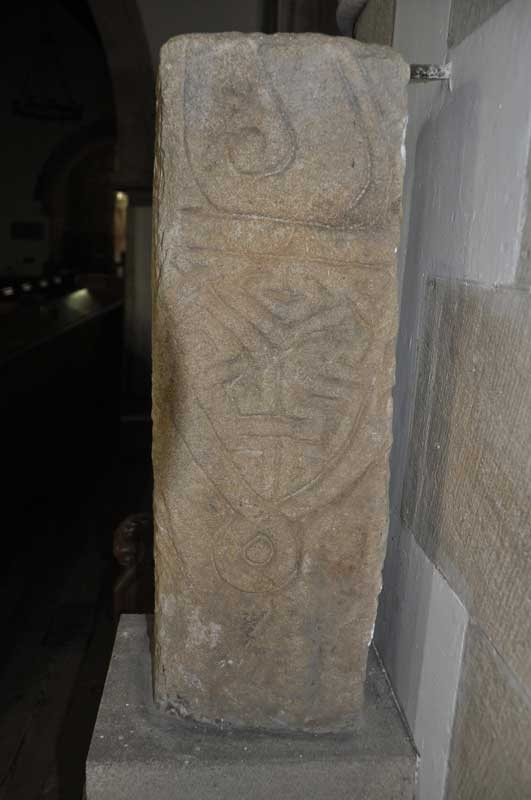
St Andrew's Church (Bywell) submitted by Anne T : Close up of the second decorated side of the larger fragment, which is the lower part of a cross shaft (Corpus of Anglo-Saxon Stone Sculpture reference: Bywell 01). This face shows the remains of a ring knot and shield shaped pendant. (Vote or comment on this photo)
Ancient Cross in Northumberland

Two early Christian cross shaft fragments from the 7/8th and 10th centuries

Bywell, from Old English ‘byge-wella’ (a spring in the bend), is now a quiet little hamlet sitting in a bend of the River Tyne comprising a few houses, the ruins of a castle, a medieval market cross and two Saxon churches only a couple of hundred metres apart: St. Peter’s, the ‘white’ church (founded by the White Canons of nearby Blanchland Abbey) and St. Andrew’s, the ‘black church’ (associated with the black robed Benedictine monks). Bywell used to be large village situated near what is locally known as ‘The Lead Road’ and specialised in making swords and horse harness in medieval times.

Both churches are pre-Norman conquest, and sit at opposite sides of Anglo-Saxon, then Norman, land boundaries. St. Andrew’s is said to have the best Saxon tower in Northumberland, and parts of St. Peter’s chancel dates from the eighth century. The Pastscape record tell us that Bishop Egbert of Lindisfarne was consecrated in St. Peter’s in AD802.

St. Peter’s is the larger of the two churches and has become the local parish church; St. Andrew’s is now in the ownership of the Churches Conservation Trust, although is still consecrated and used regularly on an informal basis – from the visitors book, one group of people congregate each year around Christmas time for a Carol service.

St. Andrew’s has probably the best collection of mediaeval cross slab grave covers in Tynedale, most of which have been relocated inside the church to preserve them.

Between the choir stalls and the altar there are displayed the fragments of two Anglo Saxon cross fragments, placed one of top of the other.

The lower fragment dates from the late seventh to eighth century and is said to be either part of the base of a cross or an impost, reused from Roman times.

The larger, upper fragment dates from the 10th century and is the lower part of a cross-shaft. This is carved on two faces. One face shows an animal, the other a ring-knot and a shield-shaped motif.
You may be viewing yesterday's version of this page. To see the most up to date information please register for a free account.


St Andrew's Church (Bywell)
St Andrew's Church (Bywell) submitted by Anne T : This photo shows fragments Bywell (from left to right) St Andrew's 4, 5 and 6. (5) is in the middle, and recorded as Ryder's Bywell (St Andrew's) 5, dated to the thirteenth century. He describes it as "(a) Stone with a moulded edge and a line of dog-tooth ornament ... It is not clear whether this is part of a sepulchral monument; it may be a fragment of one edge of an elaborate slab". (Vote or comment on this photo)

St Andrew's Church (Bywell)
St Andrew's Church (Bywell) submitted by Anne T : Ryder's Bywell (St Andrew's) 6, part of the head of a cross slab with a round leaf-bracelet cross "carved in relief within a sunk circle". Dated to the late twelfth or early thirteenth century. Set close to fragments (4) and (5) at the north end of the west wall of the north transept. (Vote or comment on this photo)

St Andrew's Church (Bywell)
St Andrew's Church (Bywell) submitted by Anne T : This complete slab of sandstone is set in to the external face of the east wall of the north chancel chapel. Recorded as Ryder's Bywell (St Andrew') 1, he dates it to an early period, possibly the twelfth century. Ryder describes it as having: "(a) Four-circle cross head, with pointed buds; cross-bar near head of shaft, which rises from a stepped mount. On the left of the shaft, near its base, is... (Vote or comment on this photo)

St Andrew's Church (Bywell)
St Andrew's Church (Bywell) submitted by Anne T : This slab, which has had its left side cut away, can be found in the external face of the north wall of the north chancel chapel, near its eastern end. Ryder has recorded it as Bywell (St Andrew') 2, dates it to possibly the thirteenth century, describing it as "The design is deeply incised; the left edge has been cut away, presumably at some point of re-use. Slab with cross botonee head, the ter... (Vote or comment on this photo)

St Andrew's Church (Bywell)
St Andrew's Church (Bywell) submitted by Anne T : This slab, whilst broken in half, is more or less complete and has been set into the external face of the north wall of the north chancel chapel. Recorded by Ryder as Bywell (St Andrew's) 3, it is dated to the later thirteenth century and described as: "(having an) interlaced diamond cross with trefoil terminals, on a broad cross shaft that tapers upwards from a two-stepped base". (Vote or comment on this photo)

St Andrew's Church (Bywell)
St Andrew's Church (Bywell) submitted by Anne T : Close up of Ryder's Bywell (St Andrew's) 4, set high on the north end of the external west wall of the north transept. Ryder dates it "probably to the twelfth century" and describes it as a fragment of the tegulated side of a coped slab. He adds that "this style is more common in County Durham".

St Andrew's Church (Bywell)
St Andrew's Church (Bywell) submitted by Anne T : Ryder's Bywell (St Andrew's) 7, set low, half way along the external wall of the north transept. May be missing its base. Ryder dates it to the twelfth or thirteenth century and describes the worn design as: "Cross wither with simple trefoil terminals or of cross crosslet form; cf Bywell St Peter (7). Vestiges of pair of shears on the right".

St Andrew's Church (Bywell)
St Andrew's Church (Bywell) submitted by Anne T : This very small slab, missing its base, is set high up on the external west wall of the north transept. Recorded by Ryder as Bywell (St Andrew's) 8, it is dated to the late twelfth or thirteenth century, and shows as "Round-leaf bracelet cross, its head carved in relief within a sunk circle". Ryder comments that even if this slab was full-sized, it can only have been about 60-70cms long.

St Andrew's Church (Bywell)
St Andrew's Church (Bywell) submitted by Anne T : This very wall, small portion of a slab, is set into the external west wall of the north transept. Ryder records it as Bywell (St Andrew's) 9, and describes it as having a cross shaft with a pair of shears on the left. Despite the weathering to this slab, the shears can still be seen. Ryder has been unable to give this a definitive date.

St Andrew's Church (Bywell)
St Andrew's Church (Bywell) submitted by Anne T : This slab, lacking its head, is built into the external west wall of the north transept, and recorded by Ryder as Bywell (St Andrew's) 10. He is unable to give it a precise date, but describes it as: "A slightly tapering cross shaft rises from a stepped base; at the top is a cross-bar, and then an expansion (at the broken edge of the stone) which is probably the beginning of the lower terminal of...

St Andrew's Church (Bywell)
St Andrew's Church (Bywell) submitted by Anne T : This slab is set into the south end of the external wall of the north transept. Ryder records it as Bywell (St Andrew's) 11, but is unable to give it a precise date. He describes it as: "(a) cross with stepped base of the Bywell type, except that the steps are here right-angled. On the right of the cross shaft is a sword and at the top of the surviving section of stone there is a cross-bar, or ju...

St Andrew's Church (Bywell)
St Andrew's Church (Bywell) submitted by Anne T : This slab, re-used on its side as the internal head of the south door, is dated to circa 1100. It is recorded as Ryder's Bywell (St Andrew's) 12, and described as a: "Simple cross with a chevron pattern on its shaft, and a crude base of the Bywell type with very angular steps. There is a pair of shears on the left hand side of the shaft".

St Andrew's Church (Bywell)
St Andrew's Church (Bywell) submitted by Anne T : Used as the internal inner lintel of the south window of the south transept, this slab lies directly under (14). Recorded as Ryder's Bywell (St Andrew's) 13, it is dated to the twelfth century, and described as: "The cross head (partly concealed by the wall) appears to have had eight arms of simple petal-like form with a rounded end. Stepped base, and sword on the right of the shaft".

St Andrew's Church (Bywell)
St Andrew's Church (Bywell) submitted by Anne T : Re-used as the internal window head of the south window in the south transept, above slab 13, it is dated to the thirteenth century, and recorded by Ryder as Bywell (St Andrew's) 14. He tells us the right edge has been partly cut away by the rear arch of the opening; it has "(a) Cross botonee head of the same form as slab (2), cross bar high on the shaft, and Bywell type base with square steps. O...

St Andrew's Church (Bywell)
St Andrew's Church (Bywell) submitted by Anne T : This slab was almost impossible to see, as it forms the head of the north window of the north transept, behind the organ, and above slab 16. This photo was taken by husband, Andrew, who volunteered to climb up a ladder left propped up against the north wall. The slab is dated to the thirteenth century, and recorded by Ryder as Bywell (St Andrew's) 15. It's design is virtually identical to slab 14,...

St Andrew's Church (Bywell)
St Andrew's Church (Bywell) submitted by Anne T : Seen from almost directly underneath, this slab has a round-leaf bracelet cross head, with a semi-circular mount for the cross shaft, and a sword to the right on the shaft. It has been reused as the inner lintel of the north window of the north transept. This window is almost immediately behind the organ, which is used as a storage area, so space between the organ and the north wall is limited. Re...

St Andrew's Church (Bywell)
St Andrew's Church (Bywell) submitted by Anne T : With the church lights on a timer with short 'on-time', I needed a torch and a good flash to see this slab-head. It is set into the spandrel on the northern side of the two bay arcade on the north side of the chancel, facing the chapel. Recorded as Ryder's Bywell (St Andrew's) 17, it is dated to the thirteenth century, and has a cross botonee head.

St Andrew's Church (Bywell)
St Andrew's Church (Bywell) submitted by Anne T : Another slab of grey sandstone, missing its base, fixed to the internal east wall of the north chancel chapel. Ryder records it as Bywell (St Andrew's) 18, "the head carved in relief within a sunk circular panel. A form of round-leaf bracelet cross head carrying a central disc near the head of the shaft, flanked by a pair of petalled rosettes ... Below this, on the right of the shaft, a sword with...

St Andrew's Church (Bywell)
St Andrew's Church (Bywell) submitted by Anne T : Another of the slabs fixed to the internal east wall of the north chancel chapel, recorded by Ryder as Bywell (St Andrew's) 20. A half-sized slab, dated to the twelfth century, it has a cross with 'large and crude trefoil terminals (none to lower arm) and a triangular mount, with a hint of a motif carved within it. On the right of the shaft is a pair of shears".

St Andrew's Church (Bywell)
St Andrew's Church (Bywell) submitted by Anne T : Ryder's Bywell (St Andrew's) 19, fixed to the interior eastern wall of the north chancel chapel. A half-sized slab, Ryder dates it to the twelfth century. The cross has "unusual terminals, like fleur-de-lys with the leaves curling backwards to meet the arm, but without any central bud; it rises from a semi-circular mount with a sword on the right of the shaft".

St Andrew's Church (Bywell)
St Andrew's Church (Bywell) submitted by Anne T : This is Ryder's Bywell (St Andrew's) slab 21, affixed to the lower part of the eastern wall of the north chancel chapel. Dated to around circa 1300, this slab also bears a Lion Rampant (the arms of the de Insuala (Lisle) family of Newton), similar to Bywell (St. Peter's) (11). The cross head is impressive, with ten radiating arms, with a large central disc. A shield overlies the cross shaft. On th...

St Andrew's Church (Bywell)
St Andrew's Church (Bywell) submitted by Anne T : This slab is fixed to the internal eastern wall of the north chancel chapel; its bottom part is obscured by the pews next to it. Split into two pieces, now displayed togeter, this slab is recorded by Ryder as Bywell (St Andrew's) 22, he dates it to circa 1300. He describes it as: "(a) rectangular slab, cracked in two pieces. The cross has a disc, with concentric incised rings within it, at the he...

St Andrew's Church (Bywell)
St Andrew's Church (Bywell) submitted by Anne T : Another of the slabs fixed to the internal south wall of the south transept, dated to the twelfth century. Recorded as Ryder's Bywell (St Andrew's), the slab is made of brown/grey gritstone, "its design is virtually identical to slab (20)".

St Andrew's Church (Bywell)
St Andrew's Church (Bywell) submitted by Anne T : Fixed to the south wall of the south transept, this is Ryder's Bywell (St Andrew's) 24, dated to the twelfth century. He describes it as: "(a) ‘Half size’ slab of yellowish sandstone; simple cross with slightly expanded terminals and a triangular mount. On the right a sword, overlain by a disc (a buckler?), while on the left an emblem which resembles a pair of tongs".

St Andrew's Church (Bywell)
St Andrew's Church (Bywell) submitted by Anne T : On the south wall of the south transept, this is Ryder's Bywell (St Andrew's) 25. Ryder dates it to the late twelfth or thirteenth century. The slab largely shows a round-leaf bracelet-headed cross. It's right hand side (west) has been broken off.

These are just the first 25 photos of St Andrew's Church (Bywell). If you log in with a free user account you will be able to see our entire collection.

Do not use the above information on other web sites or publications without permission of the contributor.
Click here to see more info for this site

Nearby sites

Click here to view sites on an interactive OS map

Key: Red: member's photo, Blue: 3rd party photo, Yellow: other image, Green: no photo - please go there and take one, Grey: site destroyed

Download sites to:
KML (Google Earth)
GPX (GPS waypoints)
CSV (Garmin/Navman)
CSV (Excel)

To unlock full downloads you need to sign up as a Contributory Member. Otherwise downloads are limited to 50 sites.


Turn off the page maps and other distractions

Nearby sites listing. In the following links * = Image available
 74m ENE 63° Bywell Cross* Ancient Cross (NZ0489661513)
 109m ESE 122° St Peter's (Bywell)* Early Christian Sculptured Stone (NZ0492261422)
 2.5km NNE 26° Entry Well (Ovington)* Holy Well or Sacred Spring (NZ0589163703)
 3.2km NE 42° St Andrew's Well (Ovington)* Holy Well or Sacred Spring (NZ0697563896)
 3.5km SSE 168° Castle Hill (Whittonstall)* Ancient Village or Settlement (NZ05585801)
 4.1km NNE 34° Hunters Hill (Ovington) Rock Art (NZ0711064900)
 4.2km NE 41° Eddybroth Well (Whittle Dene)* Holy Well or Sacred Spring (NZ0760464659)
 4.3km ENE 59° Ovingham Cross* Ancient Cross (NZ08506370)
 4.4km NW 318° Thornborough High Barns* Rock Art (NZ01896478)
 4.8km ENE 66° Prudhoe Castle* Rock Art (NZ09186342)
 5.3km NNW 331° Bow Bridge Homestead* Ancient Village or Settlement (NZ02256615)
 5.7km NNW 345° Shildon Hill Fort* Hillfort (NZ03356700)
 6.0km SSW 200° St George's Well (Minsteracres)* Holy Well or Sacred Spring (NZ0274555884)
 6.1km NW 317° Meg's Well, Aydon* Holy Well or Sacred Spring (NZ0070465949)
 6.3km NE 46° Croft's Well (Horsley)* Holy Well or Sacred Spring (NZ0939965821)
 6.3km WNW 298° Old Viney Museum (Corbridge)* Sculptured Stone (NY99226445)
 6.5km NE 43° Horsley Hill Homestead* Ancient Village or Settlement (NZ09266624)
 6.6km E 91° North View enclosure* Ancient Village or Settlement (NZ114614)
 6.6km WNW 296° Corbridge Crosses* Ancient Cross (NY9885564411)
 6.7km WNW 296° St Andrew's Church (Corbridge)* Ancient Cross (NY98836443)
 6.9km WNW 299° Old Prior Manor House Well (Corbridge)* Holy Well or Sacred Spring (NY9879164783)
 7.4km WNW 297° Corbridge Rock Art Panel* Rock Art (NY9826764830)
 7.5km WNW 297° Hadrian's Wall (Coria)* Stone Fort or Dun (NY9818064904)
 7.6km ENE 76° Bradley Hall Ice House Barrow Round Barrow(s) (NZ12236333)
 7.9km ENE 78° Bradley Hall Dene Barrow Round Barrow(s) (NZ12536317)
View more nearby sites and additional images

<< Three Hole Cross

The Anker's House >>

Please add your thoughts on this site

The Mind in the Cave

The Mind in the Cave

Sponsors

Latest Visit Logs

  • Badnabay
    “A short walk through rather boggy ground towards the west end of the horseshoe-shaped road coming of…”
    by RingPaw · 7 Jun 2026
  • Tsankawi
    “The complete Tsankawi Village loop trail is about 2 miles round trip. The parking lot is large, pave…”
    by stonetracker · 6 Jun 2026
  • Dun Beag (Struan)
    “Nothing much to add to earlier comments - a short walk but steep in parts. A spectacular site, defin…”
    by Glaschu · 5 Jun 2026
  • Gwal y Filiast
    “Did the anti clockwise circular walk from login, track through field by Dickman (timber merchant) is…”
    by Possumputer · 4 Jun 2026
  • Dun Buidhe
    “Access - it's easy to get to the causeway. You walk across one island which is rough ground but noth…”
    by Glaschu · 3 Jun 2026

"St Andrew's Church (Bywell)" | Login/Create an Account | 2 News and Comments
  
Go back to top of page    Comments are owned by the poster. We aren't responsible for their content.
Re: St Andrew's Church (Bywell) by Anonymous on Saturday, 15 November 2025
I have visited St Andrews church many times, I could be wrong, I'm not by any means an expert, but I have a feeling that the carved stones have a good chance of dating back to the beginnings of Christianity in Northumbria, grounds for this are that some have been incorporated into the building of the church and could have been there a long time before they were used. This has always been a feeling I've had about them, which always makes me even more fascinated with them.
[ Reply to This ]

Re: St Andrew's Church (Bywell) by Anne T on Friday, 27 September 2019
(User Info | Send a Message)
Peter Ryder makes reference to 'the Bywell type' of cross base. By this, he means: "The base is of a distinctive local form (hereafter termed the 'Bywell type') being initially cut as a triangular mount, and then indentations made so as to produce the effect of steps, in this case acutely pointed; the overall effect is reminiscent of a child’s drawing of a Christmas Tree." This is particularly noticeable, and an interesting feature of, the cross slabs at both St Andrew's and St Peter's at Bywell.
[ Reply to This ]

Your Name: Anonymous [ Register Now ]
Subject:


Add your comment or contribution to this page. Spam or offensive posts are deleted immediately, don't even bother

<<< What is five plus one as a number? (Please type the answer to this question in the little box on the left)
You can also embed videos and other things. For Youtube please copy and paste the 'embed code'.
For Google Street View please include Street View in the text.
Create a web link like this: <a href="https://www.megalithic.co.uk">This is a link</a>  

Allowed HTML is:
<p> <b> <i> <a> <img> <em> <br> <strong> <blockquote> <tt> <li> <ol> <ul> <object> <param> <embed> <iframe>

We would like to know more about this location. Please feel free to add a brief description and any relevant information in your own language.
Wir möchten mehr über diese Stätte erfahren. Bitte zögern Sie nicht, eine kurze Beschreibung und relevante Informationen in Deutsch hinzuzufügen.
Nous aimerions en savoir encore un peu sur les lieux. S'il vous plaît n'hesitez pas à ajouter une courte description et tous les renseignements pertinents dans votre propre langue.
Quisieramos informarnos un poco más de las lugares. No dude en añadir una breve descripción y otros datos relevantes en su propio idioma.