Featured: See Your Book Here

See Your Book Here

The Modern Antiquarian Reissued

The Modern Antiquarian Reissued

Login

Register here - as a registered user you get more features and fewer ads.

Who's Online

There are currently, 1669 guests and 5 members online.

Sponsors

<< Our Photo Pages >> Majorville Medicine Wheel - Round Cairn in Canada

Submitted by Andy B on Monday, 10 January 2022  Page Views: 57311

Neolithic and Bronze AgeSite Name: Majorville Medicine Wheel Alternative Name: Iniskim Umaapi, Sundial Medicine Wheel, 'Canada's Stonehenge'
Country: Canada Type: Round Cairn
Nearest Town: Calgary  Nearest Village: Milo
Latitude: 50.585167N  Longitude: 112.410639W
Condition:
5Perfect
4Almost Perfect
3Reasonable but with some damage
2Ruined but still recognisable as an ancient site
1Pretty much destroyed, possibly visible as crop marks
0No data.
-1Completely destroyed
no data Ambience:
5Superb
4Good
3Ordinary
2Not Good
1Awful
0No data.
no data Access:
5Can be driven to, probably with disabled access
4Short walk on a footpath
3Requiring a bit more of a walk
2A long walk
1In the middle of nowhere, a nightmare to find
0No data.
2 Accuracy:
5co-ordinates taken by GPS or official recorded co-ordinates
4co-ordinates scaled from a detailed map
3co-ordinates scaled from a bad map
2co-ordinates of the nearest village
1co-ordinates of the nearest town
0no data
5

Internal Links:
External Links:

Majorville Medicine Wheel
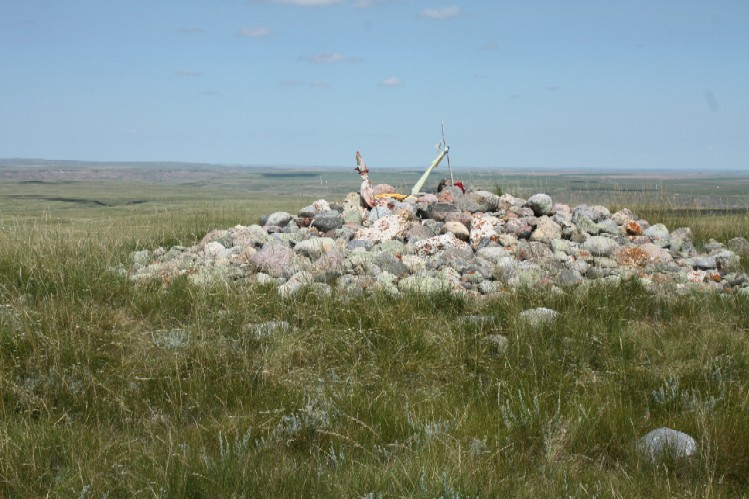
Majorville Medicine Wheel submitted by Runemage : Looking East towards the Bow River Image copyright John Nightingale who writes: "although I was somewhat sceptical , I borrowed a friends dowsing rods and "Wow" they actually moved when approaching the summit and especially in and around the top. Powerful stuff!" (Vote or comment on this photo)
Medicine Wheel in Vulcan County, Alberta.
The central cairn is nine metres in diameter and is surrounded by a stone circle 27 metre across. about 28 spokes link the circle and central cairn. In 1971 an excavation yielded artifacts which were "dated" by stone tool style. This method and radiocarbon dating of bone place initial construction of the central cairn at some 4,500 BP, although another source dates the initial site to 3200 BP. The tool finds indicate a succession of added material over the centuries.

The site became known to the world in 2009 when academic Gordon Freeman published a book stating his theory that the site was an astronomical calendar on par with Stonehenge. Canadian Press story no longer available at their site:
"An academic maverick is challenging conventional wisdom on Canada's prehistory by claiming an archeological site in southern Alberta is really a vast, open-air sun temple with a precise 5,000-year-old calendar predating England's Stonehenge and Egypt's pyramids."

"Mainstream archaeologists consider the rock-encircled cairn to be just another medicine wheel left behind by early aboriginals. But a new book by retired University of Alberta professor Gordon Freeman says it is in fact the centre of a 26-square-kilometre stone "lacework" that marks the changing seasons and the phases of the moon with greater accuracy than our current calendar.

"'Genius existed on the prairies 5,000 years ago,' says Freeman, the widely published former head of the university's physical and theoretical chemistry department.

"Freeman's fascination with prairie prehistory dates back to his Saskatchewan boyhood. He and his father would comb the short grasses of the plains in search of artifacts exposed by the scouring wind. That curiosity never left him and he returned to it as he prepared to retire from active teaching.

"Looking for a hobby, he asked a friend with an interest in history to suggest a few intriguing sites to visit. On a warm late-August day in 1980, that list drew him to what he has come to call Canada's Stonehenge, which is also the title of his book.

"A central cairn atop one of a series of low hills overlooking the Bow River, about 70 kilometres east of Calgary, had been partially excavated in 1971 and dated at about 5,000 years old. But as he approached it, Freeman strongly felt there was much more there than previously thought.

"'As we walked toward the hilltop, I saw all kinds of patterns in the rocks on the way up. As I walked around the hilltop, I could see patterns that I doubted very much were accidental.'"

Also see Freeman's own web site.

IMPORTANT NOTE: Location given is an estimate. The Majorville Cairn or Medicine Wheel is east of the village of Milo, Alberta, on the west side of the Bow River.

Note: "Canada's Stonehenge". Iniskim Umaapi medicine wheel site one of the oldest religious monuments in the world.
You may be viewing yesterday's version of this page. To see the most up to date information please register for a free account.
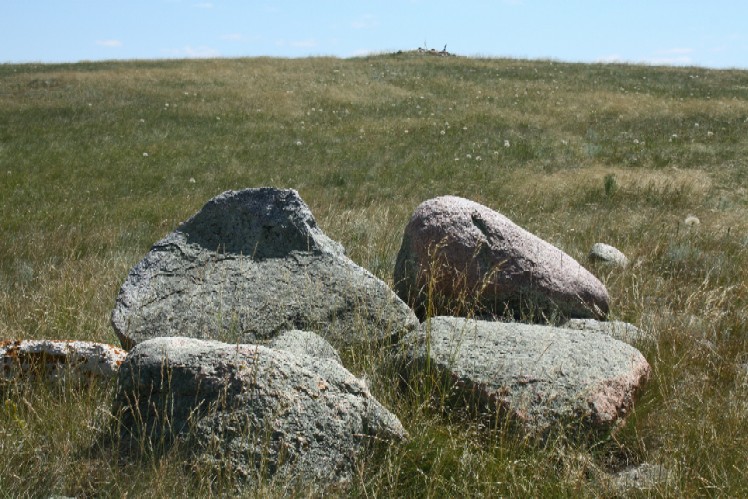
Majorville Medicine Wheel
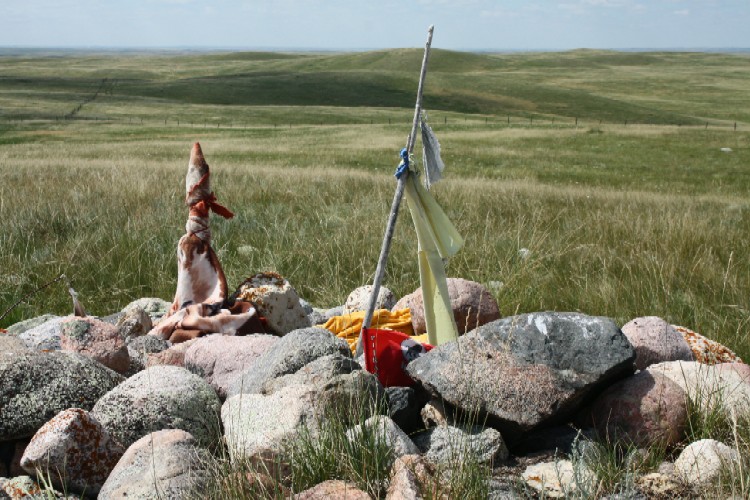
Majorville Medicine Wheel submitted by Runemage : Majorville Medicine Wheel detail of summit. Flags, prayer bundles, feathers and notice the quartz striations in some of the boulders. Image copyright John Nightingale (Vote or comment on this photo)

Majorville Medicine Wheel
Majorville Medicine Wheel submitted by Runemage : Majorville Medicine Wheel. One of the Western outliers looking towards the summit Image copyright John Nightingale (Vote or comment on this photo)

Majorville Medicine Wheel
Majorville Medicine Wheel submitted by TheDruid-3X3 : The information board. This appears to indicate that it is an Eight Spoked Wheel Design but the Sign does not indicate how it indicates anything about it being rientated towards any of the Sosltices. (Vote or comment on this photo)

Majorville Medicine Wheel
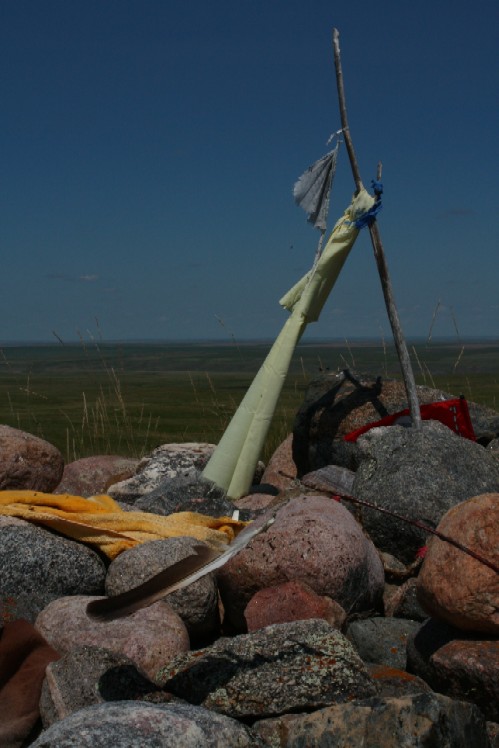
Majorville Medicine Wheel submitted by Runemage : Majorville Medicine Wheel Summit with Prayer Bundles, feathers etc. Image copyright John Nightingale (Vote or comment on this photo)

Do not use the above information on other web sites or publications without permission of the contributor.

Nearby Images from Flickr
The Chair

The above images may not be of the site on this page, but were taken nearby. They are loaded from Flickr so please click on them for image credits.


Click here to see more info for this site

Nearby sites

Click here to view sites on an interactive map of the area

Key: Red: member's photo, Blue: 3rd party photo, Yellow: other image, Green: no photo - please go there and take one, Grey: site destroyed

Download sites to:
KML (Google Earth)
GPX (GPS waypoints)
CSV (Garmin/Navman)
CSV (Excel)

To unlock full downloads you need to sign up as a Contributory Member. Otherwise downloads are limited to 50 sites.


Turn off the page maps and other distractions

Nearby sites listing. In the following links * = Image available
 58.0km SSW 204° Sundial Medicine Wheel* Ring Cairn
 83.1km SSE 153° Fincastle Grazing Reserve Bison Kill* Ancient Mine, Quarry or other Industry
 118.2km W 277° Big Rock (Alberta)* Rock Art
 131.7km WNW 296° Ootssip'tomowa Look Out Hill* Hill Figure or Geoglyph
 131.9km SW 223° Head-Smashed-In Buffalo Jump* Ancient Mine, Quarry or other Industry
 137.2km ESE 117° Saami Giant Teepee* Ancient Village or Settlement
 176.6km SSE 161° Writing-on-Stone Provincial Park* Rock Art
 187.8km ESE 122° Stampede Site* Ancient Mine, Quarry or other Industry
 267.9km SW 223° Crystal Lakes Golf Course Stonehenge* Modern Stone Circle etc
 351.4km S 169° First Peoples Buffalo Jump* Natural Stone / Erratic / Other Natural Feature
 355.2km WNW 301° Cataract Creek Petroglyphs* Rock Art
 391.8km WSW 237° Priest Lake Pictographs Rock Art
 411.9km E 80° Mistaseni Cairn* Marker Stone
 412.2km E 80° Elbow Trail Stone Picnic Area* Modern Stone Circle etc
 415.6km E 80° Mistasiniy* Natural Stone / Erratic / Other Natural Feature
 423.6km E 81° New Mistusininey Buffalo Child Stone* Marker Stone
 442.4km ENE 63° Wanuskewin Heritage Park* Museum
 451.0km S 175° Megaliths Of Helena* Natural Stone / Erratic / Other Natural Feature
 483.3km SW 232° Indian Painted Rocks (Spokane) Rock Art
 485.2km ESE 103° St.Victor Petroglyphs* Rock Art
 512.3km NE 47° Park Valley Megalithic Stone Circle* Modern Stone Circle etc
 525.6km NE 54° Âsowanânihk Ancient Indigenous Site* Ancient Village or Settlement
 546.2km ESE 106° Blackfoot Buffalo Effigy* Rock Art
 553.5km E 89° Wascana Lake Aboriginal Four Directions Medicine Wheel* Modern Stone Circle etc
 566.8km WSW 245° Balance Rock Omak* Natural Stone / Erratic / Other Natural Feature
View more nearby sites and additional images

<< Slawendorf Passentin

Water Dittins Marker Stone >>

Please add your thoughts on this site

Newgrange: Archaeology, Art and Legend

Newgrange: Archaeology, Art and Legend

Sponsors

Latest Visit Logs

  • Halsary Standing Stone
    “This May I took the opportunity, while passing through the area, to locate and photograph both of th…”
    by ladrin · 17 Jun 2026
  • Camus Cross (Angus)
    “The cross lies on private land but is accessible on foot. It is well worn but many details can be ma…”
    by asbremner · 17 Jun 2026
  • The Bargain Stone
    “Sadly when I was there it was covered by a large box. At least the workers renovating the church ha…”
    by cactus_chris · 15 Jun 2026
  • Sigtuna U 389
    “Right next to the museum entrance, this runestone is hard to miss.”
    by CharcoalBurner89 · 15 Jun 2026
  • The Awen Stone
    “Situated in the grounds of West End Campsite, easily visible and accessible as of June 2026.”
    by TimPrevett · 15 Jun 2026

"Majorville Medicine Wheel" | Login/Create an Account | 16 News and Comments
  
Go back to top of page    Comments are owned by the poster. We aren't responsible for their content.
Re: Majorville Medicine Wheel by archaeo on Monday, 10 January 2022
(User Info | Send a Message)
This placemark is 24 degrees from Denali, 1/15th of earth's circumference, back then also the inclination of the axis of rotation.
[ Reply to This ]

Re: Canada’s Stonehenge by TheCaptain on Monday, 10 January 2022
(User Info | Send a Message)
In BBC Travel today. "Built by ancient Indigenous People and long considered to be sacred, the Iniskim Umaapi medicine wheel in Alberta is one of the oldest religious monuments in the world".

Canada's Stonehenge
[ Reply to This ]

Re: Canada’s Stonehenge Launches at Audrey’s Books, February 5 by Anonymous on Sunday, 02 November 2014
Wanuskewin Heritage Park at a Saskatoon, Sask also has a medicine wheel and is the furthest north a medicine wheel has been documented. Please add this to the map and list. There has been much research through the University of Saskatchewan completed on this site and is the longest ongoing archeological research project in Canada. Very interesting site.
[ Reply to This ]
    Re: Canada’s Stonehenge Launches at Audrey’s Books, February 5 by davidmorgan on Sunday, 02 November 2014
    (User Info | Send a Message)
    Site page created for Wanuskewin Heritage Park, thanks.
    [ Reply to This ]
    Re: Canada’s Stonehenge Launches at Audrey’s Books, February 5 by rabamw on Monday, 10 November 2014
    (User Info | Send a Message)
    MEDICINE WHEELS of the Canadian Prairies
    (and a Few South of the Border)

    I graduated from the University of Alberta in Edmonton with a degree in archaeology. My Honours Research Paper was "Medicine Wheels: Changes in Form and Function Through Time, as Suggested by Typological, Archaeological, and Ethnographic Evidence ", completed in April 1986. It should still on file, tucked away somewhere in the library of the Department of Anthropology.

    My supervisors were Dr. Alan L. Bryan and Dr. Ruth Gruhn, pioneers in digging up &/or inspecting traces of the earliest human occupations in the Americas, from Siberia to Chile. An amazing team, they were. Even if 'Early Al' did break my back one Thanksgiving weekend, with relentless encouragement to keep digging into a sandy kame, north of Edmonton. Aside from an hibernating toad, however, I did uncover a stone that sure looked like it had been humanly modified around 10,000 years ago.

    This had little to do with medicine wheels. The Majorville Cairn, one of the oldest 'wheels', was built 7000 years later, but we were at least getting some precursory time-depth. Studies and surveys of medicine wheels were rare. Farming and ranching had obliterated many during the last 100 years but fortunately there been little of that before the railway cut through and the Last Spike was hammered in, (07Nov1885). There might have been hundreds of medicine wheels extant prior to 1900, but after much research I could catalogue only about sixty.

    Most sites are located in southern Alberta, north of Medicine Hat and east from Dinosaur Park. Some are in Saskatchewan and there are several further south, as far Wyoming and the Big Horn Medicine Wheel -- probably the only wheel most people had ever heard about until Gordon Freeman's "Canada's Stonehenge" was published (2009). And Big Horn was built 4500 years later.

    The 11th Chacmool Conference at the University of Calgary in 1981 had piqued my interest. In particular, the presentation by astronomer Michael Ovendon from the Vancouver Planetarium, who was evidently familiar with the works Alexander Thom. Ovendon had found not only evidence of the Megalith Yard in the construction of some older medicine wheels, but also their shapes were geometrically similar to many stone rings in Britain. One egg-shaped 'wheel' was almost identical to the Bar Brook ring in Wales. This one and many others were aligned with celestial events. And even with comparatively few medicine wheels -- 60 sparsely spread out across a thousand miles of prairie -- it became evident to me that many formed a network of cross-country alignments. Very handy for long-distance treks, from Montana to Moose Mountain near the Manitoba border, or to the northernmost wheel, Cronk's Big Circle near Saskatoon.

    -=Rab Wilkie

    [ Reply to This ]

Re: Majorville Medicine Wheel by Anonymous on Wednesday, 27 August 2014
I would like to visit this site but would need more accurate directions, is that possible?
[ Reply to This ]

Book review of Hidden Stonehenge: A Temple in North America by Andy B on Tuesday, 05 February 2013
(User Info | Send a Message)
Our review of Hidden Stonehenge: A Temple in North America Reveals the Key to Ancient Wonders by Gordon R. Freeman here:

http://www.megalithic.co.uk/article.php?sid=2146414134
[ Reply to This ]

Old Big - Is southern Alberta home to Canada's Stonehenge? by Andy B on Tuesday, 05 February 2013
(User Info | Send a Message)
A photo journalism article by Don Hill in Alberta Views - Jul/Aug2012, Vol. 15 Issue 6

The article explores the Omahkiyaahkohtoohp, also known as Ómahk which refers to a big arrangement of standing stones in Alberta. It is found in concordance with Stonehenge in England that appears to haphazardly scattered across the prairie. The design of each arrangement involves the same numbers and similar symbols which are inspired by astrological notions. Ómahk is referred by locals as the sundial while some of them see it as a monument to the dead or an effigy of the sun.

Read the article here (PDF)
[ Reply to This ]

Re: Majorville Medicine Wheel by Anonymous on Wednesday, 15 August 2012
This is one of the more aesthetic Native sites in prairie Canada. Note that on the high cliff ridges of the Bow River to the E, NE, NW across the Bow River from the Majorville site( the high point on the hills), that there are hundreds of tipi rings(rocks to hold tipis down in winds, some very embedded in the soil indicating many hundreds of years of use in time).
The use of this area above and around the Majorville site indicate that it was a seasonal focal point for many years(thousands?). Antelope, deer and river fish and migrating birds point to a rich area. Note that the cairn rock pile that was excavated in the 1930's stood about 8 to 10 foot high at the centre of the cairn and were easily seen from up to 20 plus miles away. A definite focal point in the larger area. Of note are 4 or 5 quartz type rocks inbedded in the soil some 20 to 35 feet aprox to the NW of the site.
When I viewed this site 3 times aprox 20 years ago before there were oil drilling rigs in the viewing...

Read the rest of this post...
[ Reply to This ]

Re: Majorville Medicine Wheel Photos by Andy B on Tuesday, 18 January 2011
(User Info | Send a Message)
Accurate location added, thanks to John Nightingale.
Some more links:

http://www.shrinesandsacredsites.com/mmw.htm

http://angelsandancestors.blogspot.com/2008/07/majorville-medicine-wheel.html

Someone interested in some 'armchair research' could try tracking down the locations of the other sites referred to here and adding them to our database:

http://www.shrinesandsacredsites.com/wcan.htm

[ Reply to This ]

Majorville Medicine Wheel Photos by Anonymous on Sunday, 26 September 2010
In case anyone is interested in seeing what the Majorville Medicine Wheel looks like, I have a number of photos on my web site:

Majorville Medicine Wheel Photo Gallery

Cliff LeSergent
Images West Photography
http://www.imageswest.ca
[ Reply to This ]

Re: Canada’s Stonehenge in our Forum by Anonymous on Thursday, 05 February 2009
Majorsville cairn near Bow River

Blackfoot - 13 Placemarks
maps.google.com/maps/ ms?msa=0&msid=100512295085060433494.00044277ef09e37594fe0&output=kml - 21k

Majorville Cairn Medicine Wheel: "Majorville Medicine Wheel, was partly excavated in 1971. This wheel contains an enormous central cairn 9 metres in diameter, surrounded by a stone circle 27 metre across; about 28 spokes link the circle and central cairn. The excavation yielded artifacts which archaeologists can "date" by style; the style of spear points and arrowheads changed in a regular manner over time and archaeologists have figured out the sequence of these changes. It seems that the central cairn at the Majorville wheel was initially constructed some 4,500 years ago! Radiocarbon dating of bone from the bottom of the cairn confirmed this date. It seems that successive groups of people added new layers of rock, and some of their arrowheads, from that time until the coming of Europeans to Alberta. Curiously, the site...

Read the rest of this post...
[ Reply to This ]

Canada’s Stonehenge: Sun Temple Discovery in Alberta by Andy B on Tuesday, 03 February 2009
(User Info | Send a Message)
Press Release: In a remote location west of Brooks, Alberta, scientist Gordon Freeman discovered a Sun Temple that pre-dates Stonehenge. According to Freeman, it was constructed some 5000 years ago by the Oxbow People, and contains a solar calendar like ours, but slightly more accurate. He states that the site also contains a detailed lunar calendar. During field work in England from 1986 to 2006, Freeman found striking similarities between the surface geometries of Stonehenge and this site, findings which have far-reaching historical implications.

These discoveries are carefully documented and interpreted in Gordon Freeman’s new book, Canada’s Stonehenge: Astounding Archaeological Discoveries in Canada, England, and Wales, launching February 4th.

Freeman describes the Alberta site as a complex, lace-like pattern of stones extending over an area of about thirty square kilometres. Local ranchers have called the hilltop Sunburst centrepiece of the site “the Sundial” for the...

Read the rest of this post...
[ Reply to This ]

Canada’s Stonehenge in our Forum by Andy B on Monday, 02 February 2009
(User Info | Send a Message)
Further discussions here:

http://www.megalithic.co.uk/modules.php?op=modload&name=Forum&file=viewtopic&topic=3282&forum=1
[ Reply to This ]

Canada’s Stonehenge Launches at Audrey’s Books, February 5 by Andy B on Monday, 02 February 2009
(User Info | Send a Message)
Canada’s Stonehenge Launches at Audrey’s Books, February 5

Gordon Freeman will be at
Audrey’s Books
10702 Jasper Avenue NW
Edmonton, AB T5J 3J5, Canada
(780) 423-3487

Thursday, February 5, 2009
7:30 pm

with a powerpoint presentation
to discuss Canada’s Stonehenge
admission is free

Gordon Freeman will be on hand to answer
questions and sign books after the presentation.
[ Reply to This ]

Your Name: Anonymous [ Register Now ]
Subject:


Add your comment or contribution to this page. Spam or offensive posts are deleted immediately, don't even bother

<<< What is five plus one as a number? (Please type the answer to this question in the little box on the left)
You can also embed videos and other things. For Youtube please copy and paste the 'embed code'.
For Google Street View please include Street View in the text.
Create a web link like this: <a href="https://www.megalithic.co.uk">This is a link</a>  

Allowed HTML is:
<p> <b> <i> <a> <img> <em> <br> <strong> <blockquote> <tt> <li> <ol> <ul> <object> <param> <embed> <iframe>

We would like to know more about this location. Please feel free to add a brief description and any relevant information in your own language.
Wir möchten mehr über diese Stätte erfahren. Bitte zögern Sie nicht, eine kurze Beschreibung und relevante Informationen in Deutsch hinzuzufügen.
Nous aimerions en savoir encore un peu sur les lieux. S'il vous plaît n'hesitez pas à ajouter une courte description et tous les renseignements pertinents dans votre propre langue.
Quisieramos informarnos un poco más de las lugares. No dude en añadir una breve descripción y otros datos relevantes en su propio idioma.