

Contributory members are able to log private notes and comments about each site
Sites AufderSuche has logged. View this log as a table or view the most recent logs from everyone
Lochstein (Wenigzell)
Trip No.1 Entry No.2 Date Added: 20th Sep 2026
Site Type: Holed Stone
Country: Austria
Visited: Yes on 11th Sep 2026. My rating: Condition 4 Ambience 4 Access 4

Lochstein (Wenigzell) submitted by AufderSuche on 20th Sep 2026. Holed stone integrated into the outer church wall in Wenigzell / Steiermark. It is said that it still stands at its original place. Photo taken in September 2026.
(View photo, vote or add a comment)
Log Text: There are two holed stones at the church. One is integrated into the outer wall, the other one stands around the corner at a bench and is nearly overgrown. It is said that the one integrated in the wall still stands at its original position.
Näpfchenstein Neutz
Trip No.1 Entry No.1 Date Added: 18th Jul 2026
Site Type: Rock Art
Country: Germany (Saxony-Anhalt)
Visited: Yes on 16th Jul 2026. My rating: Condition 4 Ambience 4 Access 4

Näpfchenstein Neutz submitted by AufderSuche on 18th Jul 2026. The Näpfchenstein (cup-marked stone) in Neutz in July 2026.
(View photo, vote or add a comment)
Log Text: A replica of the "Näpfchenstein" (cup-marked stone) is built into the small wall in front of the church in Neutz. The original stone can be found inside of the church.
It is believed that it was carved in the 13th century.
Hoyerstein Gerbstedt
Date Added: 15th Mar 2026
Site Type: Holed Stone
Country: Germany (Saxony-Anhalt)
Visited: Yes on 3rd Mar 2026. My rating: Condition 4 Ambience 4 Access 5
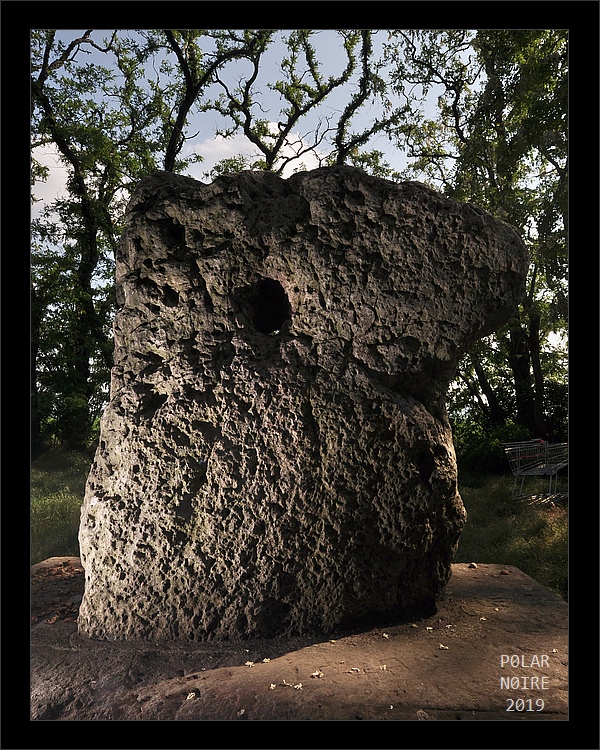
Hoyerstein Gerbstedt submitted by Martin_L on 2nd Apr 2021. Hoyerstein Gerbstedt. Size ~ 1,1 x 1 x 0,4m. Stone is pierced. Diameter 9-14cm.
Originally situated approximately 100m South of the current location. A stone cist has been discovered beside the original location. Nowadays incorporated into a pedestal as part of a battle memorial.
The nails which have been driven into it in historic times are removed. Photo taken 2019.
References:
Grimm, Paul: "Von aufrechten Steinen in Mitteldeutschland", Mitteldeutsche Volkheit 3, Halle 1936...
(View photo, vote or add a comment)
Log Text: A little over 1 km west of Gerbstedt, in a small grove, stands the so-called Hoyerstein, also known as the Holey Stone or Gerbstedt Menhir. It was moved here in 1898; originally, it probably stood about 100 m further south. During the relocation, a stone cist grave was discovered. It is made of lignite quartzite; one side is heavily weathered, the other quite smooth. It is 1.10 m high, 1 m wide, and about 35 cm deep. Today, it serves as a memorial stone for the Battle of Welfesholz. It is a holed stone, a rather rare type in this region. The hole was probably naturally formed but later artificially enlarged. Even now, holes from driven nails are still visible in the stone. This menhir was already mentioned by Johann Christoph Beckmann in his book "History of the Principality of Anhalt" from 1710. He recounts that the hole was probably only completely opened up at a later time, allowing one to see through it.
Pfaffenstein
Date Added: 15th Mar 2026
Site Type: Standing Stone (Menhir)
Country: Germany (Saxony-Anhalt)
Visited: Yes on 3rd Mar 2026. My rating: Condition 4 Ambience 1 Access 5

Pfaffenstein submitted by Klingon on 4th Oct 2013. Menhir from south.
(View photo, vote or add a comment)
Log Text: Directly on the road between Hettstedt and Gerbstedt stands the menhir known as Pfaffenstein or Feldpredigerstein (Priest's Stone or Field Preacher's Stone), which originally stood further into the field. A skeleton was apparently discovered during its relocation. The stone is again made of lignite quartzite, is 1.45 meters high, 55 centimeters wide, and 50 centimeters deep. Holes can be found where nails may once have been driven in. A legend associated with this stone tells of two girls beheading each other with sickles at its base.
Verwohrene Stein
Date Added: 15th Mar 2026
Site Type: Standing Stone (Menhir)
Country: Germany (Saxony-Anhalt)
Visited: Yes on 3rd Mar 2026. My rating: Condition 4 Ambience 4 Access 3

Verwohrene Stein submitted by Klingon on 5th Aug 2018.
(View photo, vote or add a comment)
Log Text: About 2 km east of Hettstedt, the "Confused Stone" stands on a rise in the middle of a field. It is a possible menhir, although this classification is disputed. It is made of quartz, 1.20 m high, 3 m wide, and 40 cm deep. It was once used as a nail stone. A legend tells of blue flames being seen at this stone during thunderstorms.
Ringheiligtum Quenstedt
Date Added: 15th Mar 2026
Site Type: Timber Circle
Country: Germany (Saxony-Anhalt)
Visited: Yes on 3rd Mar 2026. My rating: Condition 1 Ambience 5 Access 3

Ringheiligtum Quenstedt submitted by Klingon on 14th Jan 2005. At the top of the hill "Schalkenburg" was a Woodhenge with a diameter of 100 meter.
(View photo, vote or add a comment)
Log Text: About 1 km southwest of Quenstedt, on a natural hilltop, lies the so-called Schalkenburg, a natural promontory where a ring sanctuary once stood. It is attributed to the late Linear Pottery culture and was probably built around 6700 years ago. The ring sanctuary consisted of five palisade rings constructed of wooden stakes. The outer ring had a diameter of approximately 100 meters, and according to one calculation, over 5000 tree trunks were needed for the palisades. The palisade rings were interrupted at three points by open gateways, which may have served astronomical purposes. Excavations were carried out here in 1967 and 1986, providing the first evidence of a Neolithic circular ditch enclosure in this region. Since then, other such enclosures have been discovered in Saxony-Anhalt. The Goseck Rondel and the Pömmelte Ring Sanctuary are two similar sites that have been reconstructed. Apart from a few signs and a rampart dating from the late Bronze Age or early Iron Age, nothing on this plateau suggests its former importance. Excavations also uncovered burial groups from the Baalberge and Corded Ware cultures. The Bernburg culture later established a settlement here; in the early Bronze Age, richly furnished graves were created, and the site was again used for settlement in the late Bronze Age and early Iron Age. The remaining rampart is believed to be the remnant of a fortification wall from this period. Fortifications from the late Iron Age have also been identified here, and numerous settlement pits, house foundations, hearths, pottery, and bronze jewelry have been found.
Speckstein
Date Added: 10th Mar 2026
Site Type: Standing Stone (Menhir)
Country: Germany (Saxony-Anhalt)
Visited: Yes on 3rd Mar 2026. My rating: Condition 4 Ambience 4 Access 4

Speckstein submitted by AlexHunger on 2nd Oct 2005. Speckstein
In Aschersleben, Sachsen-Anhalt.
(View photo, vote or add a comment)
Log Text: Just under 6 km south of the "Blue Goose" menhir, on the southeastern edge of Aschersleben, stands a menhir called the Soapstone. It crowns an artificial hill built on a natural rise. The stone is likely still in its original location, but it has toppled over several times over the centuries. Archaeological excavations took place here in 1885 and 1932, revealing that the stone stands directly on a stone-packed grave. This grave contained no grave goods, so it could only be generally dated to the Late Neolithic or Early Bronze Age. The stone is made of lignite quartzite and is 1.90 m high, 1.90 m wide, and approximately 20 cm deep. Several nails were also driven into this stone.
Schneiderberg Baalberge
Date Added: 10th Mar 2026
Site Type: Round Barrow(s)
Country: Germany (Saxony-Anhalt)
Visited: Yes on 3rd Mar 2026. My rating: Condition 4 Ambience 3 Access 4

Schneiderberg Baalberge submitted by Klingon on 17th May 2005. The stone at the left slope is a modern monument.
(View photo, vote or add a comment)
Log Text: The Schneiderberg in Baalberge lies within a garden allotment and is a burial mound that was used by various cultures over a period of more than 2000 years. Excavations at this mound were carried out in 1901, and the stone-packed grave of the Baalberge culture was discovered in the lowest layers. However, it could not be completely uncovered because a trigonometric survey point is located directly above it. The mound is almost 6 meters high and has a circumference of 133 meters. It is believed to have originally been surrounded by a ditch, which was filled up in the 19th century. It was probably not significantly enlarged until the Bronze Age; the original Neolithic mound was likely only about 2 meters high. There were other such mounds in the immediate vicinity, but all of them were destroyed in the 18th and 19th centuries. The name "Baalberge," or the term "Baal," likely derives from the Middle High German "bal" or the Old Saxon "balu," which translates to evil, bad, or harmful. There are no natural elevations in the immediate vicinity that could explain the "-berge" in the name. It is probable that the place name itself refers to burial mounds. The name may have been invented by the church, as these were pagan sites. The first written mention comes from Johann Christoph Beckmann. In his book "Historie des Fürstenthums Anhalt" (History of the Principality of Anhalt), he mentions the Baal-Berge near the village of Palberge. Remains of a Late Bronze Age and Early Iron Age settlement have also been discovered in the immediate vicinity.
The finds from Schneiderberg and its surroundings can be viewed at Bernburg Castle Museum.
Menhir Blaue Gans
Date Added: 10th Mar 2026
Site Type: Standing Stone (Menhir)
Country: Germany (Saxony-Anhalt)
Visited: Yes on 3rd Mar 2026. My rating: Condition 4 Ambience 4 Access 3
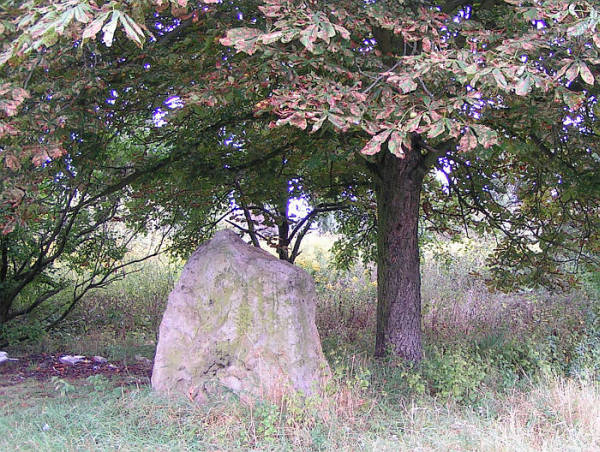
Menhir Blaue Gans submitted by peterpf on 2nd Jul 2006. the menhir seen from the front side
(View photo, vote or add a comment)
Log Text: The menhir "Blue Goose" is located about 4 km north of Aschersleben in a small wooded area. It likely still stands in its original location and was toppled in 1945 during an attempt to remove it. It has since been re-erected. Made of lignite quartzite, it is 1.84 m high, 1.88 m wide, and 60 cm deep. Nails were driven into its broad sides. The name "Blue Goose" suggests that this stone was once used as a judgment stone, as these types of stones were often referred to as "blue stones." Archaeological finds from the Linear Pottery culture to the Middle Ages have been discovered in the surrounding area.
Guddenstein
Date Added: 10th Mar 2026
Site Type: Standing Stone (Menhir)
Country: Germany (Saxony-Anhalt)
Visited: Yes on 3rd Mar 2026. My rating: Condition 4 Ambience 2 Access 5
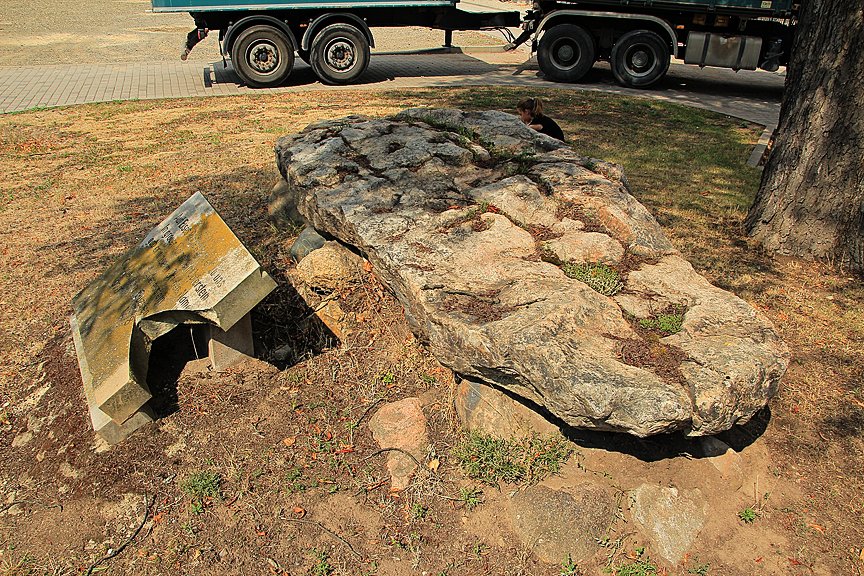
Guddenstein submitted by Klingon on 5th Aug 2018.
(View photo, vote or add a comment)
Log Text: The Guddenstein, or Gudenesstein, is a menhir that has been repurposed as a monument. It stands within the village of Guesten, whose name likely derives from this very Guddenstein. The name "Guddenstein" evolved first into "Guszsten" and later into "Guesten." The stone is made of quartzite, is 3.70 meters high, 1.40 meters wide, and 58 centimeters thick. It probably originally stood about 300 meters northwest of the train station, where old maps recorded the field name "Speckseite," a term quite common for menhirs in the area. It was then moved to its current location at an unknown time. Remnants of nails can apparently be seen embedded in the stone.
Stockhof Gröna
Date Added: 10th Mar 2026
Site Type: Artificial Mound
Country: Germany (Saxony-Anhalt)
Visited: Yes on 3rd Mar 2026. My rating: Condition 3 Ambience 3 Access 4

Stockhof Gröna submitted by Klingon on 17th May 2005.
(View photo, vote or add a comment)
Log Text: The so-called Stockhof near Gröna is a burial mound of the Bernburg culture. Excavations were carried out here in 1884, and the finds made here, along with several others, formed the basis for the definition of a Bernburg ceramic style. At the time of the excavation, the mound was 30 meters long and 7 meters wide, but it was probably even wider. A walled chamber grave was discovered in the mound, containing numerous human skeletons. Both children and adults were buried there, and some of the skeletons were found entwined. The 60 ceramic vessels found at the Stockhof were taken to the Bernburg Castle Museum. Numerous dog teeth were also found. One deceased person held a vessel in their hands, another a stone blade. Further bodies were buried within the mound itself. One of the skeletons, probably dating from the 5th or 6th century, was a remarkable 2 meters tall.
Althaldensleben 10
Date Added: 2nd Feb 2026
Site Type: Burial Chamber or Dolmen
Country: Germany (Saxony-Anhalt)
Visited: Yes on 24th Jan 2026. My rating: Condition 4 Ambience 3 Access 5

Althaldensleben 10 submitted by johnstone on 16th Feb 2021. Picture Sep.10, 2020
(View photo, vote or add a comment)
Log Text: Visited AHA10 or Teufelskueche (Devil's kitchen) in January 2026. It consists of 8 orthostats and two capstones. It is assumed that two orthostats and 1 capstone is missing.
Althaldensleben 25
Date Added: 2nd Feb 2026
Site Type: Long Barrow
Country: Germany (Saxony-Anhalt)
Visited: Yes on 24th Jan 2026. My rating: Condition 3 Ambience 4 Access 3

Althaldensleben 25 submitted by johnstone on 13th Feb 2021. Picture Sep.7, 2020
(View photo, vote or add a comment)
Log Text: Visited AHA25 in January 2026.
Galgenberg Huegelgrabfeld
Date Added: 1st Feb 2026
Site Type: Barrow Cemetery
Country: Germany (Saxony-Anhalt)
Visited: Yes on 24th Jan 2026. My rating: Condition 4 Ambience 4 Access 5

Galgenberg Huegelgrabfeld submitted by johnstone on 24th Nov 2020. Burial mound I on Sep.14, 2020
(View photo, vote or add a comment)
Log Text: The mounds date to the late bronze age or early iron age. Beneath them, flat graves from the Baalberge culture (approximately 3500 BC) have been found.
Goldene Ritter menhir
Date Added: 31st Jan 2026
Site Type: Modern Stone Circle etc
Country: Germany (Saxony-Anhalt)
Visited: Yes on 24th Jan 2026. My rating: Condition 4 Ambience 4 Access 3

Goldene Ritter menhir submitted by johnstone on 19th Feb 2021. Picture Sep.11, 2020
(View photo, vote or add a comment)
Log Text: None
Hundisburg 14
Date Added: 31st Jan 2026
Site Type: Chambered Tomb
Country: Germany (Saxony-Anhalt)
Visited: Yes on 24th Jan 2026. My rating: Condition 3 Ambience 4 Access 3

Hundisburg 14 submitted by johnstone on 18th Feb 2021. Picture Sep.11, 2020
(View photo, vote or add a comment)
Log Text: I visited the reconstructed Kuesterberg in January 2026. The place is no longer overgrown but some stones are defaced with unconstitutional symbols.
Menhir von Krosigk
Date Added: 23rd Jan 2026
Site Type: Standing Stone (Menhir)
Country: Germany (Saxony-Anhalt)
Visited: Yes on 9th Jul 2025. My rating: Condition 4 Ambience 3 Access 5

Menhir von Krosigk submitted by Klingon on 28th Oct 2004. Menhir von Krosigk, Heidenstein, Frößnitzstein, Schön-Ännchen-Stein
This Standing Stone is not at it's original place. The original place was near the village Krosigk, 15 km northwardly of it's todays position beside the "Landesmuseum für Vorgeschichte Halle" (Statemuseum of prehistory).
(View photo, vote or add a comment)
Log Text: The stone is 2,68m high and is made of quartz porphyry.
Marienborn Menhir
Date Added: 10th Dec 2025
Site Type: Standing Stone (Menhir)
Country: Germany (Saxony-Anhalt)
Visited: Yes on 10th Dec 2025. My rating: Condition 4 Ambience 3 Access 5

Marienborn Menhir submitted by AlexHunger on 26th Oct 2004. This Menhir stands in the center of the small pilgrimage town of Marienborn, about 12 Km east of Helmstedt in Saxony. I am not certain if it is original, but it would be proba-bly that it has been moved at some point as there once was quite a lot of building in and around the monastery and orangerie that represent the center of town. There are quite a few sites scattered around this small town, which I was not able to visit due to logistics constraints: Teufelsgrund (Devil’s Ground), Opferstei...
(View photo, vote or add a comment)
Log Text: I went there in December 2025 and I wonder if this stone is really a menhir. In my opinion it is more likely, that it belonged to a dolmen. Or maybe it was used in later times. Those kind of stones can be found in nearly every village in Saxony-Anhalt.
Eilsleben Hinkelstein
Date Added: 9th Dec 2025
Site Type: Standing Stone (Menhir)
Country: Germany (Saxony-Anhalt)
Visited: Yes on 9th Dec 2025. My rating: Condition 4 Ambience 1 Access 4
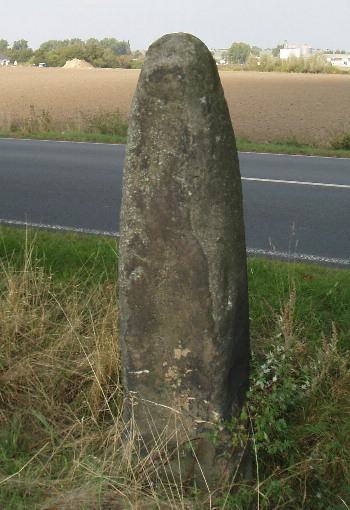
Eilsleben Hinkelstein submitted by AlexHunger on 25th Sep 2005. 1.8 Meter tall Menhir just outside of Eilsleben, Sachsen-Anhalt, on side of main Road.
(View photo, vote or add a comment)
Log Text: Visited the Eilsleben Hinkelstein in December 2025. Beautiful stone, awful ambience.
Marienborn Räuberhöhle
Date Added: 9th Dec 2025
Site Type: Cave or Rock Shelter
Country: Germany (Saxony-Anhalt)
Visited: Yes on 9th Dec 2025. My rating: Condition 4 Ambience 5 Access 3

Marienborn Räuberhöhle submitted by AlexHunger on 26th Oct 2004. This cave has existed since the dawn of time and is called the "thieves cave" on account of a highway robber living in it during the middle ages who used to prey on the locals and travelers. There are traces of the stone having been worked on. You need to walk south east down a path into the forest for less than a kilometre from the Marienborn Stone.
(View photo, vote or add a comment)
Log Text: The place is said to be an old cult site in prehistoric times. The chamber itself is small but beautiful. A cupmarked stone was found here, too and there's a spring in the vicinity.