


What More Might Saqqara Have To Reveal?
Submitted by Andy_B on Saturday, 23 January 2021 Page Views: 270
Resources
It's the former necropolis of Memphis (itself Egypt's capital city pre-Cairo), and it's given up countless archaeological and historical gems in recent years.
Maybe there's so much focus on Saqqara because ancient Egyptian history fascinates us more than the history of any other country on Earth. There's a whole Hollywood horror genre built around mummies, pharaoh's curses, and other borrowed pieces of Egyptian iconography. There's an entire demographic of online slots players who only ever play Egyptian-themed slots. Not only are there online slots games named specifically for famous Egyptian gods like Eye of Horus slot and Tutankhamun, but there are also whole online slots websites devoted to nothing other than Egyptian-themed slots. That hasn't happened by accident. You won't find websites that only feature American-themed online slots or British-themed online slots. Egypt is special, and the obsession with its history is passed down from one generation to the next.
Recently it's seemed like a discovery has been made at Saqqara every month. Even within the past week, we've had news of a newly-discovered temple there, along with megaliths and sarcophagi. Given the former purpose of the site, it's unsurprising that the temple is a funerary temple. What makes it especially interesting is that the coffins found close to it are believed to be the oldest ever discovered there. The deeper archaeologists go, the older and more mysterious the discoveries they make are. When they think they're getting to the very bottom of everything they might discover, something new emerges from the sand and rock. It's like a well of ancient treasure - one that doesn't appear to be likely to run dry any time soon.
The temple that was discovered in January 2021 is believed to be dedicated to Queen Nearit, a wife of King Teti, the first pharaoh of Egypt's Sixth Dynasty. The area around the temple is complicated and will take more time to explore and excavate fully. Researchers have thus far identified more than fifty previously-undiscovered burial shafts along with fifty wooden coffins, the oldest of which are believed to have been placed into the shafts more than three thousand years ago. Despite being so old and made of a comparatively delicate material, the coffins are so well-preserved that they still have visible inscriptions from the Book of the Dead etched upon their surfaces. In many cases, they also still have clearly-visible depictions of ancient Egyptian deities. Taken as a whole, the discoveries confirm that Saqqara's use wasn't confined to the country's Late Period, as was once thought. It was also used during the New Kingdom era and may yet prove to have a history that goes back even further than that.
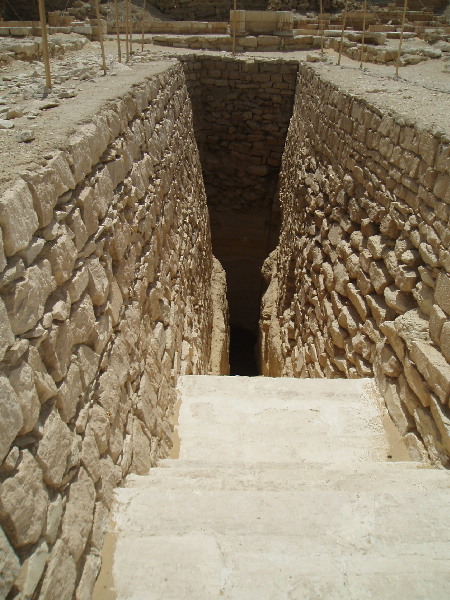
These discoveries come hot on the heels of another cache of coffins and burial goods found at Saqqara in October 2020. In that instance, the bodies they contained were laid to rest 2500 years ago and were also placed into burial shafts. The area's arid conditions have proven to be perfectly suited to keeping everything just as the ancient Egyptians left it, meaning the wooden caskets still boasted their original vibrant colors when archaeologists pulled them out of the ground. The people buried within this cache appear to have been slightly more wealthy than those who went to their graves five hundred years earlier, as their wooden caskets are gilded. They haven't been afforded the same dignity that a royal family member or high priest would have been given, but the careful and considered nature of their burial implies that they were of high social standing.
This renewed focus on Saqqara has allowed modern-day experts and researchers to reconsider some of the conclusions reached by their predecessors a century or more ago. Some of that new thinking is centered around the legendary Serapeum of Saqqara - a poorly-understood part of the graveyard where experts once thought that Apis bulls were buried in enormous giant sarcophagi as a mark of respect to the Egyptian god Ptah, of whom they were seen as a living representative. The idea that these ancient people would go to such trouble to bury bulls in caskets so heavy and hard to work with has always troubled experts, and so in 2018, they came up with a new theory.
The experts theorized that the bulls were placed inside granite and allowed to decay and ferment as part of a controlled process that would eventually build up pressure within the sarcophagi and place stress on the surface. Eventually, that would result in the surface lighting up and illuminating the tunnels they were buried in. As improbable it sounds, it can be scientifically proven that this process would work, and it would also explain why no soot has been detected on the tunnels' ceilings. Had people walked through them with ancient torches to light their way, they would have left soot behind. As there's no soot there, the ancient workers who dug the tunnels must have used an alternative illumination method. This fermentation theory is the best idea anyone's had thus far.
It's unlikely that the ongoing project at Saqqara will end at any point soon. There's clearly so much still to find, and there's also an inherent need for Egypt to carry on looking. The country relies heavily upon the tourism sector to sustain itself, but a combination of the civil unrest in the country followed by the global pandemic has resulted in tourists being put off the idea of visiting. Many tourists who choose to visit Egypt do so because they want to learn about its history, and the government knows that new discoveries will do a lot to drive that interest. They'll keep working here until there's nothing at all left to find - and we should all get to see some remarkable archaeological discoveries because of that. With many thanks to Alex H and Per T for their kind help and support of this article, including their lovely images.
