
Unearthing the historic sites of Roman Britain – the top 5 sites to visit
Submitted by Andy_B on Monday, 28 October 2024 Page Views: 116
Resources
The Romans then reigned for over 300 years. Considering that fact, it is not overly surprising that the influence of the Roman empire can still be seen and experienced in many different locations around the UK.
The impact of ancient history has been huge in the UK, and Britain’s history has included exploring all parts of the globe. Roman themes can be found in a number of things in the UK, including road names and place names. Also, slot games have embraced ancient civilisations as one of the main themes they offer. Online casinos might be a modern invention but they still have a lot of ancient themes that people find engaging, and the imagery of the ancient world is used in these video slots and in other aspects of online casinos.
Chedworth Roman Villa
Chedworth Roman Villa is an amazing example of Roman ruins. It has a beautiful setting, nestled in the Cotswolds and surrounded by woods and beautiful sites. The Cotswolds area is popular among tourists and locals alike.The structure is thought to have been built in the 2nd century CE and was luxurious then, too. The site was actually undiscovered for hundreds of years until somebody working as a gamekeeper found a piece of a mosaic and the rest of the building was uncovered.
As you might expect for a site that was not touched for so long, there are mosaics there in amazing condition, as well as baths and a Roman temple that people can walk to. Visitors can make a day of it as Chedworth also has a museum on site. New objects and items are still being found within the grounds and people are fascinated by this stunning historical location.
This is a National Trust location due to its beauty, and there is plenty to do on site and masses of information available about the history of Chedworth Roman Villa. This can be an opportunity to learn as well as just being a fun day out looking at the impressive mosaics.
Roman baths
There are ruins of Roman baths in various places around the UK, including in Hertfordshire, not too far from London. But the area everybody knows for this is Bath, of course.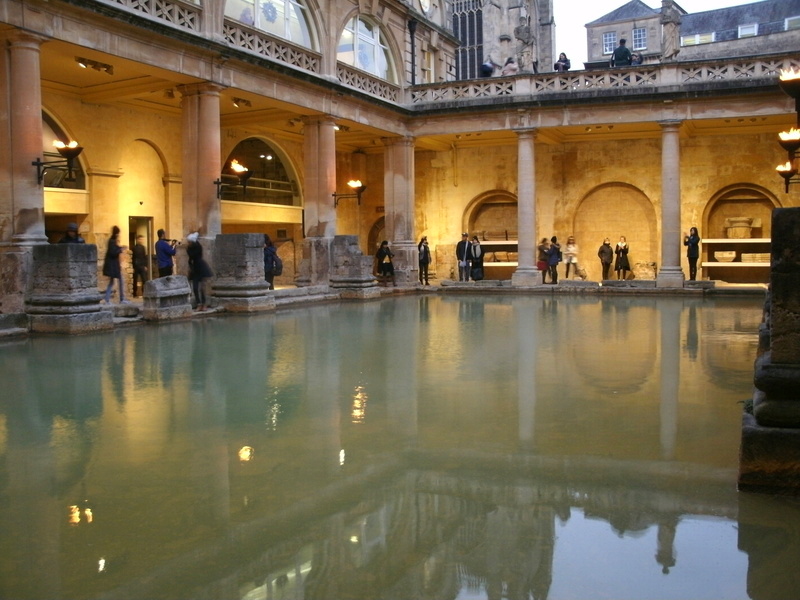 The baths that gave the city its name were constructed in the early days of Roman Britain and were a big part of socialising in those days. They are almost 2,000 years old and can still be seen today. The Roman baths hold over one million litres of hot spring water within them.
The whole of Bath is interesting for those keen on Roman history, and at the baths there are many different artefacts. On top of that, visitors are supplied with a lot of information and it can be a great learning experience.
Chester Roman Amphitheatre
Chester was one of the most crucial parts of the Roman Empire in the UK (and even across their whole empire). The amphitheatre found in Chester was the biggest of its kind and was used for training Roman soldiers as well as for entertainment.Okay, around the world, there may be more impressive amphitheatres, but this one is not insignificant! Built in the 3rd century CE, it could seat around 8,000 people, according to analysis.
The amphitheatre has also been crucial in understanding the Romans and how they lived, as lots of artefacts have been found in the area. It is also right in the middle of Chester, and the Grosvenor Museum (also in the city centre) has some of the findings on display.
Amphitheatres were a big part of culture and history when the Romans ruled, so to see a large amphitheatre in the UK is definitely interesting for those who are drawn to Roman history.
Camulodunum (Colchester), Essex
Colchester was once called Camulodunum and was the first colony that the Romans set up in Britain. It has the honour of being England’s oldest recorded town and there are numerous ways to explore the Roman history of the area.There are some ruins and remains in Colchester, including a cemetery in Colchester city that has been thought of as a Mithraeum or other church when it was functioning.
There have been lots of excavations that have revealed pottery that has been dated back to Roman times.
This is one of the locations across the UK where the Roman fabric of the place is still evident. A lot has been ruined and replaced (of course) but there are still a lot of things to see in Colchester. The city had more Roman theatres than anywhere else in Britain, and even hosted chariot races.
A defensive wall around the city is still largely intact and this means that people can choose to “walk the walls”, which is one of the most common activities for those who want to learn about Roman history.
Hadrian’s Wall
We simply couldn’t create a post like this without including what is probably the most iconic of all sites still remaining. Hadrian’s Wall is stunning to see, even though a lot of it is worn down and some of it has been destroyed. Many large sections still exist and a lot of people choose to walk the whole distance themselves.Hadrian’s Wall has been a World Heritage Site since the 1980s and is visible in some of the most beautiful parts of the Northumberland countryside.
Over the length of the wall, there were 80 forts, which were known as milecastles. There were also 17 more forts that held thousands of Roman soldiers who would defend against northern tribes that were trying to invade their empire.
Many of the forts are still visible and the whole of the wall has been turned into walks that people can undertake while camping or stopping off along the way. Construction started on the wall in AD122 and it is quite impressive that parts of it are still standing today in some areas. Browse some of the many different sites that make up Hadrian's Wall via our interactive map.
Conclusion
These are some of the top examples of places that people can visit across the UK to see some of the Roman history that has stuck with us. The truth is that there are a lot of towns and cities that have some measure of Roman history.Historic sites like this are largely managed by the National Trust or English Heritage, they have protected status and that they are wonderful places to learn about the country. These aren’t just for tourists, either.
Romans have entered culture in a big way in recent decades, too. Through movies or even through other forms of entertainment like games, there is an increased awareness of the history of the country. It is a good idea to make sure you see these things in person in a country with impressively well-preserved history.