



Stonehenge Is Getting A Facelift
Submitted by Andy_B on Friday, 08 October 2021 Page Views: 292
Resources
The most extensive maintenance and repair operation that Stonehenge has seen in the past century is currently underway. Stonehenge is an icon of Britain. It might not be the oldest stone circle of its kind in Europe, but it's far better known around the world than any equivalent European monument. It's appeared on commemorative stamps in the UK on special occasions. It served as the setting for an episode of the cult classic British science-fiction show "Doctor Who." It's even found its way to the reels of online slots websites. As staggeringly improbable as this might seem, there's an online slots game called "Stonehenge" made by a company called KA Gaming that's popular with slots players in the country. You can say what you like about other British landmarks like Buckingham Palace and St. Paul's Cathedral, but they haven't been used as marketing lures by online slots developers. Stonehenge is an ancient British icon - which is why there’s a lot of concern about the nature and extent of the maintenance work.
Unfortunately some of the necessary work is only necessary because repairs carried out several decades ago did more harm than good. The older repairs, which were supposed to counteract the effects of erosion, created micro-cracks in the standing stones that have only become visible with modern technology and laser scanning. The repairs were well-intentioned at the time, just as these latest repairs are, but there's a fear that new experts with new technology will come to the site fifty years from now and identify that these latest repairs also caused accidental damage. The stones are in a delicate state after standing for so many centuries, and any work that's carried out on them has to be executed with the greatest of care and precision. The weakest points are the lintels and the joints that hold them in place, which are also the parts most in need of attention from the experts.
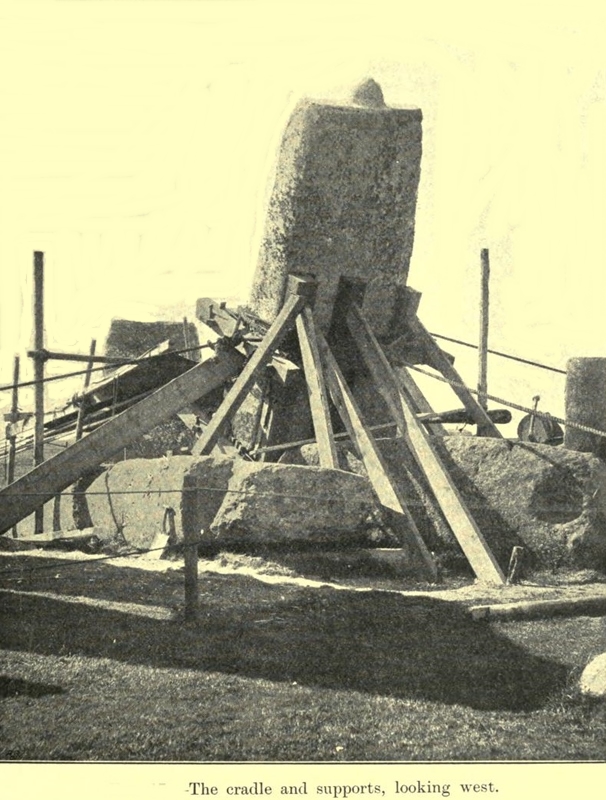 Photo right: Some of William Gowland's repairs to Stonehenge carried out in 1901.
Controversially, the work necessitates the erection of scaffolding around the stones and also the attachment of scaffolds to some of the larger stones, which raises the possibility of further damage being done. The scaffolds are necessary because of the intensity of some of the work. The experts will carefully remove concrete mortar that was injected into cracks and holes during the 1950s and 1960s and replace it with lime mortar. When the concrete mortar is removed, the stones will be especially weak. The scaffolds might be necessary to provide structural support until the lime mortar is inserted and set.
The project is of particular importance to 71-year-old Richard Woodman-Bailey, who has had a connection to Stonehenge since he was just eight. His father was in charge of a restoration project there in 1958 and allowed him to place a coin underneath one of the stones while it was being worked on. He's now in charge of the conservation works for English Heritage and will insert a newly-minted two-pound coin into the mortar to commemorate this latest set of works. He expects the job to take several months and hasn't ruled out the possibility of it extending until 2022. The notoriously wet, cold English winter might make work impossible between November and January, which will result in delays. Ideally, he would have liked to start working earlier in the year, but Covid restrictions made this impossible.
Even when the work is finished, Stonehenge's status as the oldest and most loved stone monument in the British Isles might be under threat thanks to new information that's come to light about another ancient site! Arthur's Stone in Herefordshire - so named because of its supposed connection to the myth of King Arthur - is already popular with tourists. It's always been thought to be approximately 4700 years old, which makes it about three centuries younger than Stonehenge. However, a new study from August 2021 has concluded that Arthur's Stone is likely to be one thousand years older than the previous estimate. That would make it seven hundred years older than Stonehenge and wrench the crown away from the stone circle. The findings of the study have to be peer-reviewed before the wider archaeological community accepts them, but the process is expected to be a formality.
The legend of Arthur's Stone is that it was a pebble that King Arthur found in his shoe as he made his way to a battlefield thousands of years ago. After he tossed it away, the pebble was so proud that the King had touched it that it grew into the monument as it's seen today. An alternative version of the Arthur tale is that Arthur used the stone to kill a giant, and his elbows left the indentations in the ground around the rock as he fell. Clearly, both tales are charming nonsense.
The structure is actually an ancient hilltop tomb built for an unknown individual during the Stone Age. It was once surrounded by wooden posts, but the posts decayed over time and eventually caused the burial mound to collapse. Neolithic-Era people then returned to the site and repaired it as best they could with rock pillars and a standing stone. The willingness of these Neolithic era people to come and repair a structure that was created by their ancestors suggests that the tomb remained an important site for several centuries. That makes it all the more frustrating that we have no idea who was buried inside it!
The presence of scaffolding means that tourists won't be able to enjoy an unencumbered view of Stonehenge for some time, so if you're planning a trip in the near future, you might be best holding off until 2022.
