



How did People Divorce in Antiquity?
Submitted by Andy_B on Friday, 20 March 2020 Page Views: 1955
Resources
In modern times you can even get a divorce online on the Internet. But what other circumstances were needed to allow the official separation of the spouses over the centuries?
The wife should be consigned to the river
About three thousand years BC the Sumerians developed their own written language. Clay tablets indicate that these people were extremely serious about bookeeping and all kinds of accounting generally. They also had rules for the procedure of conclusion and dissolution of marriage. The newlyweds were to appear before the three judges. Divorces also occurred only through the courts. To get rid of marital fetters, the couple had to wait for the permission of the king of their city-state. A similar case was recorded in Lagash.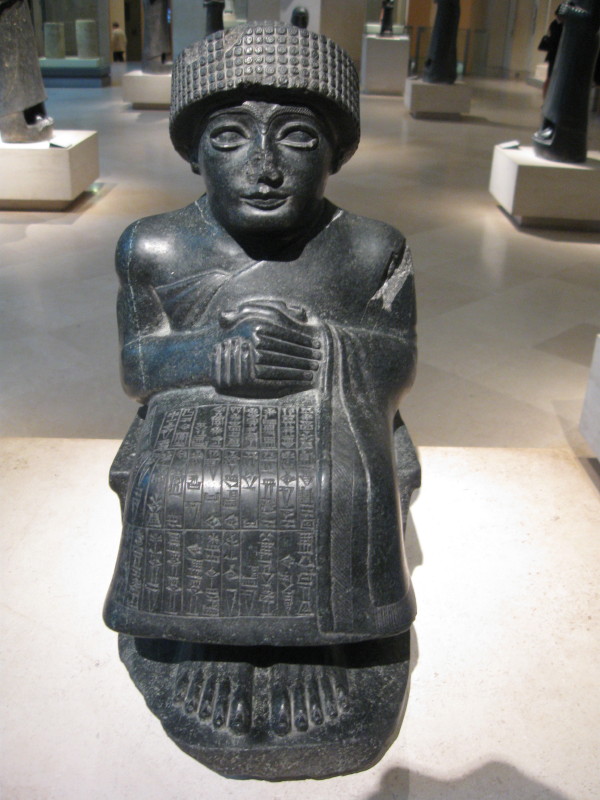
Photo (right): Gudea, Prince of Lagash. Circa 2120 BC. Now in The Louvre, Paris
The inhabitants of Larsa went further and adopted a law on divorce: “If a wife hates her husband and tells him: “you are not my husband”, then she should be given to the river.” The Hittite women were even more disenfranchised (XV - XIV centuries BC). Not only could they not divorce of their own free will, after the death of the husband, his wife passed on to her brother or another relative of the deceased!
In ancient Athens, legal wives were not respected. The phrase is attributed to Socrates: “Is there anyone with whom you talk less than with your wife?” King Solon (VI century BC) abolished the dowry, however, such innovation did not last long. As in many patriarchal societies, in Athens of that time, the legal reason for divorce was the infertility of the spouse.
But over time, things became more reasonable. Plato (IV century BC) advised in a treatise on an ideal state: “If a husband and wife do not fit at all because of the unfortunate features of their character, then ten guardians of middle-aged laws should always be in charge of such matters, and also ten women of those who know marriage.” And the author of the famous dream book “Onerocritic” Artemidor (2nd century A.D.) believed that a married woman is destined to divorce her husband if her beard grows in a dream.

One of the earliest legends about Rome is connected with the unwillingness of wives to destroy their families. Under Romulus, the Romans abducted young Sabine women, which started a war. The king announced to the girls that they were held in captivity from the most honest marriage intentions. New families really turned out to be strong. When the Sabines finally attacked Rome, their daughters and sisters persuaded their relatives to reconcile with the captors, because the new married life completely suited them.
Photo (left): The Tarpeian Rock (Rupes Tarpeia) is a cliff of the southern summit of the Capitoline Hill, behind the Forum Romanum in Rome. According to early Roman histories by Livius, when Titus Tatius attacked Rome after the Rape of the Sabines around 750 BCE, the Vestal Virgin Tarpeia, daughter of Spurius Tarpeius, governor of the Capitoline Hill citadel, betrayed Rome by opening the city gates for the Sabines. Thereafter, it was used during the Roman Republic as an execution site.
Good reason - execution
Later Roman law generally forbade wives to demand a divorce. The husband could terminate the marriage. To do this, he needed to bring gifts to the temple of the fertility goddess Ceres and give his wife some of the property. True, the Romans hardly used this right.One of the earliest forms of Roman marriage was confarreation. Such a marriage was sacred, it was concluded in the presence of the High Priest Jupiter and 10 witnesses. It was possible to terminate it only in one way - if the spouse was executed for a crime. Such a development of events was considered dishonorable for a man. Therefore, before execution, the marriage was dissolved. Confarreation became obsolete around the 1st century A.D.
In the late republic and empire, the marriage “sine manu” spread en masse. Spouses were given almost equal rights. Everyone could divorce on their own. Usually, when the marriage was dissolved, the Roman woman returned to the care of her father. Fathers could even initiate a divorce from their daughter. This custom led to the abuse by particularly tyrannical older people.
 Unauthorized dissolution of marriage by the father (father-in-law) was prohibited only in the middle of the II century by Emperor Anthony Pius. Before that, in order not to return to their family, divorcing women used a loophole - they entered into a fictitious marriage, resorting to the help of friends.
Photo (right): The so called "Gothic" Column in the park of the Istanbul Topkapi Palace of the Sultans. It is on the site of ancient Byzantium and is the last ancient column from a Pagan temple standing in the open. All others have been reused in churches, mosques and cisterns or burned for lime.
In Byzantium, Justinian law (VI century) prohibited divorce by mutual consent. Exceptions were cases when the couple went to the monastery. And unilaterally, a woman could divorce, proving that her husband is a sorcerer, a desecrator of graves or a traitor.
In the X-XII centuries, the Catholic Church forbade the marriage of relatives up to 8 knees. In practice, this restriction has become a way to divorce. The social circle of a resident of a medieval village (or even a town) was extremely small. This led to the fact that very often families were brought up by distant relatives. If you wanted to divorce (or rather, recognize the marriage invalid), such spouses should prove kinship. The absurd limitation of 8 tribes was narrowed to four tribes at the Lateran Cathedral in 1215.
In the era of Yaroslav the Wise, it was forbidden to divorce a wife who was struck by blindness or another dashing illness. The dissolution of marriage with a woman exposed to witchcraft and divination was not approved. Husbands should have kept these wives with them and brought up.
I hope this was interesting, with many thanks to Online Divorcer, Alex Hunger and Drew Parsons for their support and assistance with this article, including lovely photos.
